







Explainer: The cause of Australia’s deadly bushfires, why they are worse this year and climate change's role
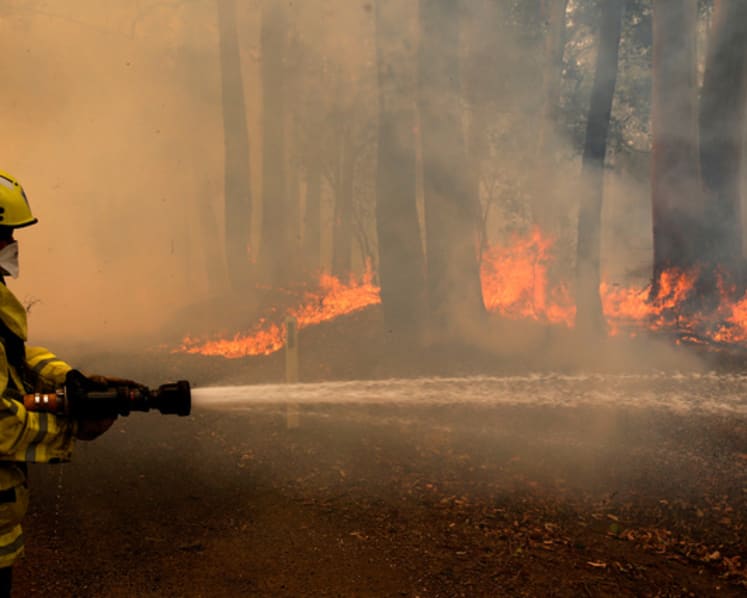
A firefigher tries to quell bushfire flames at Koorainghat, near Taree about 300km north of Sydney in New South Wales on Nov 12, 2019.
SYDNEY — Sydney is facing a “catastrophic” level of danger as raging bushfires ravage the hinterland of Australia's largest city.
The “catastrophic” rating is the highest level of fire warning issued by the Rural Fire Service, the lead agency which combats bushfires in the state of New South Wales (NSW), and it was the first time that it has been issued for the state’s capital Sydney since the rating was implemented in 2009.
A seven-day state of emergency was declared across NSW on Monday (Nov 11) as well. Areas near the Gold Coast and Brisbane in the state of Queensland are also being affected by dangerous bushfires.
"There is nothing built or designed to withstand the sorts of conditions that you can expect under catastrophic conditions,” warned Mr Shane Fitzsimmons, commissioner of NSW’s Rural Fire Service.
While bushfires are an annual occurrence in Australia during the hotter summer months from December to February, the fires this year have occurred well before summer, with some igniting as early as September.
Studies have pointed to climate change as creating warmer and drier conditions — highly conducive for bushfires. To make matters worse, many parts of Australia including NSW are in one of the worst droughts in decades, creating tinder-dry fire fuel.
TODAY takes a closer look at what causes bushfires and why this year’s fires in Australia appear to be worse than usual.
WHY THIS YEAR’S BUSHFIRES MATTER
The fires have been raging since as early as September this year and have left a trail of destruction in their wake.
To date, three people have died, more than 150 homes have been destroyed and thousands of people have been displaced from their homes as a result of the fires. Wildlife and agricultural stock have also died.
At least 350 koalas were burnt to death in a blaze at a nature reserve north of Sydney earlier this month. It is believed to be half of the population of koalas in the reserve.
According to the NSW’s Rural Fire Service, about 11,000 sq km have been burnt. This is more than 15 times the size of Singapore.
In an update on Tuesday, the agency said that there are 85 fires in the state, with slightly over half thought to be “out of control” and another 14 at an “emergency level”.
The authorities have deployed more than 3,000 firefighters and 60 aircraft to control the blazes.
WHAT CAUSES BUSHFIRES IN AUSTRALIA
Bushfires in Australia are a regular occurrence, particularly during the summer months where the hot, dry and windy conditions create conducive conditions for fires.
According to the NSW’s Department of Planning, Industry and Environment, bushfires are more likely to occur in south-eastern Australia, which covers the state of Victoria and parts of NSW, as the weather is often hot and dry.
Fires also burn more quickly when they travel uphill rather than downhill.
The direction of the slope a landscape faces can also influence the type of plants that grow there, the moisture levels and the way fires burn. In NSW, west-facing slopes are the hottest and driest, with more flammable plants.
In the most intense bushfires, eucalypt trees filled with sap can boil and explode ahead of the firefront. These fires are so fierce they also create microclimates, which are climate conditions within a small area, around them.
WHY THE FIRES ARE WORSE THIS YEAR
The NSW Rural Fire Service has blamed this year’s unprecedented fires on “worsening weather conditions”.
Analysts have pointed to more extreme weather events driven by climate change as reasons for more frequent, intense and earlier bushfires in Australia.
Record-breaking weather:
The fires have been exacerbated by longer dry spells in Australia, with the past 12 months the driest on record amid a crippling drought. On Sunday, no rainfall was recorded at any weather station in mainland Australia, a rarity in the country.
Vegetation in parts of NSW has also been dry due to lower-than-normal rainfall levels, and higher-than-usual temperatures.
The role of climate change:
Experts say that such weather conditions have been exacerbated by climate change.
A 2014 report by Australia’s Climate Council, a non-profit organisation, said that climate change is increasing the frequency and severity of “very hot days” and increasing the likelihood of fires.
The report, titled Be Prepared: Climate Change and the Australian Bushfire Threat, noted that since 1960, the annual number of hot days across Australia has doubled. The frequency of record hot days is also more than three times the frequency of record cold days over the last decade.
“Climate change is making hot days hotter, and heatwaves longer and more frequent. Some parts of Australia are becoming drier,” said the report.
With warmer temperatures, vegetation will become drier more quickly, creating conditions more conducive to fires.
It added that these conditions will increase the likelihood of fires and lengthen the fire season in many parts of Australia.
The role of climate change was also supported by Mr Chris Lucas, senior research scientist at the Australian Bureau of Meteorology, and Ms Sarah Harris, a manager for research and development at the Country Fire Authority in the state of Victoria.
In an analysis piece for The Conversation, a non-profit media outlet, the duo said that climate change has led to an average increase in the severity of seasonal bushfire weather in Australia, particularly in the south.
They said that the severity of fire season varies annually due to three climatic conditions – the El Nino Southern Oscillation, the Indian Ocean Dipole and the Southern Annular Mode.
It noted that of the three, the El Nino Southern Oscillation influences the weather the most. Weather during this phase is typically hot and dry, resulting in worse seasonal bushfire conditions.
Conditions are exacerbated when the positive phase of the Indian Ocean Dipole coincides with El Nino as Southern Australia experiences lower rainfall in this period.
This occurred in 2015 when Australia’s bushfire season started earlier than usual, the researchers noted.
However, while climate modes bring “large and rapid swings” to climate weather, climate change increases the conditions for fire, said the researchers.
DISAGREEMENT IN AUSTRALIA OVER ROLE OF CLIMATE CHANGE
Despite research demonstrating the links between climate change and worsening bushfires, Australia seems to be divided over the role of climate change.
In a commentary in The Sydney Morning Herald on Monday, the former Commissioner of New South Wales’ Fire and Rescue Department Greg Mullins said that “the science is clear” that a warming climate has led to “unprecedented” fires in the country.
Referring to letters he had sent, along with 22 other former high-ranking emergency service officials to Prime Minister Scott Morrison in April and September, Mr Mullins said: “I’m confident that our national government, when the smoke and dust settles, will finally see the obvious and understand the word ‘unprecedented’.
“I’m sure it will then start to take decisive action to tackle the base cause — greenhouse emissions — then use the high moral ground to lean on other countries to also do the right thing.”
However, the Australian government has downplayed the fires’ links to climate change, with Australian Deputy Prime Minister Michael McCormack calling those who did “raving… greenies” in an interview with the Australian media on Monday.
Mr Morrison also sidestepped questions on the impact of climate change on bushfires by the media on Saturday, saying only: “My only thoughts today are with those who have lost their lives and their families.”
Mr Morrison, who once carried a piece of coal into Parliament as a way to express his support for the coal mining industry, was the unexpected winner of a federal election in May this year, which continued the ruling Liberal-National Party coalition’s period in office.
The Labor opposition had taken an ambitious carbon emissions reduction programme to the election, along with wide-ranging economic and taxation policies. It is now reviewing its policy positions.




