







External ethnic, religious strife ‘may split S’poreans’
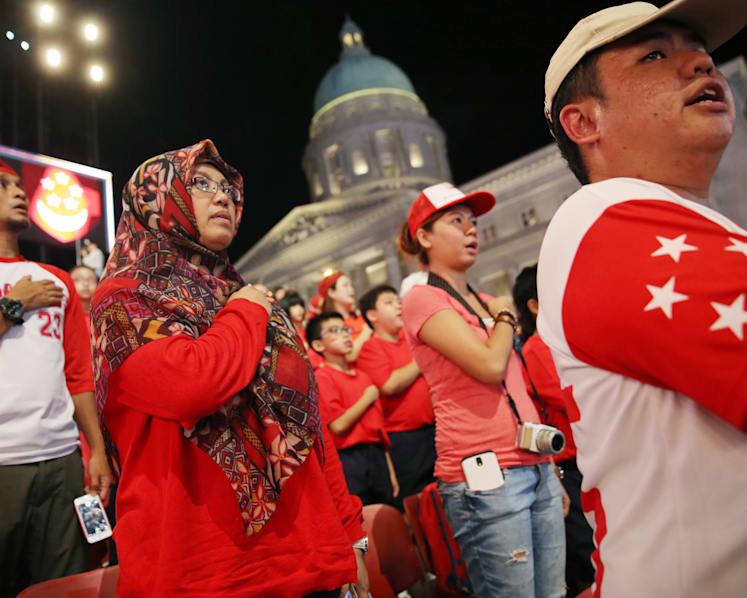
Singaporeans taking the pledge during a National Day Parade segment at the Padang. TODAY file photo
SINGAPORE — Stressing the importance of unity among Singaporeans, Prime Minister Lee Hsien Loong said external ethnic or religious strife could split Singaporeans along fault lines, and the Republic has to be careful in its ties with countries where race or religion can lead to misunderstanding.
For example, because many Singaporeans are of Chinese descent, Singapore is sometimes mistaken by other countries as a Chinese society, said Mr Lee. As such, at international meetings where countries are sometimes provided with guides donning the respective country’s national dress, Singapore’s leaders have on occasion had guides wearing the Chinese cheongsam. But the cheongsam is not Singapore’s national dress and few Singaporean woman wear it anymore, said Mr Lee in his speech at the S Rajaratnam Lecture yesterday (Nov 27).
And on one occasion, a Japanese Prime Minister had been puzzled by Mr Lee’s explanation that a “Singapore Chinese” is different from a “Chinese Chinese”, but the distinction is critical for Singapore as a multi-racial society, noted Mr Lee.
“We may be Indian Singaporeans, Malay Singaporeans or Chinese Singaporeans, but above all we are Singaporeans first,” said Mr Lee, as he urged Singaporeans to continue to work at racial and religious harmony.





Singapore is now more cohesive as a society, but this was not always the case. For example, when former Indian Prime Minister Indira Gandhi was assassinated by her Sikh bodyguard in 1984, there were reactions in Singapore, said Mr Lee.
For Singapore, national identity will always be a work in progress. “We are very careful in our ties with other countries, where race or religion can lead to misunderstanding. Take for example our relations with China, which are very good. But it is quite clear that we are Singapore, they are China and we are different countries.”
Mr Lee also spoke of the importance of political unity, pointing out that in countries where the politics is fractious, foreign policy often changes when the political winds change, making it harder for such countries to work with other countries due to the uncertainty.
Political unity does not mean no political opposition, but an opposition that will “understand Singapore’s fundamental interests in the world and will not seek to undermine Singapore’s fundamental interests either to court foreign support or to gain political points”, said Mr Lee. “It means that after elections, we come together, especially when dealing with other countries,” he said.
Citing veteran Opposition leader Chiam See Tong as an example, Mr Lee said: “(He) protected our domestic interests and policies when he (travelled) overseas, either as a national delegation or as a parliamentary delegate. He (stood) up for Singapore and closed ranks, and that is really the norm that should prevail in the political scene in Singapore.”




