







GE battle lines drawn
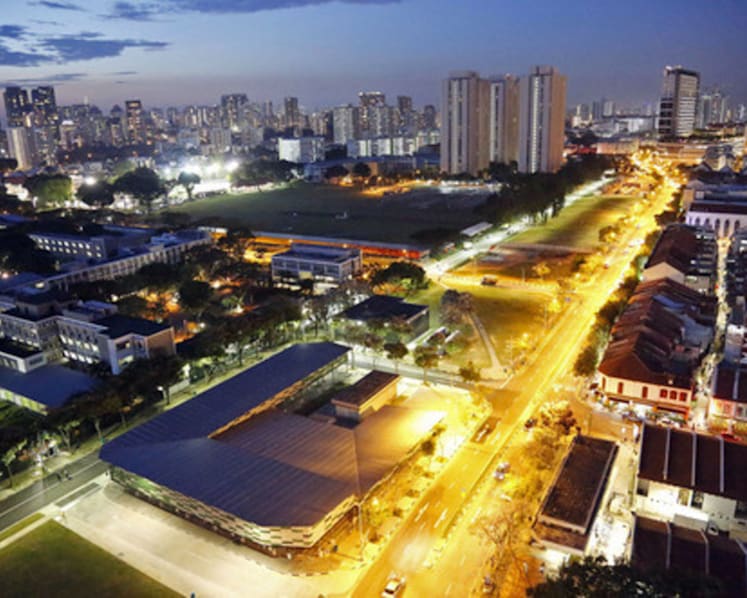
A mix of residential and commerical developments near Race Course Road which was part of Moulmein-Kallang GRC. Moulmein-Kallang GRC has been dissolved, with the area now forming parts of Holland-Bukit Timah, Bishan-Toa Payoh, Tanjong Pagar and Jalan Besar GRCs. Photo: Raj Nadarajan


SINGAPORE — Heralding changes that include more four-member Group Representation Constituencies (GRCs) and three new single-member wards — but also the disappearance of one which was closely fought in the 2011 General Election (GE) — the Electoral Boundaries Review Committee made public its report yesterday, marking the penultimate step before Parliament can be dissolved for the next GE.
The five-member committee submitted its report to Prime Minister Lee Hsien Loong on Tuesday, eight days after he announced in Parliament that it had been formed two months ago. The Government has accepted the committee’s recommendations, which political analysts labelled more evolutionary than radical.
The release of the report paves the way for Parliament to be dissolved and polls to be called, though observers could not come to a consensus on whether they would be held as soon as September — as has been widely rumoured — or as late as next year. Elections are due by January 2017, but all those contacted by TODAY agreed that the GE would be called well before that.
With the changes, the total number of Parliament seats increased by two, to 89 seats. They include 13 single-member seats, one more than the current 12. The new Single Member Constituencies (SMCs) are Bukit Batok, Fengshan and MacPherson, while Joo Chiat and Whampoa will be scrapped. Defying the expectations of some, Potong Pasir SMC was left intact despite having fewer voters than the lower range of 20,000 set by the committee. The ward, which has an estimated 17,389 voters, changed hands in the 2011 GE after 27 years under Opposition rule.





The number of four-member GRCs has been increased from two in 2011 to six, in line with the committee’s task to reduce the average size of GRCs. Moulmein-Kallang GRC will be no more, but two new four-member GRCs called Jalan Besar and Marsiling-Yew Tee will be formed. Three GRCs will also be downsized from five to four members – Chua Chu Kang, East Coast and West Coast.
The bigger GRCs remain largely unchanged, with Ang Mo Kio and Pasir Ris-Punggol staying as six-member constituencies. The five-member GRCs are Aljunied, Bishan-Toa Payoh, Jurong, Marine Parade, Nee Soon, Sembawang, Tampines and Tanjong Pagar.
The committee was chaired by Mr Tan Kee Yong, Secretary to the Prime Minister. Its members are Housing and Development Board chief executive Cheong Koon Hean, Singapore Land Authority CEO Tan Boon Khai, Elections Department head Lee Seng Lup, and Ms Wong Wee Kim, who is the Chief Statistician at the Department of Statistics.
Mr Lee had asked the committee to reduce the average size of the GRCS to fewer than five members. It was also to consider the population shifts and housing developments since the last boundary delineation exercise, and maintain the minimum number of Single Member Constituencies (SMCs) at 12.
With the changes, the average size of the GRC was reduced from 5 to 4.75.
The ruling party’s Members of Parliament in the affected wards took the changes in their stride yesterday, saying they would continue to serve the people. But some such as the Chua Chu Kang GRC MPs – who will see their Yew Tee ward carved out to become part of the new Marsiling-Yew Tee GRC – admitted they were surprised by the change. Mr Alex Yam, who looks after the Yew Tee ward, said that geographically, the area has been associated with southwest region of the island. Parts of Yew Tee and Marsiling are a 20-minute drive apart, he noted.
Opposition parties had mixed feelings about the changes. All expressed disappointment that Joo Chiat SMC would be scrapped but some were glad that Potong Pasir and Mountbatten SMCs would remain. Non-Constituency MP Yee Jenn Jong was particularly aggrieved. He was the Workers’ Party’s Joo Chiat candidate, who lost by 2.04 per cent to the People’s Action Party’s (PAP) Charles Chong in 2011. “Residents whom I have met were looking forward to a good and gentlemanly contest again like what we had the last time. Some ‘wise men’ in a small committee decided otherwise, for reasons best known to themselves,” said Mr Yee, who posted three times yesterday on his Facebook page on the topic. In one of his postings, he said he was “highly and absolutely disappointed” with the committee’s report. Noting that he was the “best loser” in the 2011 GE, which earned him the post of NCMP, he added: “Now I have been ‘upgraded’ to become THE biggest loser in today’s electoral boundaries revision.”
Several Opposition politicians signalled their intention to contest in the same constituencies as before. Democratic Progressive Party secretary-general Benjamin Pwee – who contested under the Singapore People’s Party in 2011 – said he remains keen to contest in Bishan-Toa Payoh GRC, while Singapore Democratic Alliance chief Desmond Lim Bak Chuan said his party is keeping its sights on Pasir Ris-Punggol GRC.
Save for Joo Chiat, political observers felt the electoral boundary changes would not give rise to major accusations of gerrymandering. But the review committee has kept to its practice of not providing detailed reasons for changes to the boundaries and this could trigger speculation that may not be grounded in truth, they said.
With the battlelines now drawn, attention will turn to the all-important date of the GE, as well as the faces and teams to be fielded in each constituency.
With changes to East Coast GRC, a question now is whether the Workers’ Party turns northwards or southwards from its base in Aljunied, said Institute of Policy Studies senior research fellow Gillian Koh.
“There are many old heavy-weights on the PAP bench who could be moving on and people who were made ministers in this past term of Parliament who will come to helm GRCs, so there’ll be a changing of the guard in terms of anchor ministers,” Dr Koh added. “It will be interesting to see who are the new faces helming the more radically constructed four-member Jalan Besar GRC and Marsiling-Yew Tee GRC.”
POLL DATE IS ANYONE’S GUESS: ANALYSTS
Barring unforeseen happenings, some political observers felt a September date for the polls is even more likely now, while others leaned towards a date in November or December. “Your guess is as good as mine,” said Dr Lam Peng Er of the East Asian Institute. “It’s the prerogative of the Prime Minister when he calls it. Things can change - something regional, global or something mundane like an MRT breakdown.”
Added Dr Lam: “I don’t think the Opposition should kick up too much fuss (about the electoral boundaries). They should just hunker down, get on with it, avoid a three-cornered fight, offer choices to voters and let the Singapore voters decide.”
Dr Koh noted that there is “no clear template” for the timeline. Adding that there have been “mixed signals” on how soon the GE could be called, she said: “The PAP has been rolling out fresh faces for a while, but the Prime Minister said that there would be a lot of notice about the boundaries and also said that this year would be so busy that he hadn’t had the time to think about planning a General Election and, finally, that it would not be when everyone would think it would be.”
There is no fixed date for the General Election to be called after the committee’s report is released. During past elections, Polling Day was held between 17 days and six months after the issuance of the report.
In 2011, the lag was two months and nine days — the longest window between the report’s release and Polling Day since the 1988 election. ADDITIONAL REPORTING BY SIAU MING EN AND NG JING YNG




