







Govt acquisition of Marsiling flats: The kampung buddies hoping to be neighbours again
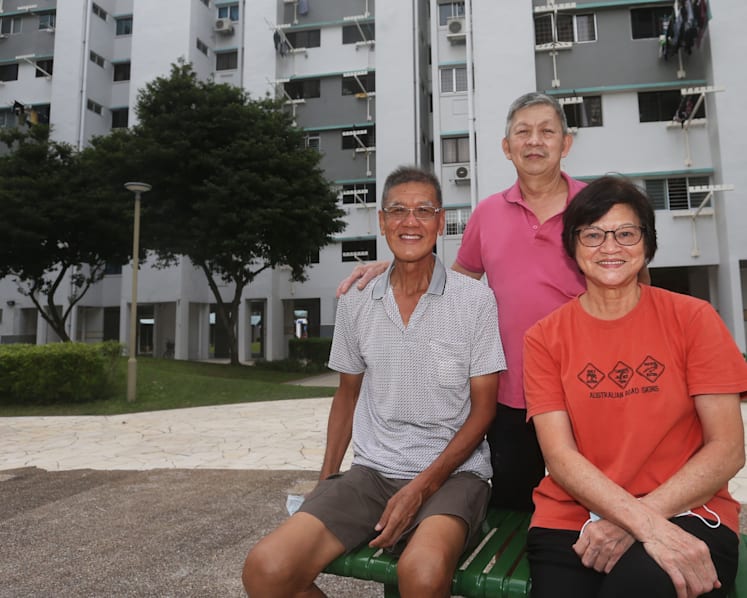
From left: Mr Nar Kim Tian, Mr Lim Tai San and Ms Onn Lian Moy are residents of Block 217, Marsiling Crescent, who used to live in the same kampung in Mandai.
SINGAPORE — Along the corridors of a public housing block along Marsiling Crescent and Marsiling Lane, a family can be heard having a discussion in their living room about the redevelopment plans for their estate.
A few floors down, workers scurry about setting up partition walls at the void decks ahead of a series of dialogue sessions residents will be having with government officers.
News on Thursday (May 26) that the Government will be acquiring blocks 210 to 218 of Marsiling Crescent and Marsiling Lane to extend the nearby Woodlands Checkpoint has set off a flurry of activity in a typically sleepy estate near the northern coast of the island.
For a group of a dozen or so long-time residents of Block 217 Marsiling Crescent, this relocation will not be their first.





After all, they were among the first inhabitants of the Housing and Development Board (HDB) estate when the block was built in 1980, having been resettled by the Government from a kampung in Mandai.
Now, they are hoping to stay neighbours when they move to the replacement flats on Woodlands Street 13 come 2028.
School canteen worker Onn Lian Moy, 72, said: “We’ve known each other since we were young.
“If we have the choice, we’ll stick together as neighbours again. It’s just that I’m not sure whether we’ll be able to choose the units we want.”
Ms Oon grew up in a kampung at Sungei Kadut near Chua Chu Kang and Woodlands but moved to another kampung near Mandai Road when she got married when she was around 20 years old.
Around 1980, government officers began making the rounds informing kampung residents that they had to move because the Government needed the land for development.
“They showed us the different HDB blocks that were available and they let us choose,” Ms Oon recalled, speaking in Mandarin like all the other former kampung residents. “Two or three of my husband’s brothers were living in the same kampung so we chose to move to this block together.”
In 1981, she moved into a flat for the first time with her husband and her three-year-old child on the seventh storey of Block 217 Marsiling Crescent.
Six families who had moved from the kampung in Mandai to Block 217 were interviewed by TODAY and they said that the kampung in Mandai did not have an official name.
It had no village chief and families lived in large plots of land far apart from each other, such that they could not tell how many households there were living in the kampung. Ms Poh Geok Khin, 68, guessed that there were probably about 50 homes at the time.
Kampung residents reared chicken and grew durian and rambutan trees near their homes, though they were often for personal consumption and residents would only sell the fruits if they had excess.
The men mostly held various odd jobs while the women stayed home to care for their children or took on sewing and laundering jobs.
After they moved out, the old Mandai Camp was built on that land, the six families in Block 217 said.
Kampung residents received payment from the Government based on how big their plot of land was. As for the cost of the new HDB flats, two of the residents, who were living in four-room units, said that they paid about S$50,000 — or roughly S$100,000 in today’s dollars — for their flats.
Moving to the new flats took a while to adjust at first. Ms Poh, who lives on the 12th floor, said that what struck her most was the lack of space to move about at home.
“Back in the kampung, I could just walk out the door and climb up the hill to pick rambutans to eat. After moving to a HDB flat, there’s no space.”
THE NEXT MOVE
None could tell how many of their former kampung neighbours were still living in the Marsiling Crescent and Marsiling Lane estate.
Ms Oon estimated that there were still about 10 families left here. “Some of them have moved out after their children grew up,” she said.
For Ms Poh and her husband, part-time cleaner Chan Ah Hock, 79, the upcoming relocation will be their third.
The couple moved from their Mandai kampung to another kampung in Lim Chu Kang when the Government acquired their home in 1978.
Four years later, the Government again acquired their land and they were resettled temporarily at an HDB flat before moving to Block 217 in 1983.
Despite being asked to relocate twice in the space of four years, Mr Chan said that he never got frustrated.
“There’s no choice if the Government needs the land.”
Shipyard worker Na Hock Chuan, 67, pointed out that times were different back then and relocating has become far more troublesome and costly than when he moved over from the kampung in 1982.
“Back then, we could throw everything away when we moved. The kampung houses that we lived in were built with wood and zinc, those didn’t matter. The furniture we had were cheap and lousy,” Mr Na, who lives on the 13th floor, said.
“Now, all the cupboards and cabinets have to be built, we have to factor in renovation costs as well, it’s very costly.”
As for the other former kampung residents interviewed, though they had all expected to live the rest of their lives in their present homes, most had no qualms about being asked to move.
Asked whether he felt that it was troublesome to relocate, handyman Nar Kim Tian, 69, said: “Not at all. Houses — they’re all the same. You just take along what you need and throw away the things you don’t need.”
Given that they have known each other for decades, hawker Pak Leh Hua, 59, has just one wish.
“It would be best if we could stay neighbours again,” the 12th floor resident said.




