







Govt should simplify eligibility for support schemes, and has been doing so: Tharman
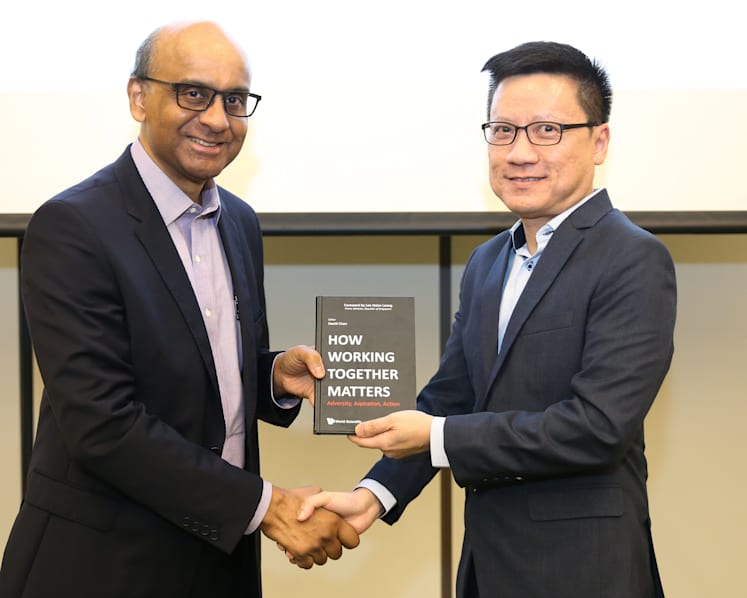
Deputy Prime Minister Tharman Shanmugaratnam (left) and Professor David Chan at the launch of the book, How Working Together Matters: Adversity, Aspiration, Action, on Nov 27, 2018.


SINGAPORE — To relieve the stress of people in financial difficulty, the authorities have to reduce the time and mental effort needed to gain access to government support schemes, said Deputy Prime Minister Tharman Shanmugaratnam on Tuesday (Nov 27).
The Government should simplify eligibility for support schemes, and has been doing so, he said at the launch of a book on how various parties worked together to help families in crisis.
He added that agencies should do back-end coordination rather than expect an individual to navigate between agencies. For instance, Social Service Offices run by the Ministry of Social and Family Development have linked their systems up with hospitals so that individuals only need to go through a single round of financial assessment, instead of two.
The book — titled How Working Together Matters: Adversity, Aspiration, Action — analyses the processes of helping 1,183 families, who were housed temporarily in Blocks 46 and 50 of Bedok South Avenue 3 between 2012 and 2018.





Mr Tharman said that the experience of this Project 4650 — part of the Interim Rental Housing Scheme under the Housing and Development Board (HDB) and named after the two public housing blocks where the families put up — shows that there is no contradiction between collective action and personal responsibility.
“They are really a compact: How we go about exercising collective action, how we go about engaging with individuals and families in difficulty, determines in a very important way, whether they are able to take charge of their lives, build up the confidence and develop their own success in a way that preserves dignity and preserves their pride,” he added.
Multiple helping hands in the form of government agencies, social service organisations and volunteers should be involved in the building of strong relationships and networks with these families or individuals, he added.
Networks made up of people from different social backgrounds can lead to “practical ambition” and aspiration.
Trust will enable the various agencies to guide the families to make decisions that are in their interests, said Mr Tharman, who is also Coordinating Minister for Economic and Social Policies.
As of April this year, all families under Project 4650 have permanent homes, of which nearly half managed to buy new HDB flats. Most of the families also managed to get housing loans from the HDB.
The two blocks are no longer in use.
Community organisations involved in Project 4650 included Pave, a social work agency dealing with family violence.
Besides housing, the Government is also focusing on education and work as pillars of its social strategy, which will help with social mobility, mitigating inequality and helping people to bounce up from difficulties, Mr Tharman said.
Dr Mohamad Maliki Osman, who is the local Member of Parliament, met the families in crisis during his Meet-the-People session back in 2011. Many of these families lost their homes for various reasons during the 2008 financial crisis, and were moving from one place to another, ending up on beaches and in void decks, he said.
"We soon realised that the complexity that they were undergoing was really tremendous. We realised that no one agency can help solve any of the problems that they are facing,” said Dr Maliki, the mayor of South East district.
Professor David Chan of the Singapore Management University, who edited the book, hopes that lessons from the project will be useful for other projects, both social and non-social.




