







Hyflux trial resumes: A reminder of what led to the court case
How did the Hyflux executives land in court and what are they charged with?
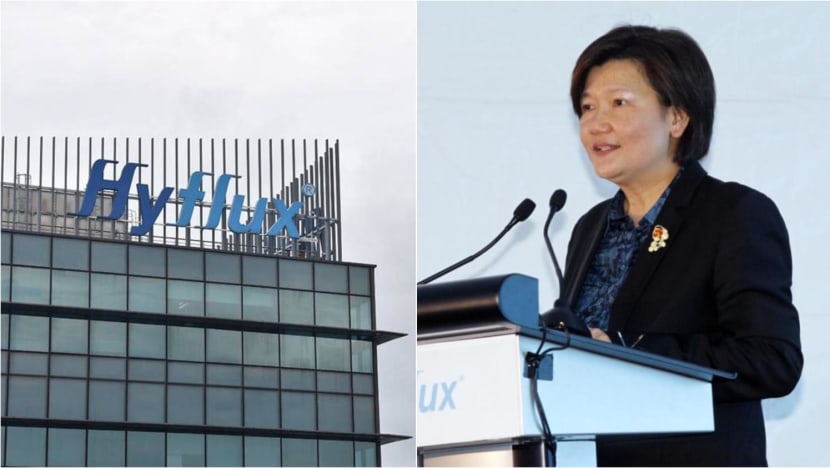
A photo of the Hyflux logo and a file photo of former Hyflux chief executive officer Olivia Lum Ooi Lin. (Photos: CNA/Jeremy Long, TODAY)

This audio is generated by an AI tool.


SINGAPORE: The criminal trial of Hyflux founder and former chief executive Olivia Lum and other leaders of the company resumes on Jan 13 with more witnesses from the prosecution taking the stand.
The trial, scheduled to run until Feb 5, began last August, nearly three years after Lum and her former colleagues were charged with violations of the Securities and Futures Act.
In total, seven individuals were charged over Hyflux’s intentional failure to disclose information relating to the Tuaspring Integrated Water and Power Project, among other things.
Hyflux’s eventual collapse resulted in significant losses to investors. This includes about 34,000 investors holding perpetual securities and preference shares, who were owed a total of S$900 million, the prosecution said at the opening of the trial in August.
How did a company that was once Singapore’s leading example for homegrown businesses land itself in court? Here’s what you need to know.

ABOUT HYFLUX
Hyflux was once a celebrated water treatment company in Singapore, backed by its founder’s rags-to-riches story. In 1989, Lum left a career in pharmaceuticals and sold her car and apartment to start a business to help solve the world’s water problems.
Lum – an orphan who grew up in a small Malaysian town – built Hyflux from the ground up with its proprietary membrane technology that can treat water through reverse osmosis.
The company went public in early 2001, and secured its first municipal water treatment project in Singapore to supply and install the process equipment for the country’s first NEWater plant in Bedok that same year.
It also developed Singapore’s third NEWater plant in Seletar and the country’s first seawater treatment facility. Eventually, it expanded to projects in northern China, India, Algeria and Oman, even briefly garnering state investment from Temasek Holdings from 2003 to 2005.
At its peak in 2010, Hyflux’s market capitalisation hit S$2.1 billion. Revenue and net profit also hit record highs of S$569.7 million and S$88.5 million respectively.
This is when Hyflux embarked on its most ambitious project.
WHAT IS TUASPRING?
In 2010, PUB called a tender for Singapore’s second and largest desalination plant to be built at Tuas.
When the tender closed in October that year, PUB received nine bids. Hyflux’s submission was way below its competitors, such as S$0.67 per cubic metre from Keppel Seghers and S$1.42 per cubic metre from Sembcorp Utilities.
It was also markedly lower than the first-year price of water for SingSpring Desalination Plant at S$0.78 per cubic metre.
Five months after it submitted the bid, Hyflux was named preferred bidder for Tuaspring. It would be the company’s largest contract to date.
In April 2011, Hyflux signed a 25-year water purchase agreement with PUB. To fund the Tuaspring project, the company geared up for the issue of its perpetual preference shares with a 6 per cent annual dividend.
When construction of the plant concluded in 2013, Hyflux’s net profit had dropped to nearly half of that in 2010. Operating cash flow, which indicates how much cash is generated from business activities, had been negative since 2010.
And more challenges were ahead. In May 2014, Hyflux reported its first delay in connecting Tuaspring to the national grid. It only managed to do so in the second half of the following year, and began selling electricity to the grid by Feb 2016.
The company also cautioned in its 2016 annual report that “persistently low electricity prices due to an oversupply are expected to continue impacting near-term profitability”.
It remained aggressive in borrowing and issued 6 per cent perpetual securities in May 2016. Again, it saw red hot demand from retail investors and had to upsize the issue from S$300 million to S$500 million.
The fall in electricity prices continued to take a toll on Hyflux’s finances. The company reported earnings of S$4.8 million for the full year ended Dec 31, 2016 – a steep drop of 91 per cent from the previous year.
The company said weaker-than-expected electricity prices had “substantially wiped out” its profits. Excluding losses from the Tuaspring plant, full year earnings would have been S$118 million.
In line with its asset light strategy, it decided that it would be seeking partial divestment of Tuaspring.
But finding a buyer amid these issues proved difficult. In February 2018, Hyflux announced its first full-year loss since going public, with the integrated plant itself chalking up losses of S$81.9 million.
It also said that it would not be redeeming its S$400 million tranche of preference shares until the partial divestment of Tuaspring was completed.
Just months later, news broke that Hyflux was eyeing court protection to facilitate negotiations with creditors. The company then confirmed that it had applied to the Singapore High Court to commence a court-supervised debt restructuring and an extended six-month moratorium.
A day earlier, it had suspended trading in its SGX-listed shares and related securities. At its last trade price of S$0.21 a share, the company’s market value of S$165 million was a far cry from its 2010 peak.
The news came as a huge shock for tens of thousands of Hyflux retail investors.
The company’s debt moratorium was granted by the High Court on June 19, 2018, and almost one year later, its Tuaspring plant was taken over by PUB at no cost.
On Nov 16, 2020, Hyflux was placed under judicial management, and on July 21, 2021, the High Court approved Hyflux’s winding up.
The collapse resulted in significant losses to investors, the prosecution said at the opening of the trial in August.
THE COURT CASE
The Tuaspring Project was pitched to the market as Hyflux's second and largest seawater desalination plant in Tuas. Investors were led to believe that Tuaspring Project was primarily a desalination project, with Hyflux's announcement in March 2011 giving the impression that the power plant was to be built to supply power to the desalination plant.
But in reality, the financial viability of the Tuaspring Project depended entirely on the sale of electricity, said the prosecutors when the trial opened.
This meant that the Tuaspring Project exposed Hyflux to electricity market risks in what was a brand-new business for the company, said the prosecution.
These material facts were allegedly not disclosed to the investing public, and the omission was purportedly repeated when the offer information statement was released to raise funds from the public.
The prosecution is pursuing charges under the Securities and Futures Act linked to two key public statements by Hyflux that contained material non-disclosures: The March 2011 announcement, forming the basis of certain charges against all six Hyflux ex-leaders, and the April 2011 offer information statement, which forms the basis of certain charges against five of them.
Both documents allegedly failed to disclose that the Tuaspring Project was Hyflux's expansion into a new business of selling electricity.
The prosecution also contends that Hyflux did not tell investors that revenue from the sale of electricity from Tuaspring Project's power plant was projected to make up the significant majority of the project's revenue, and that the profitability of the project was contingent on revenue from the sale of electricity from the power plant.
Seven individuals were charged over Hyflux’s intentional failure to disclose information relating to the Tuaspring Integrated Water and Power Project, among other things.
One of the defendants, former independent director Rajsekar Kuppuswami Mitta, pleaded guilty to a charge of neglect in relation to an announcement by the company to the SGX. He was fined S$90,000 in August.
The fine was handed down to him by a district court after he pleaded guilty to a charge of neglect in relation to an announcement by the company to the SGX on March 7 that year.
The six other defendants are Lum, former chief financial officer Cho Wee Peng, as well as former Hyflux independent directors Teo Kiang Kok, Christopher Murugasu, Gay Chee Cheong and Lee Joo Hai.
They contested their charges, which is why they have been on trial since August.
Of the six, ex-CEO Lum faces the most charges, with the prosecution proceeding on two charges under the Securities and Futures Act: For making an offer of S$200 million worth of securities to the public with omissions about the electricity sales, and for consenting, as CEO, to Hyflux's intentional failure to notify the securities exchange about information relating to the electricity sales.
Another four charges are stood down or set aside while the trial goes ahead.
Cho is on trial for one charge – for conniving in his capacity as the chief financial officer for Hyflux to intentionally fail to notify the securities exchange about the information related to the electricity sales.
The remaining four former independent directors face two similar charges each: For the same omission of information in an April 2011 offer information statement, and for their alleged neglect as directors, such that Hyflux intentionally failed to notify the securities exchange about the electricity sales.
The trial is expected to continue with the prosecution’s case on Jan 13.




