







Interactive tool to help public take part in urban planning
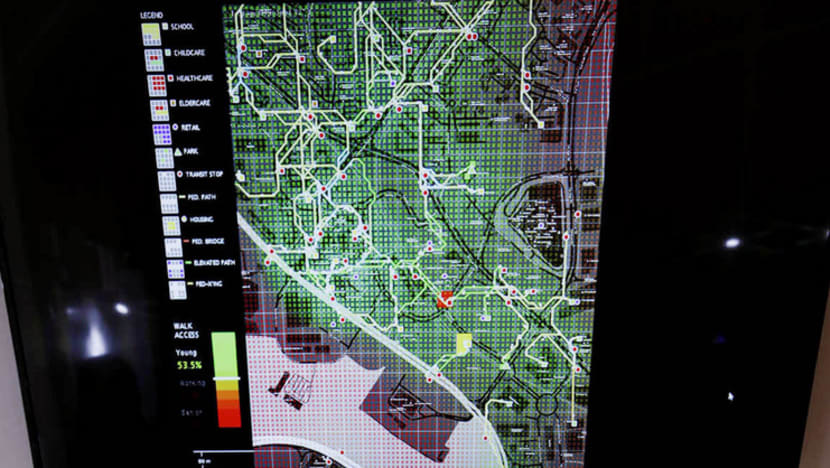
The CityScope tool uses colour-coded Lego blocks to model various components of a neighbourhood, and illustrate the potential effects of planning decisions. PHOTO: WEE TECK HIAN
SINGAPORE — The Centre for Liveable Cities (CLC) yesterday unveiled the prototype of an interactive tool called CityScope, which is meant to help the man in the street understand and take part in urban planning and development.
It uses colour-coded Lego blocks to model various components of a neighbourhood, such as schools, childcare centres, parks, pedestrian crossings and residential facilities, and illustrates the potential effects of different planning decisions.
By adding or removing specific Lego blocks from the town model, which is the size of a kitchen table, one can test, for instance, how closing off a road lane may affect traffic, or what combination of transit systems is most efficient.
Simulated changes in traffic flow and town conditions will be projected on a screen, said CLC senior assistant director Zhou Yimin, who co-leads the project, which is a collaboration between the CLC and the Massachusetts Institute of Technology Media Lab.





CityScope makes the urban planning process more understandable to people from all walks of life, not only planning experts, and serves as a “common language” for stakeholders with various expertise, he added.
By simulating real-time changes, it also helps policy planners test feedback and compare different suggested solutions to the same problem in an efficient manner.
To improve accuracy of simulations, data must be constantly updated or gathered from sensors fixed at the respective locations.
If sufficient data is furnished, the tool can distinguish people based on demographic factors, such as age, or their frequency of using a specific facility.
When CityScope is finalised, it will prove handy in communicating plans to the public, such as during focus group sessions with residents. Its “hands-on” nature also enhances participation, said Mr Zhou.
Typically, facilitators now use 2D images during such sessions.
Members of the public can try out the prototype at the Towards a Smart & Sustainable Singapore pavilion during the World Cities Summit, which kicked off yesterday. Similar tools are now employed in cities such as Beijing, Boston and Hamburg.




