







Investors sue Qiren Holdings, founder Lin Qiren over the use of S$2.4 million related to Camsing Healthcare
The four investors said that their money was used for "unauthorised self-serving purposes", but Qiren Holdings and its founder said the investors were belatedly trying to reverse the consequences of their ill-fated investment.
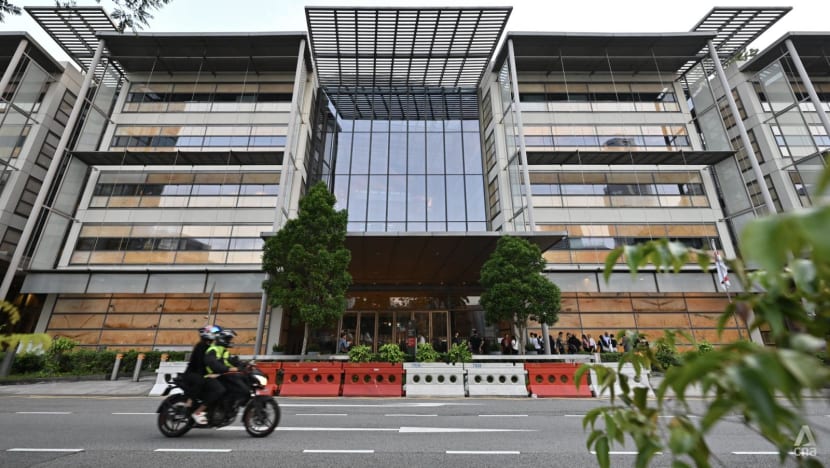
The High Court of Singapore. (Photo: CNA/Jeremy Long)

This audio is generated by an AI tool.


SINGAPORE: Four investors are suing Qiren Holdings and its founder Lin Qiren over the alleged misuse of about S$2.4 million (US$1.88 million) that the four said were supposed to go towards investing in mainboard-listed Camsing Healthcare.
The claimants are Mr Tan Aik Siang, Mr Kenneth Thng Hong Foo, Mr Foo Xuan Kai and Mr Kwek Zhi Liang. A fifth claimant had earlier discontinued her claims.
Save for Mr Tan, who is self-employed, the other three are executive directors at AIA Financial Advisers.
The suit, which lists Mr Lin and Qiren Holdings as defendants, went to trial in the High Court on Tuesday (Feb 3) and is scheduled to run until Feb 27.
According to court documents seen by CNA, Mr Lin – a former AIA agency leader and insurance agent – is the sole director and shareholder of Qiren Holdings, a company he incorporated on Aug 30, 2021 for the purpose of making investments in Camsing Healthcare.
Mr Lin also ran Qiren Organisation, which he said was an authorised representative of AIA Singapore providing financial services.
According to the defence, all four plaintiffs were agents under Qiren Organisation and were friends of Mr Lin.
Camsing is a public company limited by shares and is listed on the mainboard of the Singapore Exchange.
Its principal subsidiary is Nature's Farm, a health foods and supplements brand with four outlets across Singapore, according to its website.
Trading in Camsing shares was suspended on Apr 1, 2019 and resumed on Jul 4, 2024.
The investors are represented by Omni Law, while Qiren Holdings and Mr Lin are represented by law firms Solitaire and Siraj Omar, respectively.

THE INVESTMENT
Documents from both sides set out how the purported investment in Camsing came about.
The defendants described Camsing as a "distressed company in search of a 'white knight' investor".
Mr Lin wanted to acquire businesses that would complement Qiren Organisation's existing insurance business and identified the health and wellness market as a complementary industry.
"In this regard, the acquisition of Camsing (and through it, Nature’s Farm) was attractive given the presence of Nature’s Farm in the health and wellness market as a one-stop health food and supplement distributor, which claimed to have pioneered the retail introduction of Western supplements," the defendants said.
They added that Mr Lin intended to use Qiren Holdings to extend rescue financing to Camsing in the form of loans convertible into equity, with an eventual plan to obtain a controlling stake in Camsing when trading resumed.
In their statement of claim, the four investors said that during an Oct 3, 2021 meeting, Mr Lin and Qiren Holdings gave a presentation outlining plans to raise funds to invest in and acquire majority control over a listed company whose shares had not yet resumed trading.
Mr Lin or Qiren Holdings invited the plaintiffs to join the investment, saying that the invested sums would be kept in escrow and would not be used unless and until trading in the company’s shares resumed.
An escrow account is a third-party account that holds funds on behalf of transacting parties until contractual conditions are met.
If trading did not resume, the invested sums would be returned in full to the investors without interest, the plaintiffs said.
After the meeting, each investor entered into a subscription agreement with Qiren Holdings and an escrow agreement with law firm Morgan Lewis Stamford as the escrow agent.
They were invited to subscribe for redeemable, exchangeable notes.
Between October and December 2021, Mr Tan deposited S$1 million, Mr Thng S$600,000, while the remaining two plaintiffs each transferred S$400,000.
The four investors argued that the escrowed funds were held on trust for a specific purpose – to finance capital expenditure for Qiren Holdings' investment into Camsing – and were not meant to be freely used by Qiren Holdings.
They said that the investment gives rise to a purpose trust, known in law as a Quistclose Trust. This means that the money ought to have been used for a specific purpose, failing which, the funds had to be returned to investors or else there would be a breach of trust.
The plaintiffs also said they had enforceable legal rights under the escrow agreement, including having the unreleased sums refunded.
Their case is that Qiren Holdings failed to issue any notes to the plaintiffs in registered form and failed to record any notes. These failures were in breach of the agreements, the plaintiffs argued.
Apart from the S$2.4 million belonging to the plaintiffs, the escrow account held another S$1.55 million from other investors.
ALLEGED MISUSE
Things “took a turn for the worse” after Feb 7, 2022, the plaintiffs said, citing evidence that showed the “extraordinary collapse and failure” of Qiren Holdings’ investment.
From then until July 2024, a series of developments unfolded, including the entry of new investors and further contracts signed with them, leading to new investments.
On May 24, 2024, Camsing approved the new investment at an extraordinary general meeting. It completed the new investment on Jul 3, 2024, and resumed trading a day later based on the new investment.
On Jul 8 that year, Camsing transferred about S$3.2 million to Qiren Holdings to repay loans.
Instead of returning or safeguarding the plaintiffs’ S$2.4 million, Qiren Holdings went on a “dissipation spree”, the plaintiffs alleged.
“Evidence in this action has exposed Qiren Holding’s appalling four-year dissipation of almost the entire S$2.4 million for unauthorised self-serving purposes, including payments to enrich Mr Lin (under the guise of ‘director’s fees’), and/or to discharge Mr Lin’s personal debts,” the plaintiffs argued.
To date, only S$8,359.11 of the original S$2.4 million remains with Qiren Holdings, according to the plaintiffs.
“This has turned the spotlight on Mr Lin – the sole director and shareholder of Qiren Holdings – and his intentions behind facilitating the dissipation,” they said.
The plaintiffs set out how the S$2.4 million was allegedly used, including about S$254,500 that was returned as investments to other individuals, about S$211,900 paid to vendors, and roughly S$83,400 to repay other loans, including one linked to Mr Lin’s personal debt.
Mr Lin is also named personally as a defendant, with the plaintiffs alleging that he assisted breaches of trust by authorising or arranging the transfer of funds.
Part of the funds was transferred from Qiren Holdings' bank account either directly or indirectly to Mr Lin, they added.
The plaintiffs argued that Mr Lin is also liable for "dishonest assistance", as he knew funds were traceable to the investors and that the money was only meant for the purposes stated by them.
The investors asked the High Court to declare that Qiren Holdings holds their invested sums on trust and that the investment purpose has failed.
They also want the court to declare that Qiren Holdings breached that trust by failing to return the trust assets, and to order the return of the respective sums to each plaintiff.
In addition, they are seeking an injunction to prevent Qiren Holdings from further dissipating the assets.
Alternatively, the plaintiffs urged the court to order Qiren Holdings or Mr Lin to pay damages or equitable compensation equivalent to the amounts they invested, and for both to pay costs and interests to the plaintiffs.
THE DEFENCE
In a joint document presenting their defence, Qiren Holdings and Mr Lin deny the claims, characterising the lawsuit as the investors' "belated attempt to reverse the consequences of their ill-fated investment into Camsing Healthcare".
"The claimants have plainly experienced buyer’s remorse and are now seeking to rewrite the terms of the bargain they had each struck with Qiren Holdings," the defendants said.
"What they would have this court believe is that the deal they struck was one for a risk-free investment where they could elect to receive shares in the event, depending on the value of those shares."
Shares in Camsing were expected to increase in value when trading resumed, but this did not happen, the defendants said.
However, this did not mean the investors could back out of what they had agreed to, they added.
The defendants argued that the suit was "factually and legally meritless" as nothing in the subscription agreements gave rise to a trust.
It said the plaintiffs were promised they would get shares in Camsing if trading resumed within three years, or they would get their money back, with the subscription agreements spelling out a formula for calculating the number of shares each plaintiff would receive.
According to the defendants, an aggregate of nearly 5.8 million Camsing shares were allotted to the plaintiffs in accordance with the redemption formula set out in the agreements, but the investors declined these.
Only Qiren Holdings sought to comply with the terms of the subscription agreement, said the defendants.
"In contrast, the claimants are seeking to rewrite the express terms of the subscription agreements so as to unwind their investment and avoid receipt of the very Camsing shares they bargained to purchase," they argued.
They also said that Mr Lin cannot be held personally liable, as directors are generally not responsible for a company’s contractual breaches unless they have breached their own duties to the company.
In any case, Qiren Holdings' actions were motivated by Mr Lin's desire to act in the company's best interests, they said.
They asked the court to dismiss the claims with costs.




