





Judiciary ‘the sharp edge that keeps govt action within rule of law’
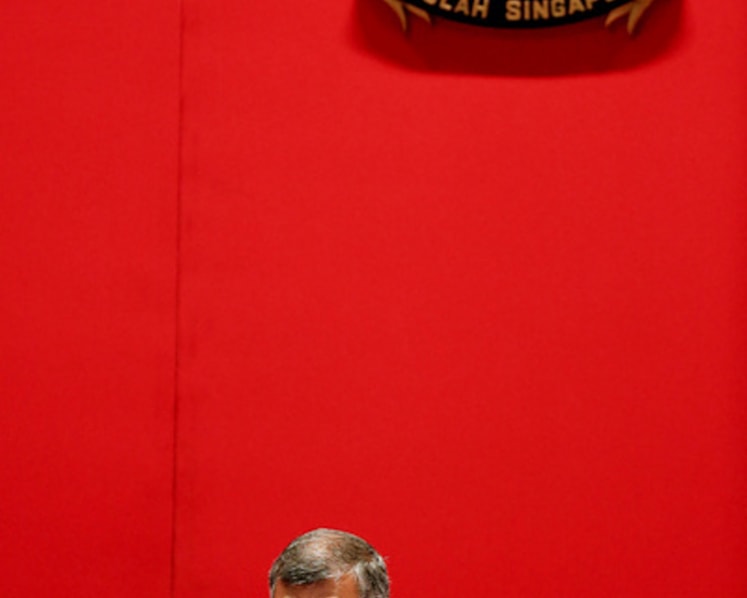
Chief Justice Sundaresh Menon. Photo: Koh Mui Fong
SINGAPORE — Citing the detention of alleged match-fixer Dan Tan Seet Eng as an example, Chief Justice Sundaresh Menon said the judiciary is the “sharp edge that keeps government action within the form and substance of the law”, in a speech at the American Law Institute earlier this month.
And noting that the Ministry of Home Affairs (MHA) later released three other detainees in light of the decision to set aside Tan’s detention — and not because the detainees made any application — CJ Menon said the commitment of the executive branch of government to comply with the law is “critical” to the rule of law and good governance.
In his speech, which was released yesterday, CJ Menon, who is to date the only Singaporean member of the American Law Institute, spoke of how the rule of law in Singapore has an emphasis on “communitarian” values, such as dialogue, tolerance, compromise and placing the community above self. “These values have modulated the court’s approach in ensuring that the rule of law rules,” he said.
Referencing comments previously made by his predecessor Chan Sek Keong, CJ Menon said good government can be encouraged through a variety of means, “only one of which is the adversarial process of pitting the government across the bar table before a judge”.





In such a society, the court plays a “supporting role” to good governance by articulating clear rules and principles, and serves as the “last line of defence” if and when these principles are breached.
Nonetheless, noting that “confrontation may be inevitable”, the judiciary “must stand firm as the last line of defence”. “Judicial review is the sharp edge that keeps government action within the form and substance of the law,” said CJ Menon.
Tan’s case last year was one such instance when the Court of Appeal had to apply its powers, he said. Lawyers acting for Tan, who had been detained under the Criminal Law (Temporary Provisions) Act since October 2013, had challenged his continued detention.
After a review of the history and purpose of the legislation in question, the panel of judges, which included CJ Menon, ruled that Tan’s detention was unlawful, and Tan was freed. He was later re-arrested and detained, but this time with the MHA establishing in detail the relevant threat in Singapore posed by Tan.
CJ Menon noted that after the ruling, the Ministry had reviewed the detention orders of three other persons, and concluded that the orders ought to be revoked.
“The point I wish to draw from this example is that the commitment of the executive to comply with and abide by the law as pronounced by the judiciary is critical to the rule of law and good governance,” he said.
“In the final analysis, the robustness of a nation’s rule of law framework depends greatly on how the other branches view the judiciary, and whether it in turn is able and willing to act honestly, competently and independently.”
Noting the “transformational power of a genuine commitment to the rule of law”, CJ Menon cited three things that can be done to encourage the embrace of the rule of law.
One is the need to combat corruption, which “violates the constitutive principles of any legal system, and is inimical to investment and economic development”.
The second is to aid the development of independent and clean judiciaries, which Singapore has done by setting up the Singapore Judicial College in November 2014 to provide training and aid to the judiciaries of emerging countries.
Finally, a rule-of-law environment must be encouraged, where there is “certainty in their enforcement and in their articulation”, said CJ Menon.