







Labour movement must respond to rapidly changing global landscape: DPM Heng
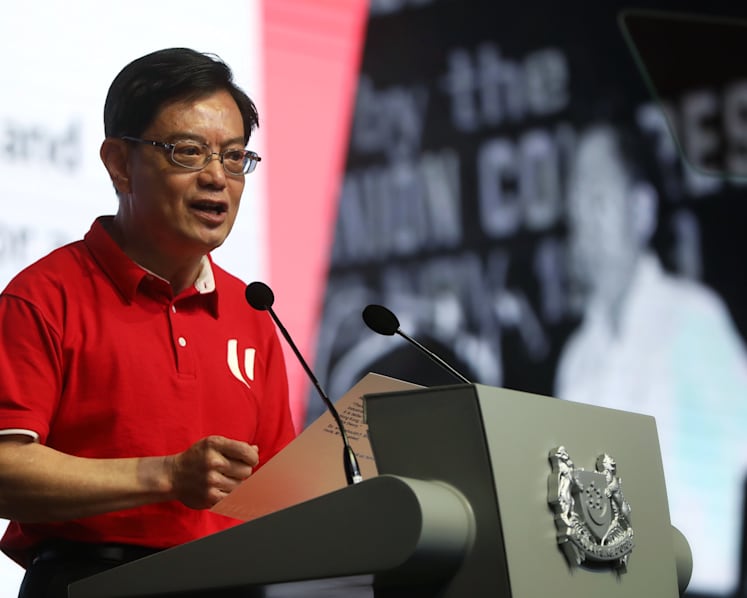
Speaking at the annual May Day rally, Deputy Prime Minister Heng Swee Keat noted that Singapore is facing a “rapidly changing global landscape, which can reshape all aspects of our lives”.
SINGAPORE — In his first speech as Singapore’s second-in-command, Deputy Prime Minister Heng Swee Keat called on the labour movement to prepare for “significant transformation” ahead and renew itself, the same way it modernised five decades ago.
Spelling out the strategies for the National Trades Union Congress (NTUC) at the annual May Day Rally on Wednesday (May 1), Mr Heng said this means the NTUC has to be an active agent in transforming the economy, while also preparing workers for jobs of the future, so that Singapore can have inclusive growth.
Mr Heng, whose appointment as Deputy Prime Minister took effect on Wednesday, is widely expected to succeed Prime Minister Lee Hsien Loong, who had delivered the keynote address at the May Day Rally in past years.
Mr Lee was also present at the Rally, as were Manpower Minister Josephine Teo, Transport Minister Khaw Boon Wan, former labour chiefs Chan Chun Sing and Lim Swee Say and Coordinating Minister for Social Policies Tharman Shanmugaratnam. Current labour chief Ng Chee Meng also spoke at the Rally.





Speaking to some 1,600 guests, including unionists and business leaders, Mr Heng noted that Singapore is facing a “rapidly changing global landscape, which can reshape all aspects of our lives”.
While automation and digitalisation will transform businesses and improve the lives of people, they would also make many jobs and skills redundant, he said.
Similarly, globalisation, which has created bigger markets and opportunities, has also created stiffer competition and unequal opportunities for some.
It is important that the fruits of growth be felt by all, “or society can fracture”, Mr Heng said.
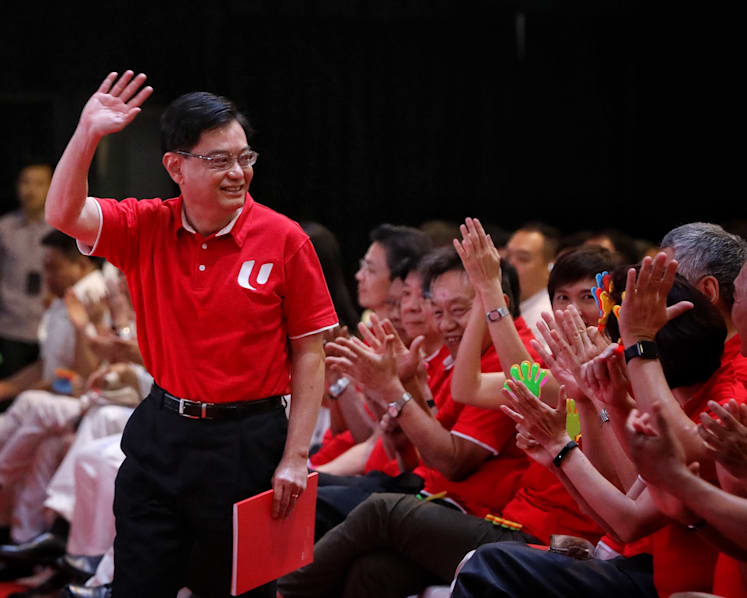
PREPARING FOR THE FUTURE
Some companies, Mr Heng noted, seek just to protect their own bottomlines and deploy technology and machines to replace workers.
“Win for companies, lose for workers. This causes retrenchment,” he said.
But, he noted, there are more companies and unions that are working together to deploy technology to augment labour.
These firms are seeking to re-design jobs, retrain workers, and redeploy them as part of the upgrading of their companies.
Citing a report from the World Economic Forum at Davos that he attend in January, he said that advanced technologies are estimated to cause the loss 75 million jobs worldwide by 2022.
At the same time, up to 133 million new jobs, almost double what might be loss, may be created by these same technologies, he added.
“What does this mean for us? It means that there are many new opportunities for all of us, and we must be prepared to seize them,” he said.
He added: “We can’t protect jobs that will be made redundant. But we can and will protect workers – every working man and woman.”
Singapore should also start thinking about how workers can develop skills for jobs that do not yet exist, he said.
Meanwhile, he added, there was a need to pay attention to lower-wage workers, seniors and those who left the workforce early.
The Progressive Wage Model, which mandates a wage floor and training-related wage tiers in certain sectors, will continue to help lower-wage workers, he said.
To help older workers, he added, the tripartite partners have agreed to raise the retirement and re-employment ages so that seniors can stay in the workforce longer, if they choose to.
Furthermore, the Government is studying how to help those who have either left the workforce early, or have not worked consistently and therefore have not accumulated much in their Central Provident Fund savings, Mr Heng added.
A STRONGER LABOUR MOVEMENT
Mr Heng highlighted the close ties between the People’s Action Party (PAP) and the labour movement, saying they are as vital today as they were 50 years ago.
“I assure you, the close symbiotic relationship between the PAP and the NTUC, which underpins our unique and precious brand of tripartism, will continue into the 4G and beyond,” he said, referring to Singapore’s fourth generation of political leadership.
Outlining a history of the ties between the PAP and NTUC, Mr Heng noted that founding Prime Minister Lee Kuan Yew began his political life as a lawyer representing the postal workers’ union.
By the time the PAP was formed in 1954, he was the legal adviser to more than 100 unions and associations.
Many other founding members of the PAP were also unionists, Mr Heng pointed out.
The unionists knew they had to enter politics to fight for the better lives of workers, while the politicians knew they had to “mobilise workers” if they were to have a mass base.
The heated political struggles of the 1960s “was the crucible that forged the close ties between the PAP and the NTUC”, said Mr Heng.
During this period, the PAP had split – with pro-communists leaving to form the Barisan Sosialis. Similarly, the Singapore Trades Union Congress (STUC) also broke apart.
Unions supporting the PAP formed the NTUC, while the unions supporting the Barisan Sosialis formed the Singapore Association of Trade Unions (SATU).
SATU commanded the overwhelming share of the unions – 82 to NTUC’s 27.
“But the PAP prevailed in the political struggle against the Barisan. And as a result, the NTUC too prevailed in the battle for the hearts and minds of workers.”
If such a relationship had not been forged, Mr Heng said Singapore may not have weathered the early crises or industrialised so rapidly.
“We will take NTUC, our workers and Singapore to the next level, just like our predecessors did in 1969.”
WHAT UNIONISTS AND BUSINESSES SAY
Speaking to reporters after the Rally, Manpower Minister Josephine Teo said the PAP depends on the NTUC to get workers motivated and moving ahead.
Meanwhile, the unions look to the Government to enact policies that will benefit workers.
“The symbiotic relationship between the PAP and NTUC has, over the many years sought to achieve this on behalf of our workers. And this relationship is what has carried Singapore this far, which is also the same symbiotic relationship that can carry us forward,” she said.
Labour Member of Parliament (MP) Zainal Sapari said he felt inspired after listening to Mr Heng’s speech as it assured him that the 4G leaders understand the importance of the labour movement in driving Singapore’s economy forward.
“If we continue working together closely as tripartite partners, we will be able to address the future challenges that Singaporean workers will face,” he said.
Mr Abdul Samad, the general secretary of the Union of Power and Gas Employees, said while he was uplifted by Mr Heng’s maiden May Day Rally speech, he said workers must ultimately see the fruits of their labour.
The 47-year-old, who is also a member of the NTUC Central Committee, said workers want to know how much more they would be able to earn if they answer the call to upgrade their skills.
“If there is no assurance (of higher wages), then you are just using me as a tool to prosper. But if you can share the fruits of business with the workers on the ground, then (it would show) that every worker matters.”
Young NTUC chairman Andy Ang said he was “enriched” by Mr Heng’s speech as it told an insightful story of how the PAP and the NTUC came to be, something he noted not many of his generation know about.
The 33-year-old primary school teacher added that he agreed with Mr Heng that economic change and development must benefit all workers.




