







Law against online falsehoods ‘justified’ if public order is threatened, argues academic
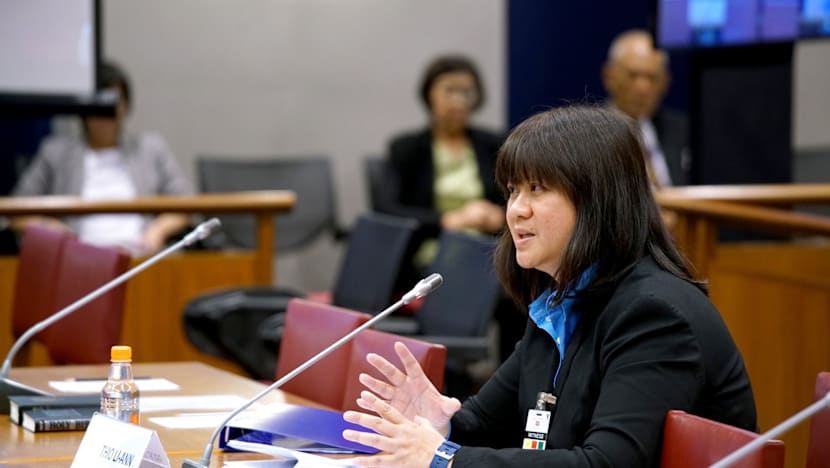
Professor Thio Li-ann, Professor of Law, Faculty of Law, National University of Singapore, at the Public Hearings for Select Committee on Deliberate Online Falsehoods on March 23. Photo Ministry of Communications and Information


SINGAPORE — While freedom of speech is a fundamental liberty for citizens that is legally protected by Singapore’s Constitution, “not all speech is worthy of protection” and legislation against deliberate online falsehoods is justified, a law academic argued on Friday (March 23) at a Select Committee public hearing on the issue.
National University of Singapore law professor Thio Li-Ann also argued that the notion of a “marketplace of ideas” which hinges on the belief that “false speech can be addressed through more speech, rather than regulation, as the better argument and best ideas will prevail” is weakening in the digital age.
.embed-container { position: relative; padding-bottom: 56.25%; height: 0; overflow: hidden; max-width: 100%; } .embed-container iframe, .embed-container object, .embed-container embed { position: absolute; top: 0; left: 0; width: 100%; height: 100%; }On the concept of free speech, Prof Thio said in her written submission that any laws regulating speech – including the spreading of deliberate online falsehood – must fall within one of eight grounds listed in Article 14(2)(a) of the Constitution.
Under that provision, free speech can be restricted among others, in the interest of the country’s security and public order.
Arguing that a law regulating deliberate online falsehood may be justified under the ground of “public order”, Prof Thio noted that falsehoods such as those that attempt to undermine democratic elections, and is akin to attempts to subvert an elected government could be a “hybrid between a threat to public order and national security”.
“’Public order’ thus appears able to accommodate not only physical threats, but threats to fundamental values and processes, such as the harm deliberate online falsehoods pose to democratic institutions and processes,” she said.
Agreeing with her views, Law and Home Affairs Minister K Shanmugam said that since free speech covers a broad range of areas including truth, deliberate falsehoods and misimpressions, “speech is generally a means to an end”, and that there is a need to examine whether the speech “achieves those ends”.
That brought Prof Thio to note that the effectiveness of a marketplace of ideas is questionable as it is based on several assumptions – such as having rational citizens who want to engage in deliberative democracy – which “seemed flawed” in today’s post-truth era.
There may be people who are “impetuous and undiscerning” as they receive information without any critical filter, she told the Select Committee.
Prof Thio said “They’re swayed more by quick soundbites than sustained argument. I do not think this necessarily helps democratic debate, particularly when one is very gullible.”
“You receive a tweet and you retweet without checking. There’s no need to check because you’re not espousing a view, you are parroting a view.”
Speaking to reporters after the hearing, Prof Thio noted that while there are laws to tackle issues such as defamation and sedition, Singapore’s courts are “struggling” with factors such as the reach and longevity of online content, and there is a need for measures to nip deliberate falsehoods quickly.
There is a need for a mechanism that can address deliberate online falsehoods quickly, such as having an ombudsman or commission, as well as a measure that has the ability to make a “declaration of falsity”, she said. This will strike a balance between free speech, and the right to call out false speech.
“I would not want to see an open-ended law,” said Prof Thio. “Maybe given the fact that free speech is so important to a democracy, maybe it’s better to have a specific law targeted to it which acknowledges the importance of free speech, which differentiates between deliberate falsehoods and maybe negligent falsehoods?”
Such a legislation should also take into account the individual’s intent, she added. For instance, while a person who retweeted a falsehood could be liable, that should be at a lesser degree if the person did so without malicious intent.
As current laws appear to be “efficiently mobilised” to deal with threats such as defamation and sedition, Dr Gillian Koh, deputy director of research at the Institute of Policy Studies, told the Select Committee that she does not see the need to “make a revolutionary change” to the country’s laws to deal with deliberate online falsehoods.
An independent body called the “Election Media Monitoring Commission” – comprising senior judges and academics – that is empowered through state legislation to monitor election-related media content generated by foreign entities and individuals, among others, could be established, suggested Dr Koh.
When asked by committee member Dr Janil Puthucheary, who is also Senior Minister of State for Communications and Information, why the focus should just be on content during elections since deliberate online falsehoods “occur all the time,” Dr Koh said that Singaporeans would be making a “consequential decision” during that time.
Aside from considering a law that requires deliberate online falsehoods to be taken down, Dr Koh argued for the need to have a measure to counter foreign news that contains falsehoods with the aim of trying to “stir the pot” during elections.
The news should carry a label indicating its origin, and further circulation should be prohibited, she added.
However, Dr Koh said taking down such content is “not entirely full proof” as it would only ignite an interest to find and read it. Noting there is a need to be careful in regulating speech, Dr Koh said that such a measure would enable public dialogue to convince Singaporeans of the truth, and prevent falsehoods from perpetuating.
However, Mr Shanmugam said that would mean the falsehoods would still be circulating, as he insisted that deliberate online falsehoods that do not serve any purpose – such as news that stated that former United States President Barack Obama is a Muslim – should be taken down immediately.
“What ends are you achieving by allowing absolute falsehoods... to circulate to try and influence people when it actually contradicts the very fundamentals of democracy and corrodes democracy,” he added.
While Dr Koh acknowledged that there are deliberate falsehoods that are clear-cut, and deserve to be taken down, there is also content that falls into grey areas, such as opinion pieces “layered on some falsehoods”.
In response, Mr Shanmugam’s line of questioning grew testy, as he pointed out that opinions should not be mixed up with deliberate online falsehoods, and that there are gaps in the legislation to deal with the “modern virality” of deliberate online falsehoods. Attempting to steer Dr Koh from wading into legal arguments as she had admitted that she does not have legal expertise, Mr Shanmugam at one juncture remarked to Dr Koh that she is not a lawyer.
Speaking to reporters after the hearing, Dr Koh said that she supports countering falsehoods through debate as she is not confident that even with legislation, tech firms would adhere to orders to take down content containing falsehoods.
“The onus is on the Select Committee and the Government to prove that it is sanguine that it can effect such an action,” said Dr Koh.
“Because they propose it, they write it and then they do it, and (if) nothing happens, that would be a mockery of the law. That would be embarrassing for all of us.”
Nevertheless, Dr Koh is optimistic that any legislation proposed by the Committee will explain how they “can make Twitter, Facebook or Google take down what they feel are deliberate online falsehoods”.




