







Look Ahead 2019: Education — Attempt at levelling playing field kicks off
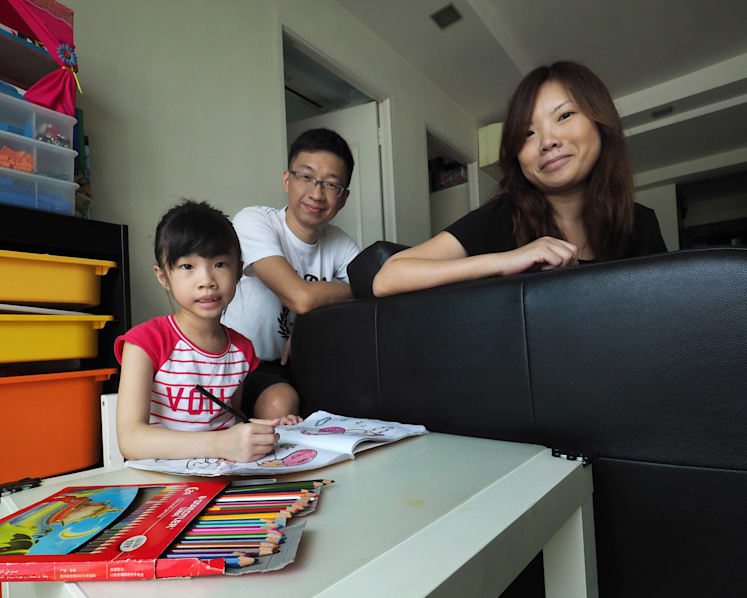
Six-year-old Arielle Soon with her parents, Mr Justin Soon and Ms Rinn Khoo. Arielle will be part of the first batch of Primary 1 students who will not have graded assessments.
SINGAPORE — Whenever six-year-old Arielle Soon returns home from her childcare centre, she immediately whips out a piece of paper and pencil and starts doodling.
Her interest in drawing prompted her father, Mr Justin Soon, 41, to enrol her for art lessons. “We wanted to explore her interest with professional guidance,” said Mr Soon.
On Wednesday (Jan 2), Arielle started Primary 1 at Alexandra Primary School. While beginning school life can be stressful for any young child, a series of sweeping changes in Singapore’s education system could give those like Arielle more time to pursue other interests such as art.
The bubbly young girl is among the Pri 1 and Pri 2 students this year who will not have weighted assessments. For Pri 2 students, they will no longer have a year-end examination as well. The Ministry of Education (MOE) announced last September that these will take effect from 2019.





There are about 40,600 enrolled in Pri 1 and 38,000 students in Pri 2 this year.
The changes in graded assessments in primary schools, as well as the removal of mid-year examinations for Secondary 1 students, are part of a larger plan by the MOE to reduce the over-emphasis on grades.
The ministry’s move to cut examinations for the lower primary school levels was met with cheers from some parents, including Mr Soon.
Calling it a “good first step”, the civil servant said: “Learning should not be based on exams alone. It will give the wrong message to the kid that if you do well in school, then everything will go well in life.”
With the removal of graded assessments, teachers can spend less time preparing for exams and focus on improving their teaching methodologies, he added.
There are other parents, though, who are taking it with some trepidation.
Ms Geeta Pillay Krishnan, 39, whose six-year-old son Arvind Pillay Khunaselvam is in Pri 1 this year, is worried that the removal of graded assessments will leave her without any means to gauge his academic performance.
“On one hand, you don’t want to stress the child, but then how will you understand what level they are at and if they understand the lessons?” asked Ms Krishnan, who is a teaching aide at a secondary school.
She added that with the lack of clear guidelines, it would be difficult for her to know if her son has met the basic requirements for Pri 1.
Despite MOE’s assurance that students will still be given informal assessments in class, Ms Krishnan is concerned that parents may not know how their children are performing. Having the teachers provide constant feedback to parents about their child’s performance would be the best solution, she suggested.
Echoing Ms Krishnan’s sentiments, homemaker Alicia Phang, 34, whose son is in Pri 2 this year, said that she was unsure if removing the year-end exam for the cohort would be useful because her child will still have to sit for exams from Pri 3.
Tuitions centres here have stepped in to fill the gap, with one making its in-house exams available to students who are not enrolled with the centre, while others are introducing more enrichment classes and assessments to supplement their offerings for primary and secondary school students.
LEVELLING THE PLAYING FIELD
Announcing the changes last year, Education Minister Ong Ye Kung said that it was a “calibrated move” to send a strong signal that “we are at a strong position of rigour, we can afford to unwind a bit without undermining the performance outcomes of our students”.
MOE said then that the new policies would allow each student to focus on his or her learning progress and discourage them from being overly concerned about comparisons.
Aside from removing graded assessments and exams, changes will be made to how the Holistic Development Profile, or report book, will be presented. Qualitative descriptors will be used to report students’ learning in all subjects in place of grades for Pri 1 and 2 students. Certain academic indicators such as class and level positions will also be removed for all levels, to discourage excessive peer comparison and ensure that students can focus on their learning progress.
At an event in October last year, Mr Ong said that a focus on the “true spirit of learning” was needed and that education was a holistic developmental experience that went “far beyond grades and marks”.
Education experts contacted by TODAY said that while the removal of graded assessments is a positive step, more time and measures are needed for Singaporean parents to adjust their mindsets and reduce their emphasis on grades.
Dr Timothy Chan, director of SIM Global Education’s academic division, said: “I would not expect parents to stop pushing their children for academic excellence just because exams are removed, but over time, hopefully, they can be convinced that other life-skills such as interpersonal skills, communication skills and cultural competence are equally, if not more important than academic results.”
Sharing the success stories of high achievers who were not top academic performers could help shape the mindset of parents and students, he suggested.
In tandem with the changes in schools, the MOE is also looking into ensuring that the education system remains a ladder for social mobility. It convened the Uplifting Pupils in Life and Inspiring Families (Uplift) taskforce in October last year to strengthen support for students from disadvantaged families. Chaired by Second Minister for Education Indranee Rajah, the taskforce will identify gaps in areas such as the motivation of students, measures to tackle absenteeism and dropout rates.
The recommendations of the taskforce are expected to be finalised in the first half of 2019, and efforts will be tracked and evaluated over a one- to two-year period to ensure they are effective.
Associate Professor Jason Tan from the National Institute of Education said that the recommendations would provide an indication of the Government’s policy strategies in tackling educational disadvantage. He thus expects education inequalities to feature prominently on the policy agenda in 2019.
He added that the primary school admission system now is heavily weighted in favour of those who come from good family backgrounds, with factors such as the family’s area of residence, parents’ religious or clan affiliation, or parental employment in school influencing which school a child attends.
To mitigate these factors, the ministry could identify students with potential in various fields and help them develop their talents, so that they can qualify for the direct school admission scheme.
However, he cautioned that with some parents tapping their resources and networks to enhance their child’s educational success, levelling the playing field in the education system will be akin to “chasing a moving target”. In this regard, Assoc Prof Tan said that the Government has to introduce more schemes to help disadvantaged students and reduce or eliminate the effects of structural barriers within the education system that unduly favour students from advantaged backgrounds. ADDITIONAL REPORTING BY ALFRED CHUA
WHAT’S UP FOR 2019
Uplifting Pupils in Life and Inspiring Families Taskforce (Uplift):
The inter-agency taskforce led by Second Minister for Education Indranee Rajah will look at how to strengthen support for students from disadvantaged families. A key part of Uplift’s role will be directed at pre-school and primary school children. The taskforce is expected to submit its recommendations in the first half of 2019 following months of stakeholder engagement.
Removal of examinations and other assessments:
From 2019, mid-year examinations for Sec 1 students will be removed. All weighted assessments will be removed for Pri 1 and 2 students, including end-of-year examinations for Pri 2 students.
The school report card — or Holistic Development Profile — will be adjusted. For Pri 1 and 2 students, qualitative descriptors will be used to describe a student’s learning progress, instead of grades. For all other levels, academic indicators will be fine-tuned.
School mergers:
Four pairs of junior colleges will be merged and begin operations under a combined identity. The newly merged JCs are Jurong Pioneer, Anderson Serangoon, Yishun Innova and Tampines Meridian.
Seven pairs of primary schools and three pairs of secondary schools will also be merged.
Expansion of MOE kindergartens:
Seven new MOE kindergartens will be opened and will be co-located with primary schools. They include Kranji Primary School, First Toa Payoh Primary School and Fernvale Primary School. Another six are expected to open in 2020, with the target of 50 MOE kindergartens to be in operation by 2023.
The new MOE kindergartens will collaborate with anchor operators PAP Community Foundation Sparkletots Preschool and National Trades Union Congress’ My First Skool to provide “a continuum of quality and affordable pre-services for children aged two months to six years old”, the MOE said.
Review of admissions to institutes of higher learning:
The Institute of Technical Education will be reviewing its admissions system from the 2019 admission cycle, with the aim of placing emphasis on skills assessment and expanding aptitude-based assessment.
The Polytechnic Foundation Programme will be expanded to include students who score an aggregate of up to 12 points, up from the previous 11 points. This will allow 300 more spaces for the 2019 cohort.




