







MOE to review National School Games competitions for pri school pupils
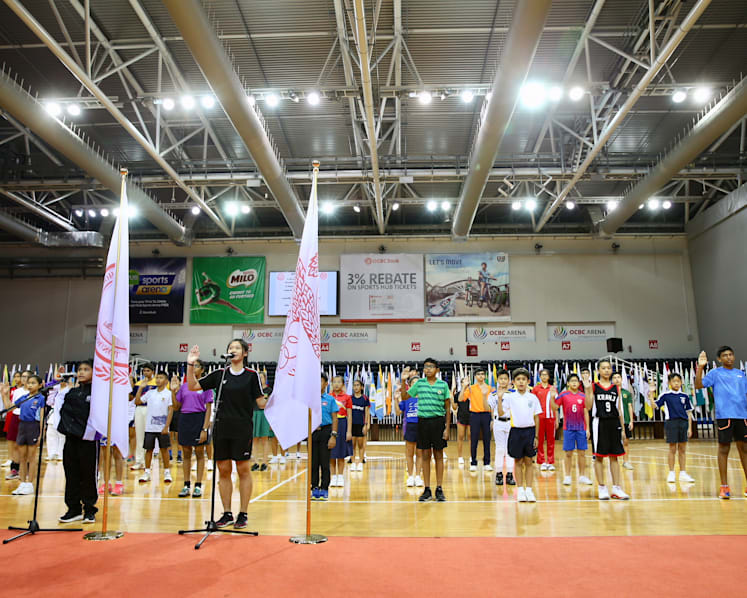
Athletes take their oaths during the National School Games Opening Ceremony at OCBC Arena Hall 1, Singapore Sports Hub, Jan 24, 2018. Photo: Koh Mui Fong/TODAY


SINGAPORE — In the first major review of the decades-old national inter-primary school sports competitions, Education Minister (Schools) Ng Chee Meng announced on Wednesday (Jan 24) that the tournaments will be revamped to reduce the “perceived stakes” in sports contests and increase playing opportunities.
New sports competitions under the National School Games Junior Division — open to students aged nine to 11 — will be piloted or rolled out over the next three years, Mr Ng said.
This is to provide students competing for the first time experiences that are “developmentally more appropriate” by strengthening their basic skills and cultivating the joy of playing sports, he added. “I look forward to seeing these important changes that support the development of our young athletes, especially in reducing the perceived stakes of competitions at a young age, and instilling a growth mindset in our students through sports.”
Mr Ng was speaking at the opening ceremony of the National School Games competition held at the Sports Hub.





In a statement, the Ministry of Education (MOE) said that the latest move is part of ongoing efforts to “strengthen the holistic development” of primary school students.
On the academic front, for instance, changes were made to the Primary School Leaving Examination scoring system to reduce emphasis on grades.
The review will be led by committees in charge of the 21 sports competitions organised by the Singapore Primary Schools Sports Council (SPSSC). It will also involve educators, MOE officers as well as representatives from National Sports Associations (NSAs). The review may be extended to inter-secondary school sports competitions, SPSSC chairman Lee Hui Feng said.
The committees have been conducting trials and holding focus group discussions with students, teachers and representatives from the National Youth Sports Institute as well as Sports Singapore.
‘TIERED’ COMPETITION SYSTEM
As part of the review, a two-tier competition system has been implemented for rugby, for a start.
Under the traditional competition structure, schools compete in a round-robin format, with the top two schools from each group advancing to the next stage of the competition.
With the new system, schools knocked out in the round-robin stage will continue to compete at the “second-tier” level. Those that top their groups will advance to the “first-tier” level.
“As a result, students, including substitute players, will have more playing time, with more chances of experiencing small successes to encourage them along the way,” Mr Ng said.
In response to queries, MOE said that by implementing a tiered competition, “teams are able to compete with players of similar abilities”. “The change will also allow teams to play more matches during the National School Games,” it added.
Separately, the review committee for sailing has recommended raising the number of sailors from the junior division deemed as “top performing” from four to eight. This is to enhance the opportunities for student athletes to be recognised, MOE said.
Mrs Lee from SPSSC, who is also principal of Qihua Primary School, told TODAY that some students placed too much pressure on themselves when they compete. When they fail to progress, it seemed as though it is the end of the road.
By having the three-tier competition system, students might feel less pressure because even if they are knocked out in the earlier stages, they can still compete at another level within the competition, she added.
REMAINING COMPETITIVE
On whether the changes could have an adverse impact on students such as blunting their competitiveness, Mrs Lee reiterated that the aim is to build up the students’ fundamentals and strengths in sports.
“By having smaller teams participating in competitions, for instance, there’s less room not to be part of the action,” she said. “So, students get to improve their skills and competency level. And this does help them to remain competitive because we are, in a way, making them good athletes.”
Among other things, the review committees will consider whether to give medals to more participants, not just those finishing in the top three positions. This is to give them “some encouragement”, Mrs Lee added.
Sports equipment that are “age-appropriate” might also be introduced, she said, citing the example of having slower tennis balls so that students can engage in longer rallies to build up their competency.
Officials from the national sports associations who spoke to TODAY also said that the revamped formats are not likely not kill competitiveness and hamper talent development.
Mr Cyrus Medora, Netball Singapore’s chief executive officer, said: “Netball, for example, is a late development sport… the players have plenty of time to grow to be competitive. At that age, they should be having fun, and we have to give them a love of the sport.”
He believes that the three-tier competition will encourage more youth to continue playing sport. “It’s something fantastic, as the teams that play each other will be more balanced. Getting beaten 80-5 by a ‘power’ school is very demoralising. Hopefully, (this system will extend to) the secondary schools as well.”
EXPOSURE TO SPORTS MORE VITAL
Agreeing, Singapore Sailing Federation president Benedict Tan, said: “Some schools are powerhouses in their sports and as the gap gets bigger, (the other schools) will stop playing. They should de-emphasise results as it is damaging and counter-productive to a child’s progress and development. There’s a place for high-level competition and that’s what the Olympic Games and senior-level competitions are for, but not the primary school level, for sure.”
Mr Tan, who is also a sports physician, added: “The priority is on exposure, not results, and you want them to try multiple sports. If they don’t do well, it doesn’t matter… in Singapore, there is a natural tendency to emphasise on results and, ironically, parents are the competitive ones. It is the wrong way because the child will end up hating the sport.”
He is hopeful that MOE will include more categories for the National School Games Sailing Championships, which sees sailors from six divisions competing in the “optimist class”. With more categories, budding young sailors will be able to try different sailing classes, he said.
On the use of age-appropriate equipment, Mr Medora said that during netball carnivals that the association organises, the children already use smaller balls. “It’s a friendlier environment and we try to make it non-competitive,” he said, adding that there are plans to hold more such carnivals to get more young children to play the sport.
First introduced in 1959, the National School Games – which runs from January to August – is the largest annual youth sports event here, with more than 400 sports championship titles contested.
This year, there are about 58,000 student athletes from more than 365 primary and secondary schools, junior colleges and centralised institutes expected to take part in 29 different sports. ADDITIONAL REPORTING BY LOW LIN FHOONG




