







Multiple challenges in S’pore’s future, Shanmugam warns
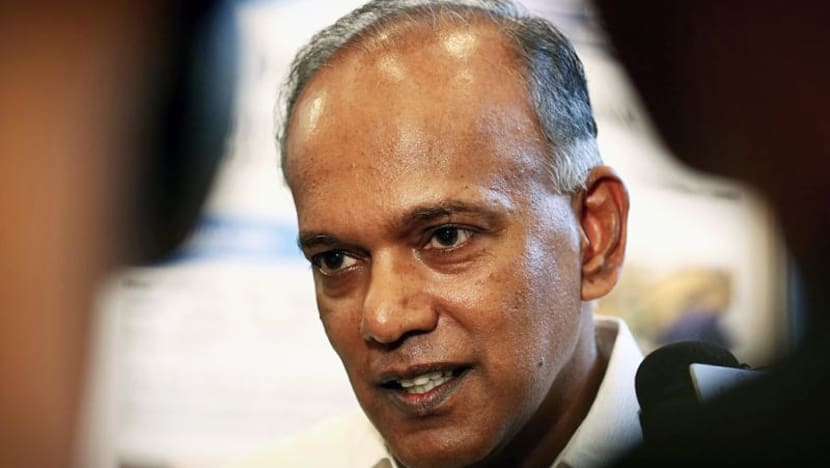
In a two-hour dialogue session at NTU, Mr Shanmugam spoke on challenges such as an ageing population, geo-political dynamics in the region, and the threat of terrorism. TODAY file photo


SINGAPORE — In moving towards SG100, Singapore must maintain its racial and religious harmony, and have Singaporeans remain willing to compete with the rest of the world and to work with the Government for longer-term benefit, said Home Affairs and Law Minister K Shanmugam to university students yesterday.
While he expressed his faith in the younger generation, Mr Shanmugam presented a sobering picture of challenges facing the Republic on multiple fronts in a two-hour dialogue session at Nanyang Technological University (NTU). These challenges include an ageing population and low birth rates, geo-political dynamics in the region and beyond, new technologies and the threat of terrorism.
The Government is today running a structural deficit, spending more than what it is collecting in taxes. But with an ageing population, there is set to be more strain coming from an expected increase in healthcare spending, he said.
And Singapore cannot take successes such as its status as a regional financial centre and aviation hub for granted. “What entitles us to where we are today, how did we get here, how will we get to SG100 — keeping our sovereignty and our economic vibrancy — these are big questions,” Mr Shanmugam said at the NTU Students’ Union Ministerial Forum.





For instance, Singapore faces competition from its neighbours, which also aspire to be regional financial centres. “But the reality is we’re like a spinning top spinning on a very narrow base and dependent on the region. And not because of charity but because we are able to run faster, have ... better education, rule of law so that people trust us,” he said.
Asked by a public policy student how the government implements hard policies, Mr Shanmugam said it has so far been successful in satisfying some short-term aspirations while making sure it keeps long-term objectives in mind.
Whether Singapore reaches SG100 “in the same shape” depends on the younger generations staying united with the Government and accepting that some short-term pain is necessary for long-term gain, he said.
Among other issues, Mr Shanmugam was also asked about the death penalty and whether the Government could have done better in the tragedies involving two SMRT trainees and the late Private Dominique Sarron Lee.
On the case of Private Lee, who died in April 2012, Mr Shanmugam noted that the facts were quite technical, with some developments happening a few years ago before the court recently dismissed a civil suit brought by his family against the Singapore Armed Forces and two officers involved in the training exercise.
“What else could (MINDEF) have done? I think what they could have done perhaps, with hindsight, is come out to explain the fact that there was a Coroner’s Inquiry, come out to explain what the punishments (of the officers) were, come out to explain that (the Attorney General’s Chambers) has looked into the culpability of the officers and what their role was — they could’ve explained it better. But actually all of this came out some years ago but has been forgotten,” he said. “I think we have to see how we can handle these things in a way that people understand.”
He added: “I do not think there was lack of grace or humility on the part of MINDEF ... I think the best thing MINDEF can do, is do what it did.”
On the death penalty, Mr Shanmugam said those in the drug trade destroy lives and people here can walk on the streets safely at night and 10-year-olds can take public transport because the drug situation is under control, he said. Nobody wants to see the death penalty imposed but sometimes “hard choices” have to be made to keep Singapore safe.




