







‘No rationale’ for tough property cooling measures: Redas
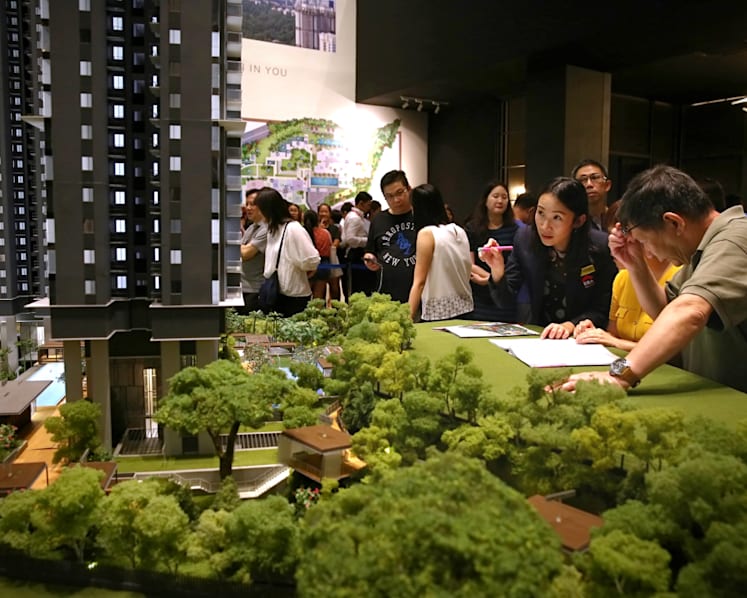
Visitors at the Stirling Residences showflat on the evening the Government announced the increase in Additional Buyer's Stamp Duty (ABSD) rates and tightened Loan-to-Value (LTV) limits to cool the property market, July 5, 2018.


SINGAPORE — The Real Estate Developers' Association of Singapore (Redas) said on Friday (July 6) that it saw "no rationale" for the fresh round of property cooling measures introduced by the Government the previous day.
On Thursday, the Government raised Additional Buyer's Stamp Duty (ABSD) rates and tightened the Loan-to-Value (LTV) limits for Singapore citizens, permanent residents, and foreigners in a bid to "cool the property market and keep prices in line with economic fundamentals".
Describing these measures as "tough", Redas pointed out that the property market is "in the early stages of a recovery and the recovery is in line with economic fundamentals".
The market should be given time "to find its own course and reach a sustained equilibrium", Redas said in response to media queries.





The ABSD rates will be raised by 5 percentage points for all individuals, and 10 percentage points for entities. An additional ABSD of 5 per cent that is non-remittable will also be introduced for developers buying residential properties for development.
LTV limits will be tightened by 5 percentage points for all housing loans granted by financial institutions. These revised LTV limits do not apply to loans granted by the Housing and Development Board.
REDAS noted that the property market only started improving last year, helped by the overall stronger growth in Singapore's economy. It stressed that sale transaction volume is "not high and within market expectation".
"The existing sizable ABSD and TDSR remain a restraining factor for foreign buyers and Singaporeans. Buyers are still price-sensitive," said Redas, referring to the total debt servicing ratio framework which has remained in place since 2013.
Redas said it also "does not see the rationale" of the additional non-remittable 5 per cent ABSD imposed on developers buying residential properties for development. Developers are already constrained by financial considerations as well as "tough and unfriendly business policies", such as the existing 25 per cent ABSD which licensed developers can request to be remitted only if they manage to sell off all units within the five-year deadline.
"The new ABSD on developers will impose additional pressure on land acquisition as they compress their development, sales and land replenishment cycle time. Developers are concerned of distortionary effects of such market behaviour over the medium and long term," Redas added.
The association said it hopes the Government "maintains the confidence of investors and buyers as well as developers" while managing the property market. "It is in the interest of the country to have a vibrant real estate industry and a steady growth in real estate value for home owners and investors in the long term," Redas said.
IMPACT ON PRICES, VOLUME
As the news began to sink in, analysts expect sale transaction volumes to be significantly affected in the short term.
Cushman & Wakefield senior director of research Christine Li expects demand to “take a hit”, with primary home transaction volume possibly falling by 30 per cent.
“We could expect a quiet quarter or two moving forward,” said Ms Li.
From next month onwards, she expects new home sales to average about 500 units a month for the rest of the year.
Noting that this was the ninth round of cooling measures since 2009, Colliers International said the move will “put a drag” on home sales this year.
“We expect new home sales to decline significantly in the initial few months as the market take stock of the potential implications,” the real estate services company added.
It noted that the last two rounds of cooling measures — announced in January and June, 2013 — saw new home sales fall 65 per cent and 73 per cent, respectively, in the following months.
For the whole of this year, Colliers said new private home sales (excluding executive condominiums) could reach 8,500 to 9,000 units, down from 10,566 last year.
“We expect developers to delay launches as they re-strategise,” it added.
Nevertheless, Colliers said prices are likely to “hold steady” going forward, having risen by 7.4 per cent in the first half of this year.
“Given that developers have exercised more restraint in bidding for collective sale sites in recent months, the launch pipeline should remain fairly sustainable over the next three to four years,” said Ms Tricia Song, head of research for Singapore at Colliers International. “We do not think developers necessarily need to embark on deep price cuts to sell units especially if the new launches are (spaced) out evenly.”
Ms Li, however, warned that the market could “come to a standstill over the next couple of months” because of a mismatch in price expectations.
Buyers would want to renegotiate the terms “because of the higher acquisition costs and lower affordability, but sellers with deep pockets will not slash prices just yet”, she noted.
While prices are currently “only 3.6 per cent” below the last peak in 2013, she said it would be challenging to reach those levels “given the battered sentiments and wide-ranging impact” of the cooling measures.




