







Nurses joining mid-career tell of challenges, joys of profession
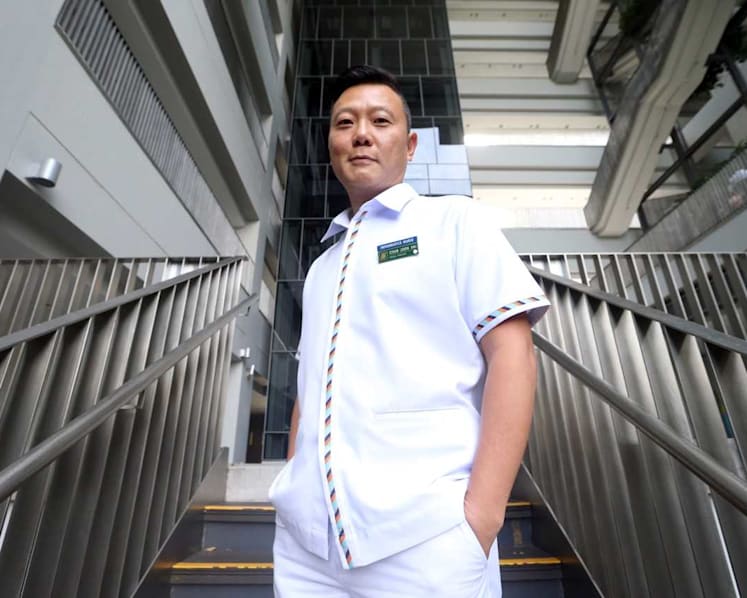
Mr Chan Joon Kai (pictured) had worked in the creative industries for nine years before he switched to nursing.
SINGAPORE — Mr Chan Joon Kai, 49, jokes that anyone wanting to lose weight should consider a mid-career switch to nursing.
“I always tell new nurses that joining the profession is like signing up for a free spa programme. You will definitely lose weight in your first year because you have to learn things along the way and you won’t have time to eat,” he told TODAY.
Mr Chan, who told his story as Singapore marked Nurses' Day on Thursday (Aug 1), is part of a growing number of nurses who joined the profession mid-career — looking for more satisfaction, fresh challenges, or more job security.
After working in the creative industry for nine years, he began to toy with the idea of leaving the field after realising it was not a sustainable career.
“Graphic designing and film-making was what I wanted to do but I needed something more stable. I was afraid of being branded obsolete when new people entered the field, so I wanted to pick up a skill that, as I go on in life, would make me more valuable.”
Mr Chan said that a friend, who was a nurse at that time, suggested he take up nursing because the friend felt that Mr Chan's tendency to be “a stickler for rules” would suit the job.
Still, Mr Chan said that he had a “culture shock” when he joined the profession after completing his two-year professional conversion programme at Nanyang Polytechnic in 2006.
“I used to think that everyone is very cordial in healthcare but because of the stress for the care of the patient, things could get hectic and stressful,” he said.
However, the nurse clinician has come a long way since he joined the profession. He oversees a team of 10 in the nursing informatics team. His role involves acting as a middleman between nurses and IT professionals to ensure that the clinical systems implemented in hospitals suit the needs of nurses and patients.
While he has met with his fair share of challenges along the way — he has had patients spit on him, for example — Mr Chan said that those coming into the sector from a different industry have an edge as they are likely to be better at dealing with different people and situations.
His advice for others considering a switch to the nursing field? Be prepared to “work from zero”.
“Perseverance, patience and humility are the most important things because you’ll be starting from ground zero again and working with people who are much younger than you.”
And for Mr Chan, gender is no issue. “Joining a female-dominated industry was never a problem or issue for me. When I decided to join nursing, I never thought of whether my gender would be an advantage or a disadvantage. To me, it was just a profession. And I felt it was an advantage because you are the thorn among the roses and somehow you will stand out."
PUSH TO ENCOURAGE MID-CAREERISTS TO JOIN NURSING
The Government has made a concerted effort in recent years to encourage more mid-careerists to join the field.
In 2017, the Ministry of Health announced that it would pump S$24 million into encouraging more mid-career Singaporeans to switch to the healthcare sector. Part of that was allocated to the professional conversion programmes for nursing.
There are three such programmes offered at a degree, diploma and National ITE Certificate (Nitec) level. Since their launch in 2003, more than 1,200 mid-career professionals have made the switch to nursing.
Driving home the importance of attracting more nurses to the field, Dr Amy Khor, Senior Minister of State for Health, said that the role of nurses would continue to evolve along with the changing healthcare needs of the population.
“As our nurses take on a wider range of healthcare responsibilities, innovation and continuing education will be key enablers for nurses to drive change for a better healthcare system and care delivery,” said Dr Khor, who was speaking at Tan Tock Seng Hospital’s Nurses’ Day celebration on Tuesday.
REALISING A DREAM
Another mid-career switcher, Ms Leong Wan Yee, 41, had wanted to become a nurse in her younger days but did not have the courage to take the leap back then.
“Nursing was my childhood dream during my teenage years. I wanted to apply after my O-Levels in 1994, but the public perception of nursing was not as good compared to today, so my parents objected to it,” she said.
However, Ms Leong, who had been working in the banking sector for nine years, reconsidered her decision after a close friend died six years ago.
Undeterred by the fact that she had not been to school in almost a decade, Ms Leong took a two-year professional conversion programme at Nanyang Polytechnic before eventually becoming a staff nurse at the Singapore General Hospital (SGH).
Ms Leong, who went through the same two-year programme as Mr Chan, took up her staff nurse position at SGH in 2017.
It was not an easy ride though, as she was unprepared for the stresses of returning to school. "I never expected that nurses would have to study biology, or sociology and psychology and statistics modules.”
She even came close to giving up during her first clinical posting during her studies, because she was unable to bear the suffering faced by patients and their families.
However, she has since found her footing by seeking the advice of her seniors. She has also made use of her skills in communication that she had honed while in the banking sector. This, she said, has allowed her to better explain medical terms to families in language that they can understand.
MORE THAN DOLLARS AND CENTS
For Mr Lai Kok Kiong, who was in the purchasing sector for six years after graduating from mechanical engineering from Ngee Ann Polytechnic in 1994, the hardest part of making the switch to nursing was the fear of getting things wrong.
“I would ask myself, 'Am I doing the right thing? Will I get scolded?' You are dealing with other humans in the profession, so you will get a response from them.”
The 45-year-old nurse had taken the plunge after coming across a newspaper advertisement for the job in 2004.
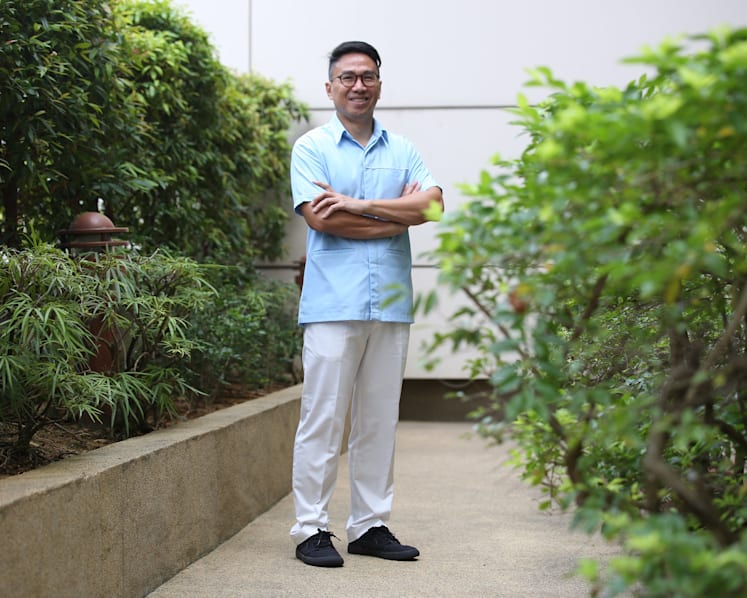
Mr Lai Kok Kiong, who worked in the purchasing sector before, draws deep satisfaction from his nursing role. Photo: Najeer Yusof/TODAY
At the time, he had been looking for opportunities that would give him a better sense of satisfaction and prospects for career advancement.
He signed up for the diploma-level professional conversion programme offered at Nanyang Polytechnic the same year and entered the healthcare industry two years later.
Today, the clinician nurse who works in critical care at Tan Tock Seng Hospital has finally found satisfaction in his job. “I am very satisfied and happy with what I am doing. The gratification is not money. It’s more than dollars and cents.”
This sense of satisfaction comes every time former patients or their family members remember him when they see him on the streets, he added. “It’s a demanding job but the gratification comes from how well patients are at the end of the day,” said Mr Lai.
When asked how Singaporeans viewed nurses, Mr Lai said that nursing degrees had helped to elevate the image of the sector.
Seeing that it is a female-dominated profession, patients do look at him twice. "They will say, ‘Are you a nurse or are you a doctor?’. Even now, I will get that kind of response."
Mr Chan said that there is still some way to go to change how Singaporeans viewed nurses.
“Some people blur the line between nurses and maids. Nurses are there to help, but sometimes loved ones who are visiting patients expect nurses to do little things for (the patients) such as helping them get a drink.”
That said, Mr Chan acknowledged that more Singaporeans have realised that a nurse’s role went beyond providing bedside care. ADDITIONAL REPORTING BY KIMBERLY LIM




