







One year on, MediShield Life sees 66% more payouts than previous scheme
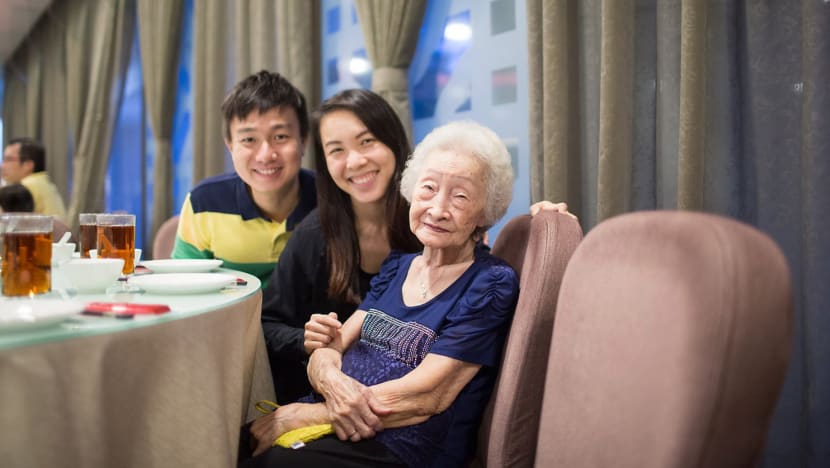
Mdm Yuen Soh Ying, in her 90s, had S$6,600 of her more than S$10,000 hospital bill covered by MediShield Life when she had a hip replacement and an infection this year. The remainder was paid for through her Medisave account and she paid about S$100 in cash. Photo: Family of
Mdm Yuen Soh Ying


SINGAPORE — MediShield Life, the basic hospitalisation insurance scheme covering all citizens and permanent residents, paid out S$614.3 million in claims in the first 11 months of its rollout, or 66 per cent more than the S$370.5 million paid out under its previous incarnation MediShield, in the same period the previous year.
Supplying the figures on the first anniversary of MediShield Life’s rollout, the Ministry of Health (MOH) said the increase is due to the scheme providing coverage to more people and offering enhanced benefits. MediShield formerly had an age ceiling and excluded some pre-existing conditions.
Since MediShield Life took effect on Nov 1 last year, it has offered higher daily claim limits for normal and intensive-care wards in public hospitals and community hospitals, among other enhancements.
A total of 399,100 claims were paid out under MediShield Life from November last year to September this year, or 37 per cent more than the 291,500 claims from November 2014 to September 2015. The average amount per claim under MediShield Life was S$1,539, or about 20 per cent more than the average S$1,271 under MediShield.





As for policyholders who were previously not insured by MediShield, MediShield Life paid out about S$102.5 million for about 65,000 claims. This worked out to an average of about S$1,577 per claim. Previously uninsured claimants who were aged 93 and above had a higher average claim of S$1,968 — their 3,100 claims added up to S$6.1 million paid out, said the MOH.
Among those who were previously not insured under MediShield is Mr Wong Kim Jam, in his 70s. He had a relapse of throat cancer, and made use of MediShield Life in the past year, said the MOH, which provided the stories of three individuals to the media.
Mr Wong underwent an operation in January and his medical bill amounted to S$14,500, of which about S$12,000 was covered by MediShield Life.
He later stayed in a community hospital and about S$7,400 of the S$7,600 bill was covered by MediShield Life, which also covered S$820 of the S$850 incurred for day surgery (after government subsidies) to reinstate his voice box.
Another such case is Mdm Yuen Soh Ying, in her 90s, who had to undergo hip replacement surgery and be hospitalised for an infection this year. Her hospital bill mounted to more than S$10,000, of which S$6,600 was covered by MediShield Life. The remainder was paid for through her Medisave account and she paid about S$100 in cash.
The increase in the number of claims and claims paid out in the first 11 months of MediShield Life are not surprising, said Dr Jeremy Lim, who leads the health and life sciences and public sector practices of consulting firm Oliver Wyman in the Asia-Pacific. Another reason for the increase is the latent or pent-up demand for health services from those previously uninsured. “This should stabilise and so future claims should taper off,” he said.
“All in, it is too early to celebrate or worry about financial sustainability. But what we as a society should be happy for is that MediShield Life was intended to increase affordable access to healthcare for all Singaporeans and the early experience suggests this has become a reality,” added Dr Lim.
The MOH said it will continue to monitor claims patterns and reiterated that MediShield Life premiums would not increase for the first five years. From last November to this September, it collected S$1.736 billion in MediShield Life premiums, close to half of which was government-supported. Part of the premiums are set aside because the scheme is designed for policyholders to “front-load” payments in their younger working days, that will become rebates in one’s older years.
Although critics felt the amounts individuals had to fork out before insurance kicked in were still high under MediShield Life, the scheme was generally well-received as a move by the Government towards a more inclusive society.
MediShield Life premiums had to be raised to provide enhanced benefits but the Government pledged close to S$4 billion over five years in premium subsidies and other forms of support for households, and also raised Medisave contributions by employers.
The first anniversary of MediShield Life also marks the end of a freeze on the top-up portions of Integrated Shield (IPs) premiums, which are insurance plans offered by private insurers and provide additional coverage on top of MediShield Life. IPs are meant to cover stays in private hospitals or B1 or A class wards in public hospitals — unlike MediShield Life, which aims to cover stays in B2 or C class wards.
Premiums for some IPs are set to go up, with Aviva and Prudential reportedly expected to announce increases this month. This is due to significant increases in claims for private-hospital plans.
Overall bill sizes increased at a rate of 8.7 per cent per year for private hospitals versus 0.6 per cent per year for public hospitals, across inpatient treatment, day surgery and outpatient treatment, between 2012 and 2014, according to a study by the Life Insurance Association.
Asked about the take-up rate of standard IPs covering stays in B1 wards since they became available in May, the association said it has not surveyed its members.




