







PE 2023: President and spouse need not be born in S'pore to contribute effectively to the country, says Ng Kok Song




SINGAPORE — A President and his spouse need not have been born in Singapore to contribute effectively to its welfare, said Presidential candidate Ng Kok Song, in response to fellow candidate Tan Kin Lian’s claim that voters “prefer a chance to have” both the President and his or her spouse to be “true Singaporeans" born here.
“If you look at some of our political leaders, people like (former Deputy Prime Minister) Goh Keng Swee, (former Minister of Finance) Hon Sui Sen, many of them, were they born in Singapore? No,” said Mr Ng.
Both Goh and Hon, considered to be among Singapore's founding fathers, had been born in Malaysia.
Mr Ng, a former chief investment officer at sovereign wealth fund GIC, was speaking to reporters during a walkabout at Chong Pang Market and Food Centre on Saturday, where he spoke and took photos with various members of the public.





On Friday (Aug 25), his rival Mr Tan had told reporters that he and his wife were “blue-blooded” Singaporeans, and that “deep down”, he believes Singaporeans would prefer “at least a chance” to have the President and the first lady to be “true Singaporeans from birth”.
This was an apparent jab at Mr Ng’s fiancée, Sybil Lau, who was born in Canada and became a Singapore citizen 18 years ago, as well as at fellow candidate Tharman Shanmugaratnam's wife Ms Jane Yumiko Ittogi, who moved to Singapore when she was three years old.
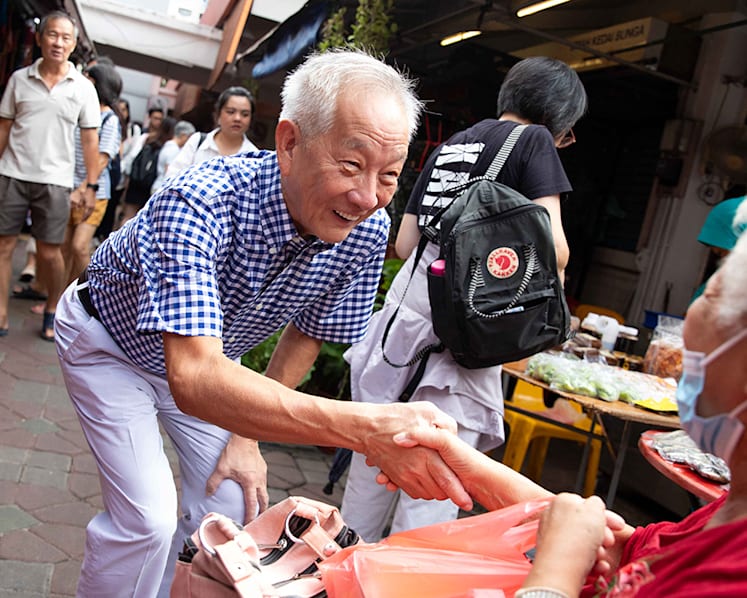
Mr Ng added that if one were to look at the “history of our leaders in Singapore”, such as Goh and Hon, then they should take a more open stance towards accepting naturalised citizens.
“We should welcome people from other nationalities who want to come and live in Singapore and take up citizenship and contribute to the welfare of Singapore, either in political office, in presidential office, or as a citizen,” said Mr Ng.He added that Singapore is in fact “very fortunate” to have people who come from overseas who admire the country and then want to become citizens.
His fiancee, Ms Lau, 45, came to Asia 20 years ago and has lived in Malaysia and China, he said.
“And then, finally, she came to Singapore 18 years ago… And she discovered that Singapore is where she wants to live for the rest of her life,” said Mr Ng. “So she decided to give up her Canadian citizenship to become a Singapore citizen.”
Mr Ng was also asked by the media if he had been trying to build up the public’s impression of Ms Lau over the first few days of the hustings.
In recent interviews, Mr Ng said that when he first told Ms Lau about his bid to become president, she had expressed concern over whether she could be a “liability” to his campaign, given the questions they would face over their 30-year age gap.
Mr Ng said that he did not need to help Ms Lau build an impression.
“Sybil is here today. You can meet her. You can talk to her. You get to take photographs with her and find out the person she is, so I don't have to build up a good impression,” he said.
“When you say you build a good impression, you mean to look good. We don't have to look good, we want to be good.”
THE TIME FOR A NON-PARTISAN PRESIDENT
During his visit to Ang Mo Kio Central Market and Food Centre in the evening, Mr Ng turned to the topic of non-partisanship, saying that 2023 is the year that Singaporeans can and should vote in a truly non-partisan President, and that doing so would help to attract more good non-partisan presidential candidates in future.
He noted that back in 1993, when Singapore held its first presidential election, the system was untested and there was a shortage of capable people so a compromise had to be made to the spirit of the Constitution.
“We were just trying to comply with the letter of the law," he said. "Mr Ong Teng Cheong resigned from the People's Action Party shortly before he contested and since then, Mr S. R. Nathan was endorsed by the People's Action Party — two walkovers, he was not elected.”
Mr Ong was President from 1993 to 1999 and Mr Nathan from 1999 to 2011.
Mr Ng added that it is more important than ever for Singapore to have a President who has never belonged to, nor is backed by, any party, because politics today has become "highly contestable".
While that is not a bad thing to an evolving democracy, he said, it means that the ruling party is under "tremendous pressure" to win people's support.
"And so we now run a very high risk that the governing party, in order to hold on to power, might resort to populist policies."
This could mean spending more while reducing taxes to defend its share of the vote, he added.
“We must not have a President who is beholden to the governing party or the opposition party... Only a non-partisan President will have the strength and the steel in the spine to veto populist policies which will erode our reserves,” said Mr Ng.
When asked by the media what questions he would ask if he received a request by the Government to unlock the reserves, Mr Ng said: "I’m a professional in this business, about the reserves. I spent 45 years investing our reserves, building up the results, helping to build up the capability of the GIC.”
He posed a hypothetical situation in which the Government had a request to spend S$50 billion of Singapore’s reserves.
Mr Ng said the first question he would ask is why, and if he found the answers unsatisfactory, he would “veto such a request”.
Even if Parliament overrides his veto, it would make the news, he said.
“The people of Singapore will know that I've raised a warning light, people all over the world will know that the President has vetoed the Government's request and hopefully that will be enough to stop a possible raid on our reserves.”
He added that thus far, good and capable people perceive that unless they are endorsed by the governing or opposition parties, they stand no chance in the presidential race.
But if he were to be elected, it would establish a principle that the President should not have come from any party, and more capable and non-partisan candidates would feel confident to step forward in future elections, he added.




