PM Lee urges G20 leaders not to ditch multilateral trade deals
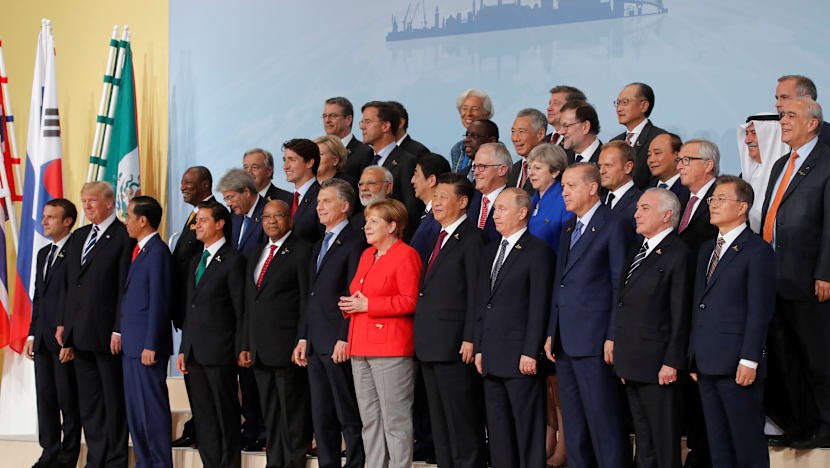
Singapore's Prime Minister Lee Hsien Loong takes a group photo together with other attendees and world leaders at the G20 summit. Photo: Reuters


HAMBURG — With the pushback against globalisation resulting in a shift by some countries towards bilateral trade agreements, Prime Minister Lee Hsien Loong has urged global leaders at the G20 summit not to abandon the multilateral model, which is critical to small countries like Singapore.
Small countries, especially, prefer multilateral trade arrangements because they are a “more comprehensive strategy for countries to cooperate for the common good”, said Mr Lee on Friday (July 7). They give countries “more scope to make trade-offs between different sectors and reach win-win deals”.
Mr Lee was speaking on global growth and trade at a working session at the summit, which brings together leaders from 20 of the world’s major economies including the United States, the European Union (EU), China, Indonesia, Brazil and Canada. The G20 countries account for three-quarters of global trade.
Singapore is not a G20 member, but is an invited guest representing the Global Governance Group, an informal coalition among United Nations member states that speaks up for the interests of small and medium-sized countries.
Mr Lee noted that many major trading countries have reaffirmed their support for a multilateral model. “This is courageous politically and very important to prevent tit-for-tat responses setting off a downward spiral," he said.
The EU and the Association of Southeast Asian Nations Economic Community are examples of countries working multilaterally with one another, and Mr Lee said the “ideal” of multilateral trade is to use the World Trade Organization (WTO). With 164 members, however, reaching deals at the WTO has become difficult and time-consuming, although it still does “valuable” work – such as the Trade Facilitation Agreement that came into force in February, he said.
The WTO Ministerial Conference will take place in Argentina at the end of the year. Mr Lee called on G20 leaders to help contribute to its success, by focusing on issues where convergence is likely and taking “meaningful steps” to support a multilateral trading system.
International trade has been an engine of growth and prosperity for all countries but its benefits have been unequally distributed, resulting in workers and unions in some countries anxious about jobs and becoming anti-trade, he said.
Trade brings “huge” economic benefits, he stressed. “There will be pluses and minuses within each country, but these can and must be squared off by governments through domestic policies, adjustment packages and political understandings,” he said.
Mr Lee did not mention specific countries in his speech. But notable pushbacks against globalisation include Britain’s decision to exit the EU and United States President Donald Trump pulling his country out of the 12-nation Trans Pacific Partnership (TPP) trade deal negotiated under the Obama administration, saying he would only negotiate trade deals with individual countries. He had blamed international trade deals for job losses. The TPP had included Singapore, Japan, Australia and Chile, among other countries.
Mr Lee is expected to have a bilateral meeting with Mr Trump on Saturday. It will be their first face-to-face encounter after two telephone conversations.
Mr Lee met Dutch Prime Minister Mark Rutte on the sidelines of the G20 summit on Friday. Both reaffirmed excellent bilateral relations and agreed to step up cooperation, including in cybersecurity, according to the Singapore Prime Minister’s Office. They looked forward to the early ratification of the EU-Singapore Free Trade Agreement and reiterated their support for an open international trading system.
On Thursday, Mr Lee met German Chancellor Angela Merkel in Berlin and Chinese President Xi Jinping in Hamburg.