







Public sector must be flexible, able to experiment: DPM Teo
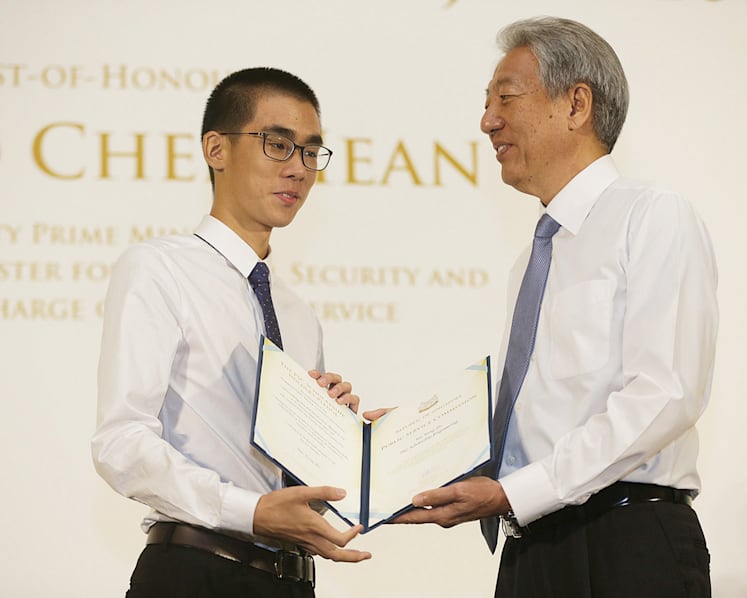
Nineteen-year-old Tan Yong Zhi, a recipient of PSC Scholarship (Engineering), receiving the scholarship from Deputy Prime Minister Teo Chee Hean at the award ceremony yesterday. Tan did an internship at the SCDF, where he saw them use robotics to aid firefighting efforts without requiring manpower. Photo: Wee Teck HIan


SINGAPORE — The Public Service must be allowed to challenge the status quo so that it can respond quickly to the constantly changing environment, said Minister-in-charge of the Civil Service Teo Chee Hean yesterday.
He also expressed the Government’s commitment to create a conducive space for public servants to innovate.
To harness opportunities brought by rapid advances in technologies, there is also a need to develop a stronger engineering core within the Public Service, said Mr Teo in his speech at the Public Service Commission (PSC) scholarship award ceremony for 71 recipients, held at the Grand Copthorne Waterfront Hotel.
As part of efforts to promote innovation in the public sector, the Government is looking into streamlining processes such as procurement and creating new spaces for experimentation.





Mr Teo, who is also the Deputy Prime Minister, cited “regulatory sandboxes” as an example.
They were introduced to public sector agencies for officers to experiment with new regulatory methods before making changes to existing regulations or laws.
At the same time, public servants also need to spot “pattern-breaks” early, so that the Public Service can act fast to adjust its policies and to implement necessary measures to test new ideas and “scale up good solutions for the benefit of Singapore and Singaporeans”.
Focusing largely on the need to develop talents in the engineering field, Mr Teo said that the PSC Scholarship (Engineering), introduced last December, is one way to strengthen Singapore’s engineering leadership pipeline.
Those who received the scholarship will be groomed to be specialist leaders, undertaking stretch postings in one of three engineering clusters: Defence and security; information and communications technology and smart systems; as well as infrastructure and environment.
“The technical demands of their postings will sharpen their domain skills and groom them into experts in their selected engineering field,” said Mr Teo.
This, he added, will bring valuable high-tech expertise to the Public Service and advance its capabilities to address challenges in defence technology, climate change and efforts to transform Singapore into a Smart Nation.
Among those who received their scholarships yesterday was 19-year-old Tan Yong Zhi, who is also one of the eight pioneer recipients of the PSC Scholarship (Engineering).
Tan said that his interest in engineering was sparked at the age of nine, after his father bought him a kit which allowed him to construct robots.
After graduating from NUS High School of Mathematics and Science last year, Tan did an internship at the Singapore Civil Defence Force, where he saw them use robotics to aid firefighting efforts without requiring manpower.
Tan, who plans to pursue a computer engineering degree in the United States, said: “As we are moving to become a Smart Nation, it’s better for the Public Service to develop its own technology, instead of relying on third party services.”
PSC chairman Eddie Teo, who also spoke at the event, noted that 17 scholarship recipients chose to study subjects related to either science, technology, engineering or mathematics.
“The favourable response from the applicants showed that the younger generation is eager to contribute to our goal of being a Government at the forefront in using technology to improve the lives of our people,” he added.




