







Singapore's rough sleeper count dips slightly in 2025; MSF to launch S$450,000 fund to tackle homelessness
Nearly half of rough sleepers polled said they had a place to return to — such as a public rental flat, a property they own, or the home of a family member, relative or friend.
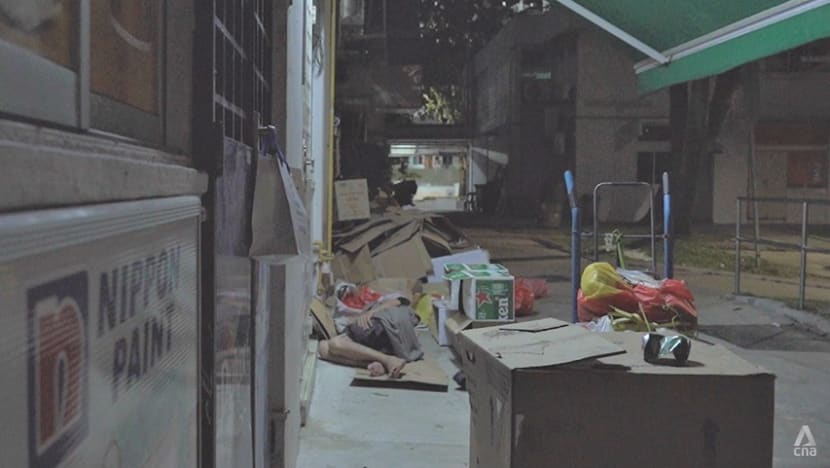
According to a survey done by MSF, almost half of respondents cited disagreements with family members, friends, or co-tenants as the reason they were sleeping rough.

This audio is generated by an AI tool.


SINGAPORE: The number of rough sleepers counted on a single night fell by 6.4 per cent in 2025 compared with 2022, according to a report released by the Ministry of Social and Family Development (MSF) on Friday (Jan 9).
Among other measures, MSF will launch a S$450,000 (US$349,896) fund to help community organisations tackle homelessness. Applications open on Apr 1, 2026, the ministry said.
A total of 496 rough sleepers were counted during a single-night street count on Jul 18, 2025, a slight decrease from the 530 counted in 2022.
Rough sleepers are defined as individuals who sleep in public spaces, regardless of whether they have housing. This includes those without a home as well as those who have a home but are unable to return to it.
Homeless persons are those without access to adequate housing, and not all homeless persons sleep rough – some may be staying in temporary accommodation such as shelters while seeking long-term stable housing.
Speaking to the media at the Yio Chu Kang transitional shelter, Senior Parliamentary Secretary for Law, Social and Family Development Eric Chua said it is a common misconception that rough sleeping is a crime, and he emphasised the importance of showing care.
He encouraged members of the public to look at rough sleepers with a “different lens” and that they should not be seen as a "menace to be dealt with”.
“If they're comfortable, they may even lean forward to talk to our rough sleeping friends on the streets (and) lend some help.”
SLIGHT DECREASE IN ROUGH SLEEPER NUMBERS
Volunteers initially recorded 573 observations during the street count, but 77 were excluded as the individuals either did not meet the criteria of a rough sleeper or were confirmed to be foreign nationals, MSF’s report showed.
All Urban Redevelopment Authority (URA) planning areas in Singapore that were safe and accessible on foot at night were covered, which means that islands outside of mainland Singapore, cemeteries, military zones, water catchment areas, private housing estates with no public pavilions, gated residential areas, and restricted, unsafe or poorly lit industrial areas were excluded from the count.
MSF said that this point-in-time count provided a comprehensive and accurate snapshot of the geographical distribution of rough sleepers on a single night, and also minimised duplicate counting.
Giving a breakdown, the report identified rough sleepers in 35 out of 36 URA planning areas, with Tengah being the exception.





The highest numbers of rough sleepers were recorded in Bukit Merah and Jurong West, with 39 each, followed closely by Bedok with 38. In comparison, Kallang had the highest count in 2022, with 50 rough sleepers.
The number of areas with more than 20 rough sleepers also decreased marginally from nine in 2022 to 8 in 2025.
This reflects a “declining concentration” of rough sleepers across URA planning areas, said the MSF report.
The majority of rough sleepers counted, or 85 per cent, were male. More than half were over the age of 50, 36 per cent were between 31 and 50, and 6 per cent were aged 30 and younger.
Over 800 volunteers from the public sector, community organisations in the Partners Engaging and Empowering Rough Sleepers network, and members of the public took part in the count.
A survey of rough sleepers was also conducted to find out more about what brought them to the streets, the types of locations they chose and the challenges they face.
The month-long survey began on Jul 27, 2025, and included input from 128 rough sleepers – or 26 per cent of the number from the Jul 18 street count.
MSF’s survey found that 77 per cent of respondents had been sleeping rough for more than a year, and 70 per cent said it was not their first time sleeping rough.
“This suggests that some may be entrenched, possibly due to the complex and interconnected issues they face, and their reluctance to seek help despite the various support offered,” the report said.
Despite this, nearly half of those surveyed (47 per cent) had a home to return to.
This includes public rental flats (17 per cent), purchased properties (16 per cent) and homes belonging to a family member, relative or friend (13 per cent) that they could live in.
“These findings highlight that rough sleeping may not always be driven by a lack of housing options but can stem from complex personal circumstances that make returning home untenable,” the report noted.
Almost half of respondents (49 per cent) cited disagreements with family members, friends, or co-tenants as the reason they were sleeping rough.
Around 29 per cent of respondents reported difficulties securing or maintaining housing, while 20 per cent of them cited financial struggles.
On their employment-related status, 65 per cent of respondents had some form of employment, with 35 per cent working full-time and 20 per cent holding part-time jobs.
More than 70 per cent of those with employment reported income earnings of less than S$2,000 (US$1,558), while 20 per cent earned S$2,000 to S$3,999.
Of the 32 per cent who were unemployed, 27 per cent indicated that they were actively looking for work.
A majority of respondents, 95 per cent, indicated that they regularly slept rough in the location where researchers had spoken to them.
“This indicates a preference to be at or near familiar surroundings,” MSF said.
When asked about staying in a shelter, 80 per cent of respondents indicated that they had never stayed in one. Of the 20 per cent that have done so, more than half said they were unreceptive to staying in a shelter or residential home again.
Meanwhile, 57 per cent of respondents had the desire to move into long-term housing.
These include a HDB rental flat (49 per cent), purchasing their own home (7 per cent), or renting a room or house in the open market (5 per cent). Respondents could select more than one housing option that they hope to move into.
Among the 52 per cent of respondents who indicated that they would continue sleeping rough, two-thirds also indicated that they had other accommodation plans.
“This suggests that many still aspire to have their own home and view rough sleeping as a temporary arrangement,” the report said.
EFFORTS TO SUPPORT ROUGH SLEEPERS
To address the homelessness issue, MSF said it will launch a new S$450,000 fund to work with organisations to trial solutions that address the underlying causes of rough sleeping and help rough sleepers work towards housing stability.
The new fund, named the Partnership to Tackle Homelessness (PATH), will begin taking applications from organisations to fund trials and initiatives that provide support for rough sleepers from April 1, 2026.
The ministry said such initiatives can help to provide rough sleepers with medical and psychological aid, as well as social support.
MSF has also partnered with two transitional shelters, Transit Point at Yio Chu Kang and Transit Point at Jalan Kukoh, to redesign shelter units to give occupants more privacy and storage space.
“These enhancements aim to encourage more rough sleepers to take up shelter support,” said the ministry.
Other efforts include facilitating ComCare financial assistance through MSF’s social service offices, linking individuals to employment opportunities via Workforce Singapore, and providing rental support under HDB’s Public Rental Scheme.




