







S$66m set aside to explore ways to make S’pore more liveable, including using space underground and at sea
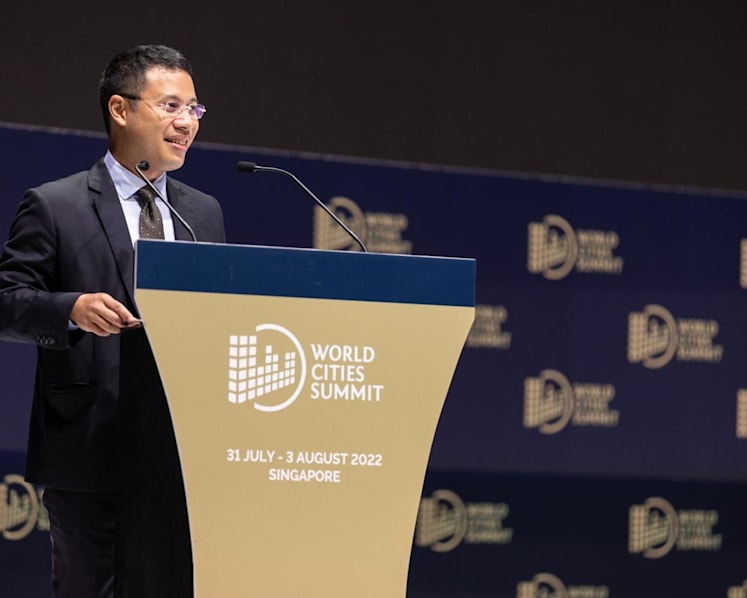
Minister for National Development Desmond Lee delivering his opening address at the World Cities Summit on Aug 1, 2022.
SINGAPORE — A sum of S$66 million will be set aside over the next five years to support more research aimed at establishing Singapore as a liveable and sustainable city, with more than half going towards exploring ways to free up land space by going underground or using the sea.
The allocation of the funds to the Cities of Tomorrow (CoT) research and development programme was announced by Minister for National Development Desmond Lee on Monday (Aug 1) during his opening address on the second day of the World Cities Summit.
The goal of the CoT programme, launched by the Ministry of National Development (MND) in 2017, is to identify challenges that cities face and develop solutions to address them.
The new funds are over and above the S$110 million allocated to the programme earlier this year during MND's Committee of Supply debate in March.





Speaking at the biennial summit held at the Sands Expo and Convention Centre, Mr Lee said: "As new challenges come our way, we will need new and creative solutions to address them.”
He added that the stress of a difficult situation, such as the Covid-19 pandemic, can provoke an innovative response.
“In many cases, technology can be an important enabler,” he said.
In March, the MND announced that S$110 million will go towards supporting research related to enhancing liveability and sustainability through the built environment, and supporting a city in nature, for example.
Providing more details of how the S$66 million sum will be allocated on Monday, the MND said that it will focus on three other areas:
- S$35 million will go towards exploring “ways to create underground and sea space more cost-effectively, resiliently and productively” to free up land space to support live-work-play activities
- S$18 million will go towards developing advanced multi-disciplinary urban planning solutions to help planners and policymakers deliver more targeted planning outcomes and services to meet the needs of residents
- The final S$13 million will be used to “enhance maintenance and maintainability” of ageing infrastructure by developing advanced building inspection and repair systems, as well as durable building materials to address the challenges ageing infrastructure poses
REDEFINING CITIES AFTER THE PANDEMIC
Speaking during the same session as Mr Lee was Senior Minister and Coordinating Minister for National Security Teo Chee Hean, who touched on how the pandemic has highlighted the challenges that cities face, in terms of how to be more resilient, sustainable and cohesive, among other topics.
Mr Teo spoke about the need for a “new paradigm” in city planning, yet he acknowledged that the path ahead is not a simple one as cities face several dilemmas.
For instance, he said there is the question of whether cities should be more concentrated or distributed.
A concentration of people and resources in urban centres, he said, continues to bring many advantages.
For instance, cities reap economies of scale in efficiently producing, supplying and exchanging a wide variety of goods and services for a large number of people.
A concentration of people, economic activities and knowledge also sparks new ideas and innovation, which drive economic growth, create new jobs and attract more people to the city, said Mr Teo.
“However, we are all too familiar with the problems that afflict cities,” he said.
This includes overcrowding and traffic jams, long and crowded commutes, and higher levels of stress and health issues.
“As the Covid-19 pandemic has shown, while urbanisation is designed to increase opportunities for interaction, this also increases contact and exposure, and the likelihood of transmission and evolution of infectious diseases,” said Mr Teo.
“Cities can become incubators and multipliers for disease outbreaks.”
The question then, he said, is how society can “reap the benefits of urbanisation, without the disbenefits of concentration”.
Hence, he said a “key way to push the boundaries and unlock green growth opportunities” is to invest in research and development, and catalyse innovative and sustainable urban solutions.
“Cities can serve as a ‘living laboratory’ for companies and researchers to develop, test and validate clean and sustainable technologies in real-world settings,” said Mr Teo.
Several panelists similarly spoke about how the pandemic has highlighted the need to relook how cities are planned.
The panel discussion was moderated by Professor Simon Tay, chairman of the Singapore Institute of International Affairs, and it involved:
- Ms Patricia de Lille, South Africa’s minister of public works and infrastructure
- Ms Maimunah Mohd Sharif, the executive director of UN-Habitat, a United Nations programme for human settlements and sustainable urban development, and
- Dr Chi Young Cho, the president and chief innovation officer at Hyundai Motor Group
The World Cities Summit, now in its eighth edition, will be held at Marina Bay Sands until Wednesday.




