





Employers urged to share gains with workers as Singapore's economy outperforms: National Wages Council
Lower-wage workers earning up to S$2,800 a month should get wage increases of 6 to 8 per cent, depending on how their employer has performed.
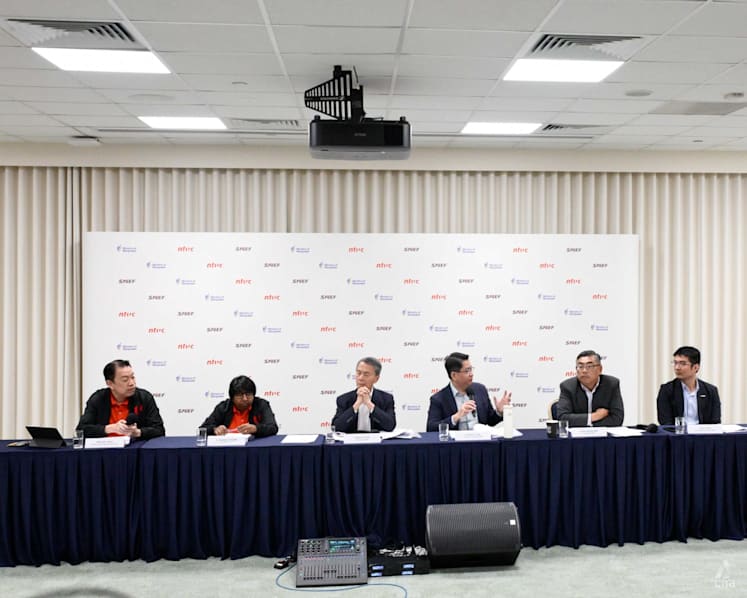
(Left to right) NTUC assistant secretary-general Melvin Yong, NTUC president K Thanaletchmi, National Wage Council chairman Hsieh Fu Hua, Manpower Ministry Permanent Secretary Stanley Loh, SNEF president Kuah Boon Wee and SNEF chief executive Hao Shuo during a press conference at the Ministry of Manpower on Oct 19, 2026. (Photo: CNA/Wallace Woon)

This audio is generated by an AI tool.


SINGAPORE: Employers should take a "positive-leaning" approach to wage increases and share productivity gains with their workers, given Singapore's strong economic performance, the National Wages Council (NWC) said on Monday (Oct 19).
In its guidelines for December 2026 to November 2027, the council said firms that have performed well should reward employees through built-in wage increases and variable payments.
Those that have not done well “may exercise wage restraint”, with management leading by example, it said in a press release.
Productivity and business growth have been uneven across sectors, the council said, so employers should have the flexibility to calibrate wage increases based on their own performance and prospects, balancing rewards for employees against competitiveness.





“To ensure wages remain fair and competitive, employers should regularly review market wage benchmarks and adjust wage ranges accordingly where possible,” the council said.
NWC called on all employers to implement the flexible wage system in full, with both its annual and monthly variable components. The system lets firms cut costs rather than jobs in adverse conditions, and adjust wages quickly in an upturn to retain talent, it said.
LOWER-WAGE WORKERS
NWC said the national effort to uplift lower-wage workers must continue so that every worker benefits from Singapore’s growth. To narrow the gap with the median wage worker over this decade, their wages must consistently grow faster than the median wage, it said.
Employers that have done well have greater scope to share their gains, the council said, recommending a higher percentage range of increases and higher minimum dollar amounts.
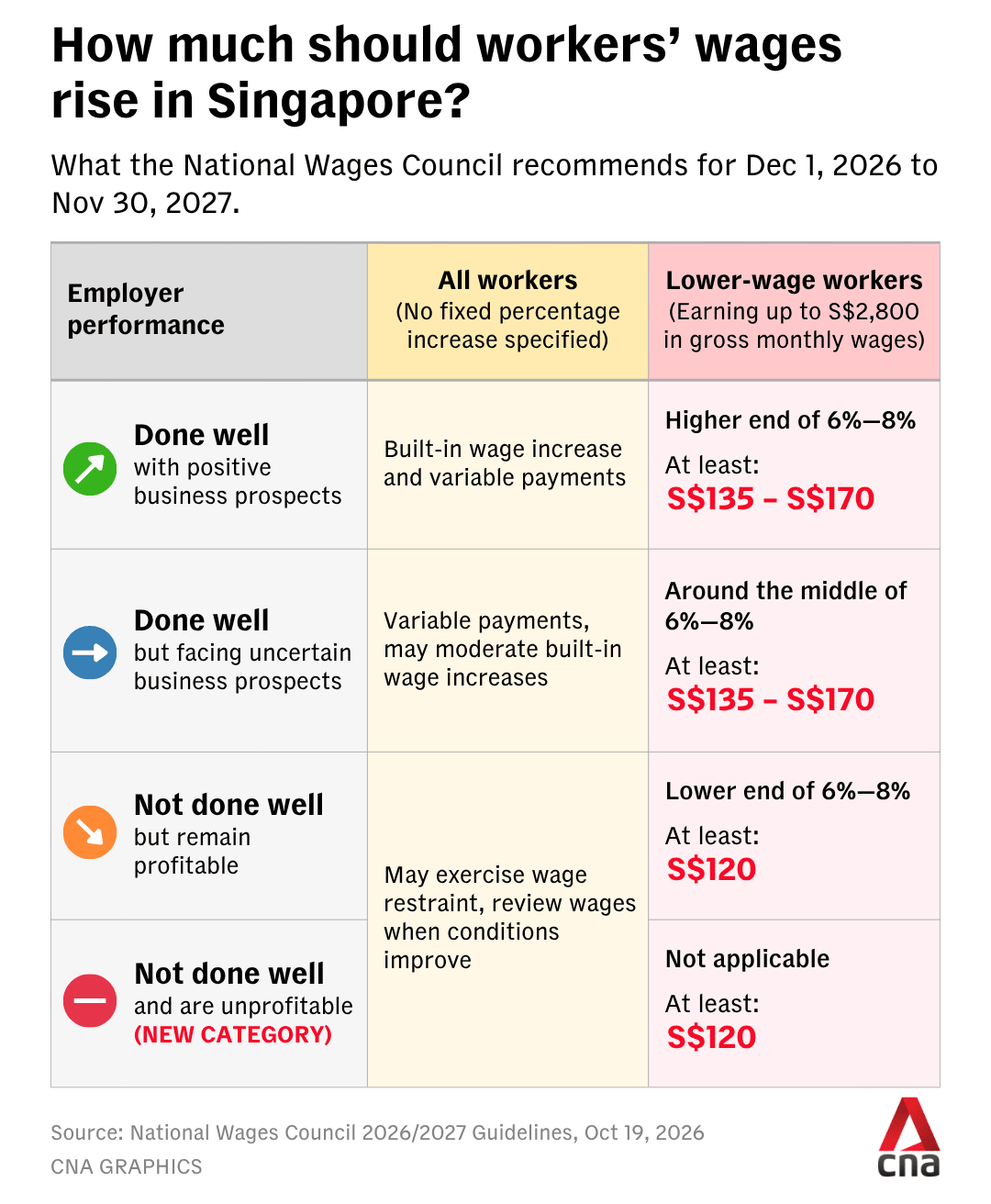
For workers earning a gross monthly wage up to S$2,800, employers that have done well and have positive business prospects should give a built-in wage increase at the higher end of 6 to 8 per cent of gross monthly wage, or at least S$135 to S$170, whichever is higher.
Employers that have done well but face uncertain prospects should give an increase around the middle of that range, or at least S$135 to S$170, whichever is higher.
Employers that have not done well but remain profitable should give an increase at the lower end of the range, or at least S$120, whichever is higher.
For the first time, the guidelines also cover firms that did not do well and are unprofitable. They should give a built-in increase of at least S$120, the council said.
“If business prospects subsequently improve, employers should review wages and consider further wage increases for their lower-wage workers,” it added.
The government has accepted the council’s recommendations.
“The NWC’s recommendations for lower-wage workers provide meaningful wage uplift for lower-wage workers, while allowing for flexibility for employers based on economic and business conditions,” the Ministry of Manpower (MOM) said in a press release.
At a press conference on Monday, the ministry's permanent secretary Stanley Loh said adoption of the guidelines last year was a little over 25 per cent as companies adjusted to expanded coverage and higher recommendations. The adoption rate surpassed 70 per cent at its peak, he said.
NWC chairman Hsieh Fu Hua emphasised that the figure did not mean the remaining 75 per cent of employers did not bother to do anything for lower-wage workers. They failed to provide wage increments in line with the recommendation, he said, which is why the new category was introduced in the hope of raising adoption.

AI ADOPTION AND TRAINING
NWC called on employers and workers to build capabilities to thrive in an economy driven by artificial intelligence, which can raise productivity, create new sources of value and strengthen Singapore’s competitiveness.
It said workers should build AI-relevant skills to access new opportunities, and develop their AI literacy alongside human skills and judgment.
Employers should prepare their employees for changing job functions and support their training, while redesigning jobs and investing in their workforce through available support. They should also set aside an adequate budget for continuous education and training across all career stages, and strengthen their human resource capabilities to support workplace transformation, the council added.
The proportion of employers providing structured training to employees fell from 66.4 per cent in 2024 to 64 per cent last year, while the proportion of employees receiving structured training also declined, from 52.6 per cent to 48.1 per cent over the same period.
“The NWC also recognises that some workers face greater employment barriers and challenges, which may in turn impact their career progression and corresponding wage growth,” it said, emphasising the need for inclusive employment practices.
“Employers and employees should also engage in structured career conversations to align career aspirations with business needs and identify reskilling or upskilling opportunities."
National Trades Union Congress president K Thanaletchimi said the labour movement supported the recommendations, but called on employers to provide "protected training time" so that workers can pursue training without having to choose between learning and their work responsibilities.
INFLATION CONCERNS
At the press conference, Mr Loh said the council weighed factors including economic growth, sector growth and inflation in crafting the guidelines.
He said inflation is “a bit higher but manageable”, and additional measures such as one-off annual payments are not needed. The government has also rolled out other support to help citizens with the cost of living, he added.
Mr Hsieh said that since economic and business performance is uneven, workers are bound to be unevenly compensated.
“But in the longer term, the longer goal is, of course, for all to be lifted, which is why we will observe and we try and address every part of the economy,” he said.
He said the council will also address senior employment, though not this year.
Singapore National Employers Federation chief executive Hao Shuo said real gross monthly income rose in the first half of this year.
“Over 10 years, you are seeing real wage growth. So although there are concerns over inflation, I think the outcome speaks for itself,” he said.