







'Unnerving, scary': S'poreans in Japan jolted by deadly Jan 1 quake, alarmed at warnings of more to come
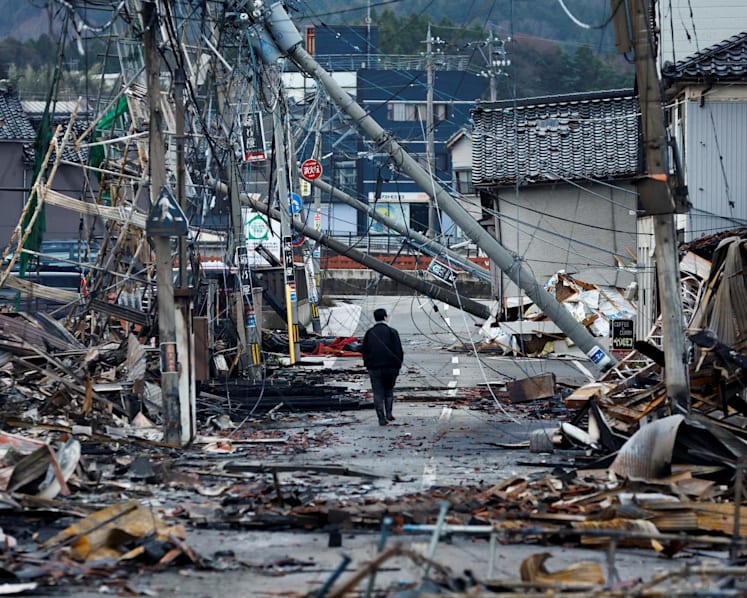
A man makes his way along Asaichi-dori street, which burned down due to a fire following an earthquake, in Wajima, Japan, on January 4, 2024.


JAPAN/SINGAPORE — Singaporean Ryhan Mohd Yazid quickly realised Monday's (Jan 1) devastating earthquake in Japan was far more serious than the many quakes she has felt during her four years in the country.
Even though Ms Ryhan, 30, was at home in Kyoto, 375km from the epicentre, it soon became apparent that it was an unusually powerful earthquake.
“At first, I assumed it was just another earthquake, but my metal hangers were clanking against one another, and it went on for longer than usual,” the graduate student told TODAY.
Alarmed, she turned on the television to a news channel and heard the anchor using language reflecting a dire sense of urgency.





“The newscaster was almost shouting, which is extremely rare for news broadcasts in Japan.”
TODAY spoke to several Singaporeans living in Japan, and like Ms Ryhan, they said that the New Year’s Day earthquake was the strongest they had felt in their years of living there.
The initial 7.5-magnitude quake was followed by a vast number of smaller aftershocks.
The Japan Meteorological Agency said that as of 12pm (Japan time) on Wednesday, there had been 499 quakes with a magnitude of 1.0 or higher near the epicentre.
However, most were relatively mild, with a seismic level of below 3.0.
“People here are upset, but they are still going about their daily lives as best as possible,” Ms Ryhan said of the sense of palpable gloom among the community living with her.
The initial quake tore through the Ishikawa prefecture in central Japan, starting from the northern Noto Peninsula.
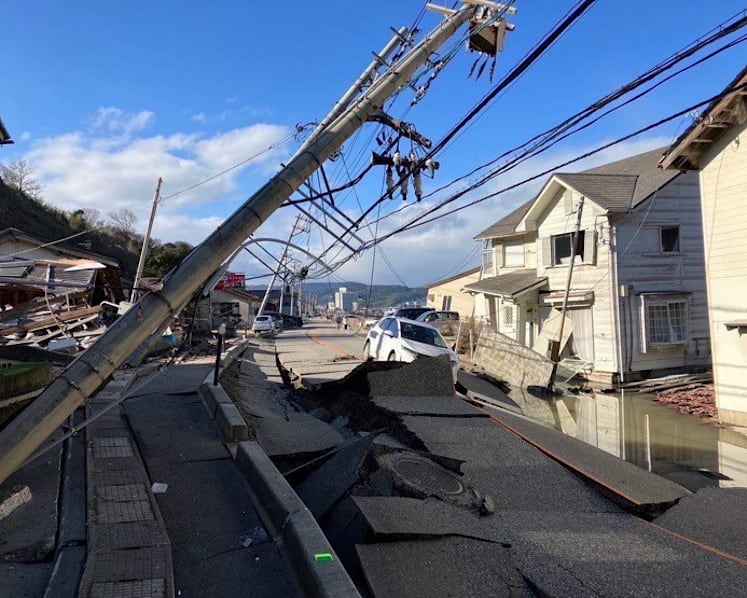
The string of earthquakes were followed by tsunami waves that were more than 1m high, sparking fires and devastating homes. The disaster has claimed at least 62 lives.
TREMORS FELT IN OSAKA, TOKYO
Another Singaporean, PhD candidate Daniel Tan, 31, who lives in Osaka, felt the tremors and learnt that it was a 4-magnitude quake — the biggest earthquake he has experienced so far in Japan.
“My house is on the sixth floor and I could feel the entire building shaking. Larger electrical appliances like my television and standing fan were rocking back and forth.
“This continued for another minute or so before subsiding,” he said, adding that nothing was damaged.
Content creator Kelvin Tan, who goes by the name "Mayiduo", 32, said that he was in the toilet at the Legoland Discovery Centre when his “vision started to shake”.
"It felt like I was dizzy, yet I was clear-headed," he said.
Mr Tan, who was travelling with his 31-year-old wife and four-year-old son, said that his wife went into panic mode and started calling for him to carry their son and run.
"The staff members at the centre were calm while guiding us to the exit paths. The only downside was that we didn't understand Japanese, so we could only follow the crowd," he said.
Mr Tan added that no evacuation warnings were issued in Osaka. "At the moment, the plan is to continue with our itinerary in the city. But should the situation worsen, we will definitely be flying back to Singapore."
Another Singaporean, Ms Kelly Lam, 27, was in her hotel room in Osaka with her boyfriend when Monday's earthquake struck. The couple was on a holiday in the Kansai region.
Ms Lam said she was shocked that she could feel the tremors in Osaka when the earthquake happened in Ishikawa, some 420km away.
"The entire shaking thing was quite scary because I have never experienced anything like this. We don't have any plans to change our itinerary for now, but we're being more alert to news and updates about the earthquakes," she said.
As of Wednesday, Ms Lam was in Kyoto.
Business consultancy and media startup founder Rachel Leng, 33, was at home in Tokyo at the time of the incident, some 455km from the epicentre. She has lived in Japan for five years.
“The quake caught my attention when I noticed the stationery items on our desks trembling. Being on the 20th floor, the movement escalated swiftly," she said.
“The entire building started swaying, and that's when I began feeling dizzy and nauseous even when staying still. It was quite an unnerving experience.”
Despite earthquakes being common in the country, this latest one immediately stood out for Ms Leng due to the prolonged swaying and multiple tremors.
“Even after about 10 minutes, the building was still swaying, and there were multiple rounds of tremors, which was unusual based on our prior experiences,” she said.
Back in Kyoto, in the aftermath of the earthquake, Ms Ryhan peered out of her window to see if any of her neighbours were headed to the evacuation spot.
“We did not need to evacuate and just stayed indoors.
“I am better now but was definitely shaken. Although, to be honest, I am more worried for people in Ishikawa and those along the Sea of Japan because I have friends whose families live in that area," she said.
“But my friends said their families are fine, so that’s a good thing.”
In Tokyo, Ms Leng said that the buildings in the vicinity of Tokyo remained intact. “However, the elevators in my apartment building were not functioning for about eight hours.”
This made it difficult for others to gain access in and out of the building and their apartments unless they used the emergency stairs.
“Being in one of Tokyo’s many high-rise buildings, practically everyone was confined within their apartments,” she said, adding that the temporary restriction eerily resembled the lockdown experience during the Covid-19 pandemic.
Asked if she knew anyone affected by the quake, Ms Leng said that some of her company’s clients were in the Ishikawa and Toyama prefectures, which were the hardest hit by the quake.
“One of our clients in Wajima City, (there was) extensive damage (to their property). Wajima City was perhaps the hardest hit in the Noto region by the tsunami and earthquake.
“It was heartbreaking when they shared distressing images where their stores and homes were completely destroyed,” she added.
Thankfully, nobody was hurt.
Singapore's Ministry of Foreign Affairs said that there have been no reports of Singaporeans affected by the earthquake.
However, in view of possible aftershocks, the ministry advised Singaporeans to "defer travel to the affected regions, remain vigilant, take all necessary precautions for their personal safety and heed the instructions of the local authorities".
Aftershocks were still occurring in Japan on Wednesday, with the latest one in Ishikawa at 6.48pm (Japan time).
The magnitude recorded was 4.8.
Ms Ryhan recommends that Singaporeans in Japan download the Nerv Disaster Prevention mobile application, which gives real-time data on disasters such as earthquakes, tsunamis, volcanic eruptions and floods.
FEAR OF SEVERE AFTERSHOCKS
Mr Tan said that things in Osaka returned to normal relatively quickly.
“But the earthquake has brought back painful memories for people living in the Tohoku region who experienced the 2011 tsunami.”
That earthquake, which struck Japan on March 11 in 2011, was the most powerful earthquake ever recorded in the nation. Nearly 20,000 lives were lost in the disaster.
“Everyone is still quite shocked, though I get the sense that they have no choice but to look forward,” Mr Tan said of the situation in Osaka.
However, he noted that the only fear now was the prediction that another earthquake of the same magnitude might happen within a week as the tectonic plates settle.
“Hopefully, (the prediction) does not happen. But I think everyone is much more shocked by the aircraft collision at Haneda Airport right now.”
Tragedy struck at Tokyo's Haneda airport on Tuesday as a Japan Coast Guard aircraft collided with a Japan Airlines passenger plane on the ground, resulting in the deaths of five people on the coast guard aircraft.
The coast guard plane was preparing to fly to Ishikawa prefecture to deliver supplies after the earthquake.
Japanese Transport Minister Tetsuo Saito said that all 379 passengers and crew on the plane, which caught fire following the collision, were successfully evacuated.




