







Singapore's wealth inequality higher than income gap, comparable to other advanced economies
Property and CPF balances form the bulk of household wealth in Singapore, especially for lower-wealth households.
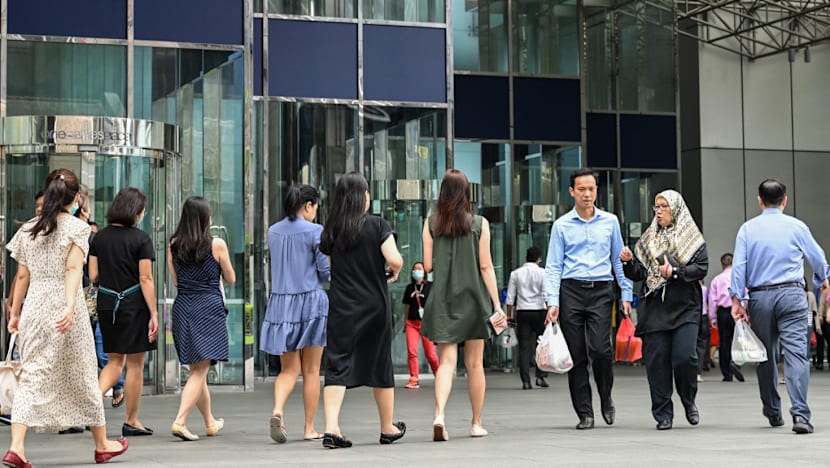
A lunchtime crowd is seen at Raffles Place in Singapore on Feb 16, 2023. (File photo: AFP/Roslan Rahman)

This audio is generated by an AI tool.


SINGAPORE: Wealth inequality in Singapore exceeds income inequality, and is broadly in line with other advanced economies, the Ministry of Finance (MOF) said on Monday (Feb 9).
The ministry released new findings on income growth, inequality and social mobility trends based on expanded data that includes household market income and wealth for the first time. The data was published in the Key Household Income Trends 2025 report by the Singapore Department of Statistics (Singstat).
The data indicates that the government's policies have worked well over the past decade, said Prime Minister Lawrence Wong in a video message online after the report's publication.
"But amid new headwinds, keeping Singapore moving in the right direction will require more effort and a willingness to adapt and do things differently."
Wealth inequality measures how unevenly net worth – such as property, savings and investments – is distributed across the population. This differs from income inequality, which tracks the distribution of earnings. Both are measured using the Gini coefficient.
Wealth tends to be more unequally distributed than income because assets accumulate over time and can be passed down through generations, while income represents what people earn in a given period.
Previous reports measured only household employment income. The 2025 report now captures "market income" – encompassing both employment earnings and non-work income sources such as investments and rental income, Singstat said.
The expanded definition also includes households where no members are employed, reflecting Singapore's growing affluence and ageing population.
With more retirees and greater wealth accumulation, an increasing number of households derive income from non-employment sources, MOF said.
Some degree of underreporting and underestimation is expected for certain groups, especially wealthier households, because some non-employment income, such as income from investment or properties overseas, is collected through survey data only, the ministry added.
FIRST WEALTH DATA RELEASE
Singapore's wealth inequality coefficient stands at 0.55, comparable to estimates of other advanced economies like the United Kingdom, Japan and Germany, ranging from 0.6 to 0.7.
This marks the first time Singapore has published wealth data, though MOF acknowledged the challenges in measuring certain assets, including private company equity and overseas holdings.
“To the extent that wealth at the top of the distribution is underreported, measured wealth inequality would be underestimated,” the ministry said.
Globally, wealth inequality typically exceeds income inequality, MOF noted.
Across all resident households in 2023, property accounted for 56 per cent of household wealth, while Central Provident Fund (CPF) balances and other financial assets each represented 22 per cent.
For the bottom 20 per cent of households, property comprised 54 per cent of wealth and CPF balances made up 39 per cent.
Among the top 20 per cent, property held a 58 per cent share, CPF balances accounted for 15 per cent, and other financial assets made up the remaining 27 per cent.
SOCIAL MOBILITY SHOWS "GRADUAL MODERATION"
While most Singaporeans have experienced upward income mobility across generations, social mobility has shown signs of “gradual moderation” as the economy matures, said MOF.
Analysis of children born between 1978 and 1989 found that a high proportion of those from lower- to middle-income families earned more than their fathers.
However, among children born to fathers in the bottom 20 per cent of earners, the proportion who remained in that income bracket as adults increased across three five-year cohorts starting in 1978, 1982 and 1985.
Still, three in four children born into the bottom 20 per cent of households in the late 1970s and 1980s moved to higher income tiers in adulthood, said Mr Wong, who is also Finance Minister.
“Overall, this is an encouraging picture. But we cannot be complacent,” he added.




