







Creating puzzles to entertain their animals, it's Mandai zookeepers' turn to do the juggling
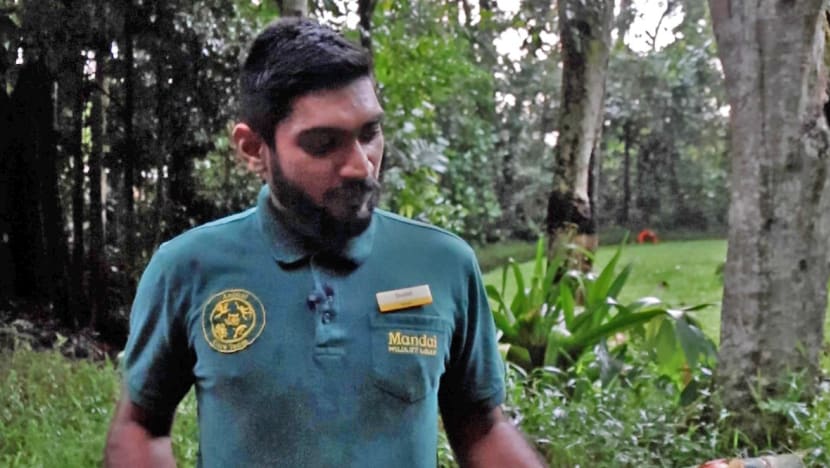
Zookeeper Lloyd Daniel Anthony holding up a piece of bamboo stuffed with food which is used as an enrichment activity.


SINGAPORE — Twice a night, the sloth bears are given a "puzzle" to solve: To extract an apple out of a bamboo stick. Succeed and they get to eat the apple.
It is not easy, looking at how their bodies get all contorted as they go about their task.
But it is how zookeepers like Lloyd Daniel Anthony keep the animals physically and mentally stimulated throughout the night.
"It tests their cognitive skills. The food is a huge motivator to keep them active," said the 31-year-old.





When he first joined the Night Safari about four years ago, they did such "enrichment" activities once every few days.
Now, he and other zookeepers have a daily schedule to ensure their animals are kept entertained with different puzzles that they create.
"It's hard to be constantly adjusting our routines in caring for the animals," Mr Anthony said. "But when we look at the research and understand why we are doing it, we adapt because we love our animals."
Mandai Wildlife Group constantly does research into animal welfare and behaviours to keep up with best practices.
This means that zookeepers and presenters at its four parks — Singapore Zoo, Bird Paradise, Night Safari and River Wonders — find their workload increasing and their job scope constantly changing.
This includes adopting new practices, such as enrichment activities for the animals, and needing to relearn skills.
Keeping up with this is no easy feat, said chief human resource officer Marcus Heng, as there are no zoological institutions in Singapore that Mandai Wildlife Group can "mirror".
It takes a page from other top zoos around the world such as the San Diego Zoo, Bronx Zoo and Chester Zoo, but largely relies on its in-house curators and life sciences team to research and identify skills employees need.
'NOT A CIRCUS'
Gone are the days when trainers get the animals under their charge to perform tricks to entertain visitors to the parks.
These days, the shows are put up for a purpose.
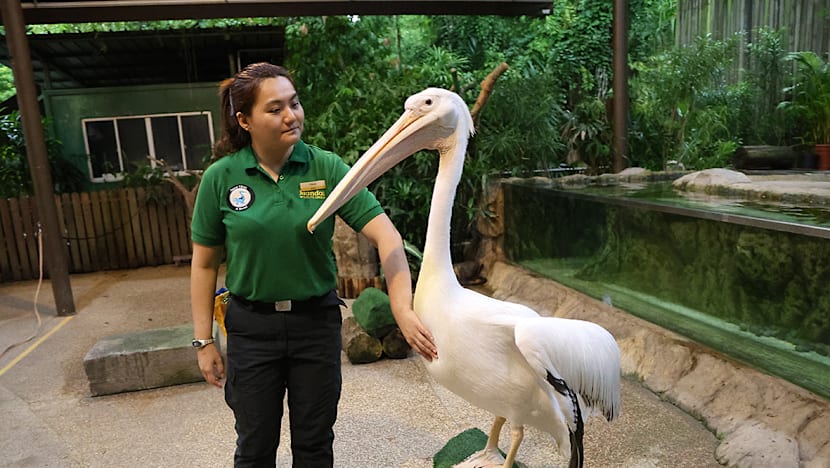
"I train behaviours, not tricks. Our animals are not circus acts," said Ms Fiona Goh, a senior trainer and presenter at River Wonders.
"The animals we showcase in our shows display behaviours typical to those they would have in the natural environment."
The 31-year-old illustrates this by getting some visitors to put their arms up during the Once Upon a River show. An Oriental Pied Hornbill then jumps from arm to arm, displaying how it moves from branch to branch.
While some may think showcasing an animal's natural behaviour requires less work as it may "come naturally", Ms Goh said this is not the case as it involves working closely with the animals to prompt them to showcase these behaviours.
"The behaviours we train them in also help us check on their wellbeing. Things like lifting their arm allow us to ensure they're physically healthy," she added.
Trainers and zookeepers also have had to change how they interact with their animals, even with simple things like calling their names.
"Once you call the animal's name, you have to make sure you reward them for it, so when you give instruction and use (the animal's) name, it doesn't lose its impact," said Mr Anthony, who learned this during a class on "positive reinforcement" as part of a development programme by Mandai Wildlife Group.
"So the relearning also made me realise that it's not just about what I want the animal to do, but reading their body language."
The zookeepers themselves spend hours behind the scenes doing research and initiating ways to improve animal welfare at the zoo.
For example, Mr Anthony had suggested providing water sources for the Malayan Tigers to defecate in.
"We realised that the Malayan Tiger would poop in the water trough, which was difficult to clean up. After reading up some manuals that researchers make on different species, we realised that (they do this) in their natural habitat to mask their scent," he said.
"So we started looking into providing them water sources and making adjustments to improve their levels of comfort, including in their back of house dens."
Back of house dens are the areas where the animals reside in when they are not in their exhibits.
While this means more work having to clean the water and changing it daily, for Mr Anthony the effort is worth it.
Similarly, when asked how she handles the workload and constantly evolving job scope, Ms Goh said: "The animals are like your children, so you want to do everything you can for them."




