







Singaporeans naive about fake news? No, just complacent and lacking awareness, says Edwin Tong
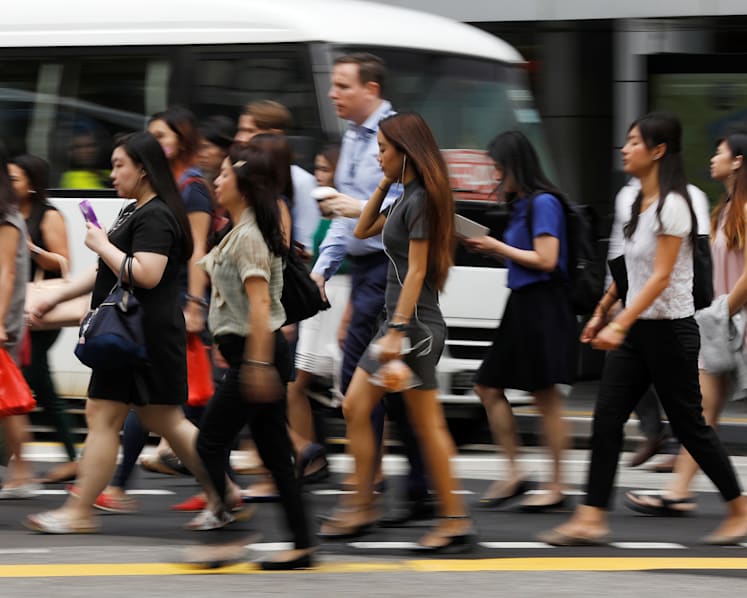
Office workers cross a street in Singapore's central business district. Photo: Reuters


SINGAPORE — Singaporeans are not naive about online falsehoods, but there is a degree of complacency among them and they don’t understand how fast falsehoods can spread and the damage this can cause, said Senior Minister of State for Law Edwin Tong.
Prior to the hearings conducted by the 10-member Select Committee on Deliberate Online Falsehoods earlier this year, Mr Tong — who sat on the committee — said that the average Singaporean might have little understanding on how online falsehoods can be weaponised.
This included himself. “I’ll be very candid to say that, even for myself, prior to the hearings, I wasn’t so exposed to the extent to which (online falsehoods) have been used around the world,” he said.
Mr Tong was speaking to TODAY in an hour-long interview — his first with the local media since he joined the Government in July — in which he talked about the dangers of online falsehoods and the need for counter measures to be adaptable.





Last month, the Select Committee had submitted its 273-page report containing 22 wide-ranging recommendations to the Government.
Its proposals include having new laws and criminal sanctions to cripple the revenue sources of “hired guns” as well as holding technology firms such as Facebook and Twitter accountable.
The committee’s report triggered a spirited discussion, on issues such as the lack of definition on what constitutes deliberate online falsehoods, and the concerns that new laws might stifle free speech.
A day after the release of the report, retired diplomat Bilahari Kausikan said in a Facebook post that many Singaporeans are “naive” about the threat posed by fake news even though it is a key national security issue.
He pointed out, for instance, that China’s influence operations might threaten Singapore’s social compact.
In response, Mr Tong said: “I won’t say Singaporeans are naive about (online falsehoods), but perhaps I might say that there’s a degree of complacency and lack of awareness of the extent to which this can proliferate.”
That complacency exists at multiple levels, he explained.
First, people are aware of fake news but might not think it will affect Singapore. Second, they might not appreciate the extent to which state and individual actors might see Singapore as a target.
“We are a potential target. We are possibly a valuable target as well,” he said.
Singapore is more susceptible because of its openness and reliance to trade as well as high Internet connectivity, he added.
HOW FAKE NEWS PERPETRATORS OPERATE
In its report, the committee said it had been briefed by a national security agency on how Singapore has been the subject of foreign disinformation campaigns.
When asked to elaborate, Mr Tong said he could not reveal details for national security reasons, but there are a “couple of takeaways”.
The perpetrators are not “small-time actors”, but are state-linked and use highly sophisticated and advanced methods. Their target: Creating rifts within a society through divisive issues such as race, religion and politics.
Based overseas, the perpetrators use online platforms to instigate a riot, to “slowly feeding” false information to create news that are outright false and inflammatory with a viral effect, said Mr Tong.
“So, it’s different methods and it depends on what you want to achieve.”
Such operations have taken place in other countries such as Indonesia where, during the 2014 presidential election, fake news circulated that Mr Joko Widodo — then a candidate and now president — was of Chinese descent and a Christian.
“Once it is out there, and you have no ability to stop it either by legislation or, over time, building up trust and discernment and education, then I think there’s going to be serious trouble”, said Mr Tong, who is also Senior Minister of State for Health.
MEASURES HAVE TO BE ADAPTABLE
He conceded that the committee’s recommendations cannot be fool-proof, saying: “I can’t imagine that it will be fool-proof because you are dealing with a dynamic creature, one that is advancing technologically each time.”
Because of that, the measures have to be adaptable. That was why the committee focused more on the outcomes that should be achieved, rather than detailing how to deal with fake news, said Mr Tong.
Such outcomes include disrupting the viral effect of online falsehoods and crippling its source. As to how the measures should take shape, Mr Tong said it is up to the Government and, eventually, Parliament to decide.
“We have set out what we want to target,” he added, noting that there is a need to find a consensus on how to deal with it and implement the measures quickly given the threats posed by online falsehoods.
“And I don’t just mean legislation, I mean the spectrum of measures the committee has (proposed). All across the board, I think we should start that now,” said Mr Tong, who was a senior counsel in the private sector. “The quicker the better.”
He stressed, however, that soliciting public feedback before implementing the measures is necessary.
“We don’t want to move in a way which is so quick that people don’t have the chance to give their views.”
GETTING TECH FIRMS ONBOARD
Moving on to how tech giants such as Facebook are used to circulate falsehoods, he said this shows that those firms have tools at their disposal which influence the way people look at news.
And it has become clear that “there needs to be a degree of control” when it comes to the content on their platforms, said Mr Tong, who was co-head of litigation and dispute resolution, as well as head of restructuring and insolvency practices at law firm Allen & Gledhill before his current appointment.
“Whether you call it legislation, regulation or just some parameters, whatever it is, I think there’s acceptance that something needs to be done.”
Mr Tong senses that those firms are prepared to work with governments, mainly because it is in their interest not to have falsehoods circulating on their platforms to gain trust among users.
“So we work with them to see what can be done. Doesn’t mean we take it at face value, but we do talk to them to see what is within their realm of expertise.”
At the same time, he acknowledged that tech giants might have different values.
This was illustrated during one of the more memorable public hearings, which saw the committee grilling representatives of social media giants on content found on their platforms.
Twitter’s representative, for instance, was questioned on the company’s refusal to remove a cartoon depicting a group of male, ethnic minority migrants tying up and abusing a semi-naked white woman while stabbing her baby to death. The company had argued that it did not breach its hateful conduct policy.
This shows measures introduced need to have “some teeth”, said Mr Tong.
“If we can’t find consensus, then ultimately, we as a Government has the responsibility to ensure that our society is protected from certain types of influences,” he said.
“I think, we as a Government and we as a society, should look at our own social mores, norms (and) attitudes, and we should have the right to decide what we want.”




