







Singapore’s tripartite model a successful one: PM
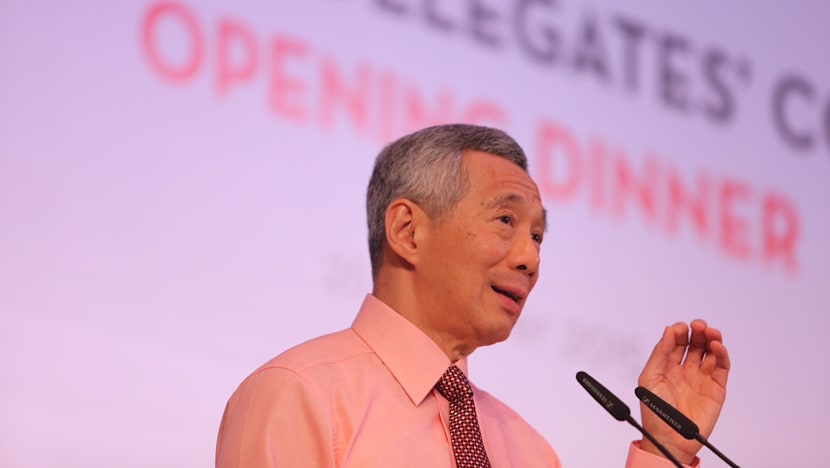
Prime Minister Lee Hsien Loong speaking at the opening dinner of the NTUC National Delegates Conference at the Singapore Orchid Country Club. Photo: Don Wong/TODAY


SINGAPORE — Despite criticisms that other countries sometimes level against Singapore’s model of partnership among the unions, government and employers, it is a model that has worked for the country in building cooperation instead of strife, and tripartism instead of industrial warfare, said Prime Minister Lee Hsien Loong.
Pointing out that various approaches taken by other countries have had their failings, Mr Lee said: “If we had a weak union movement, which cannot represent workers properly, cannot get a fair deal from employers, I think that’s not only bad for workers, it’s bad for Singapore … if we have strong unions but hostile, antagonistic, focused narrowly on short-term interests of members, it will hold back the country and, eventually, workers will get hurt.
“So what we need in Singapore is a strong labour movement with good support from workers, a seat at the table, working constructively with employers and the Government to get the best deal for workers and advance the shared national interest,” he added.
Speaking at a dinner today (Oct 26) to mark the opening of the National Trades Union Congress’ (NTUC) National Delegates Conference, he cited how union leaders in Singapore are involved in key national decisions and sit in key forums that shape national policy, such as the National Wages Council and SkillsFuture Council. They serve as labour Members of Parliament and also on statutory boards and the boards of many companies, he added.





A “crucial” sign that tripartism has worked for Singapore is the growth of union membership to nearly 900,000 members, even as union membership has declined in almost every advanced economy.
In countries where union members enjoy strong protection, such as in Europe, those who are non-members carry the burden. Some youths have to take on temporary jobs with no security and poor working conditions, or often remain unemployed, he said.
For instance, France today is finding it hard to restructure, at a time when its economy needs to modernise — one union is in fact campaigning to reduce its 35-hour work week to 32 hours, he noted.
Conversely, the weak unions in the United States, which have seen years of declining membership, come with their own problems. Improvements in productivity are outpacing wage increases and workers do not feel that they are getting a share of the fruits of growth, nor being shielded from economic uncertainties and upheavals beyond their control, he said.
A third model is that of China’s, where unions are closely linked to the government and so do not try to be difficult, said Mr Lee. But Chinese workers still face fierce competition from one another, between different cities and provinces, and from robots. The welfare of workers is also a concern and when things become difficult, Chinese workers express discontent through demonstrations and appeals to top national leaders, he said.
Singapore stands apart in the way government, unions and businesses work as equals and trust one another, said Mr Lee. This relationship of trust was built over the decades, starting from the early years of independence, and Singapore should keep its formula of tripartism.
Nevertheless, adapting to stay relevant is important, he said. The NTUC needs to adapt to an ageing population and a workforce with a higher proportion of professionals, Mr Lee said. The government has to develop new economic policies while employers need to ensure their companies remain viable, seize new opportunities to grow and develop their workers, he added.




