







S'pore beefs up counter-terror strategy as threat level spikes
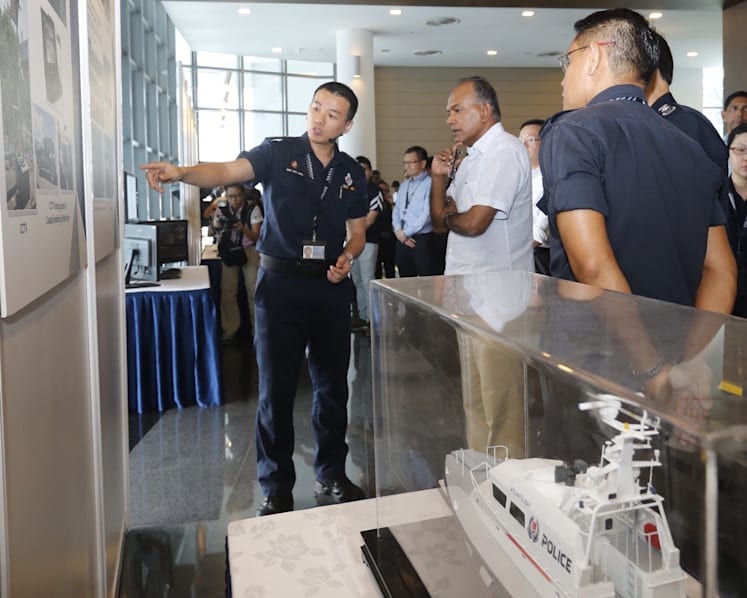
Mr K Shanmugam visiting the Police Coast Guard (PCG) HQ Brani Base on March 18, 2016 to observe PCG's counter-terrorism and maritime security measures. Photo: Ernest Chua/TODAY


SINGAPORE — With the terrorist threat morphing and hitting its highest level in recent times, the Ministry of Home Affairs (MHA) on Friday (March 18) announced a raft of counter-terrorism measures that include greater closed-circuit television surveillance across the island and new laws where necessary to require owners of premises and organisers of major events to put in place security measures.
New emergency response teams will be formed, comprising police officers specially trained with counter-assault skills and equipped with more firepower. A second wave of forces — specialist teams from the Special Operations Command and the Gurkha Contingent — will also arrive on the scene faster.
A new SG Secure national movement will be launched later this year to “sensitise, organise, train, and exercise Singaporeans, so that we can better protect ourselves from attacks”, Home Affairs and Law Minister K Shanmugam said to Home Team leaders at a closed-door forum on Friday. “SG Secure cannot (be) just another public awareness campaign. It has to be a call to action. It has to be a movement,” he said.
In his speech, provided by the MHA to the media, Mr Shanmugam said the terror threat morphed last year into a “much more powerful large monster”.The Islamic State in Iraq and Syria (ISIS) now presents a far graver threat that Al-Qaeda and its affiliates ever were, and the threat of an attack here is “much more so than after 9/11 (in 2001) and the arrest of Jemaah Islamiyah members”, he said.





Singapore is at the epicentre of the caliphate that ISIS wants to establish in the region, said Mr Shanmugam as he outlined trends in the region and four possible threats Singapore faces.
As part of the country’s security response, CCTV surveillance will be expanded to cover common areas in the heartlands — especially places with high human traffic such as town centres, hawker centres and walkways linking to major transportation nodes.
The cameras will be installed from later this year and be completed over the next four years, adding to the installation of police cameras at 10,000 public housing blocks and multi-storey car parks that will be completed this year.
The Government will also enable more CCTVs monitoring public transport, commercial and government buildings to be accessible to the police on demand. The police will also work with owners of premises for access to their CCTVs, and members of the public will be able to submit videos on crowdsourcing platforms. “This is a necessary, strategic and direct response to the evolving nature of the threats,” said Mr Shanmugam.
At major events, organisers may be asked to screen people entering a venue. This is to protect soft targets that terrorists have exploited elsewhere. Attackers in January’s Jakarta blasts were apparently targeting a different mall but, due to tight security screening, had trained their sights instead on Sarinah mall, he said. “We will all need to get used to more security and bag checks prior to entry. But I believe that our people will understand and accept the need for these measures,” he said.
In addition to preventive measures, new emergency response teams will be formed to respond quickly, take down attackers and minimise casualties. They will be familiar with stakeholders and the areas assigned to their charge, said Mr Shanmugam.
This re-organisation of police response forces came after the police studied shootings such as last November’s attacks in Paris, which took place at multiple locations. The French capital had well-trained frontline responders and specialised units but post-incident analysis showed there were substantial periods when the terrorists operated with little or no hindrance, said Mr Shanmugam, adding that the Home Team will work closely with the Singapore Armed Forces where needed.
These measures will help Singapore tackle at least four possible threats Mr Shanmugam identified: Attacks planned just outside Singapore but carried out in the country (similar to the Paris attacks); attacks with weapons smuggled into Singapore for use by Singaporeans; lone-wolf attacks by self-radicalised people; and the radicalisation of foreign workers in Singapore, as shown in the recent arrests and repatriation of 27 Bangladeshis.
Each year, 200 million people pass through Singapore’s checkpoints including the two land checkpoints. That is why checkpoint checks have to be very stringent — in the recent case of the four Indonesian aspiring ISIS fighters repatriated by Singapore, for instance, there was nothing to suggest they were would-be terrorists but a sharp-eyed immigration officer sniffed them out, revealed Mr Shanmugam. Noting how the Paris attacks were planned outside France — in Belgium’s Brussels district of Molenbeek — Mr Shanmugam said: “We have several possible Molenbeeks around us.”
He stressed that hard measures are not enough to deal with threats. Community response is a cornerstone of the counter-terrorism strategy, Mr Shanmugam said. “Given today’s threat environment, we will have to revamp the Community Engagement Programme considerably. There is a strong, urgent need for the community to be vigilant before and during an attack.”
In its call to action to the community, the government will reach out to neighbourhoods, schools, workplaces, the National Service community and other groups. It will not be an easy task but, speaking to reporters the Police Coast Guard’s headquarters at Brani Base on Friday, Mr Shanmugam encouraged the public to help by looking out for suspicious items, by knowing what to do if in the vicinity of an attack and by helping victims.
The country must recover well from any attack and emerge stronger and more united. Characterising it as a fight between freedom and terror, Mr Shanmugam said: “We must believe that we can never be kept down by terror. Liberty, freedom, the human spirit will ultimately succeed. But we have to be prepared to fight for it.” ADDITIONAL REPORTING BY NG JING YNG




