







SQ321 turbulence: Early findings show passengers experienced change in G-force almost 3 times Earth's pull
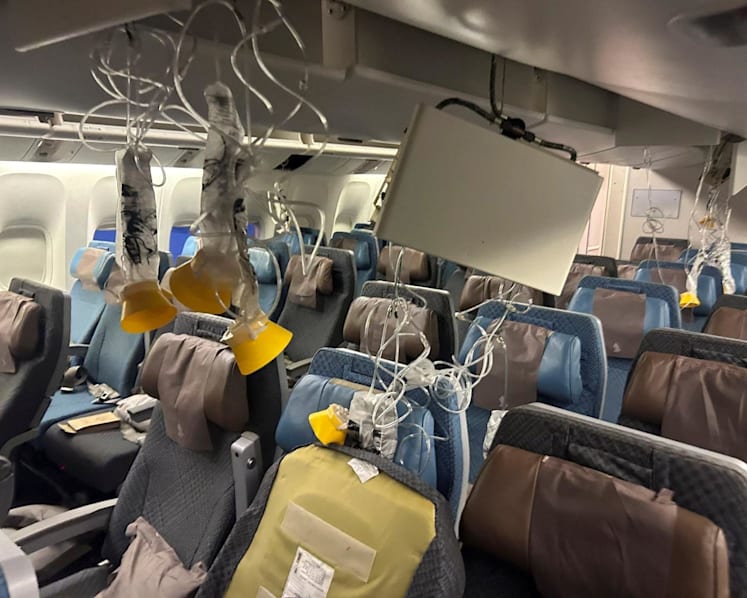
The interior of Singapore Airlines flight SQ321 after an emergency landing at Bangkok's Suvarnabhumi International Airport, Thailand on May 21, 2024.


SINGAPORE — The passengers on Singapore Airlines (SIA) flight SQ321 experienced a rapid change in gravitational force (G) within 0.6 of a second. This caused those not wearing seatbelts to become airborne, based on data retrieved from the flight black box so far.
Singapore's Transport Safety Investigation Bureau, an arm of the Ministry of Transport, issued a press release on Wednesday (May 29) detailing the chronology of events during the May 21 incident, using data stored in the flight data recorder and cockpit voice recorder of the flight.
The plane experienced a rapid change in G as the recorded vertical acceleration decreased from +1.35G to -1.5G, within 0.6 of a second.
This works out to about a 2.85G change, which likely caused the occupants who were not belted up to become airborne.





Then, the vertical acceleration changed from -1.5G to +1.5G within four seconds. This likely resulted in the occupants who were airborne to fall back down, the findings showed.
G refers to changes in speed and are expressed in multiples of gravitational acceleration. For the findings of SQ321, G is recorded as vertical accelerations.
A science report by British news channel BBC stated that most people can withstand 4G to 6G, while fighter pilots can manage up to about 9G for a second or two.
Astronauts endure around 3G on lift-off, but the report said that this is “marginally easier” to bear.
“The crew sit in a laying down position so the G-force acts from the back to the front of the body rather than top to bottom, where blood would be forced down from the head,” the BBC report added.
However, sustained G-forces of even 6G would be fatal.
A total of 131 passengers and 12 crew members on SQ321 were badly hit by turbulence. The flight that was heading to Singapore from London in England was diverted to Bangkok in Thailand for emergency support.
A relief flight for those not receiving treatment in Bangkok arrived at Changi Airport in the early hours of May 22.
SQ321 carried a total of 211 passengers and 18 crew members.
A 73-year-old British man died of a suspected heart attack and at least 30 people were injured, some critically.
The investigation team comprises investigators from Singapore's Transport Safety Investigation Bureau and representatives from the United States of the US National Transportation Safety Board, Federal Aviation Administration and aircraft maker Boeing.
The following is the chronology of events based on preliminary analysis of the data from the flight data recorder and cockpit voice recorder, compiled by the investigation team. The timings used are in UTC, which stands for Coordinated Universal Time, a standard used to set all time zones around the world.
WHAT HAPPENED ON FLIGHT SQ321
SQ321 departed London on May 20 and the flight was normal before the turbulence event.
At 07:49:21 UTC, or 3.49.21 pm Singapore time, on May 21, the aircraft was passing over the south of Myanmar at 37,000ft (about 11,300m) and likely flying over an area of developing convective activity in the atmosphere. Convective activity refers to the movement of air of varying temperatures that causes clouds to form and weather changes.
For about 19 seconds, the G fluctuated between +0.44G and +1.57G. This would have caused the flight to begin to experience slight vibration.
Around the same time as the onset of the slight vibration, an "uncommanded" increase in aircraft altitude was recorded, reaching a peak of 37,362ft.
In response to this, the autopilot pitched the aircraft downwards to descend back to the selected altitude of 37,000ft.
“In addition, the pilots observed an uncommanded increase in airspeed, which they arrested by extending the speed brakes,” the investigation report stated.
While managing the airspeed, at 3.49.32 pm Singapore time, "it was heard that a pilot called out that the fasten seat belt sign had been switched on".
The uncommanded increases in aircraft altitude and airspeed were most likely due to the aircraft being acted upon by an updraft. An updraft refers to the upward movement of air.
The autopilot was engaged during this period.
Eight seconds later, at 3.49.40 pm, the aircraft experienced a rapid change in G as recorded vertical acceleration dropped from +1.35G to -1.5G, within 0.6 of a second.
This worked out to about a 2.85G change, which likely caused the occupants who were not belted up to become airborne.
Around one second later, at 3.49.41 pm, the vertical acceleration changed from -1.5G to +1.5G within four seconds. This likely resulted in the occupants who were airborne to fall back down.
“The rapid changes in G over the 4.6-second duration resulted in an altitude drop of 178ft, from 37,362ft to 37,184ft. This sequence of events likely caused the injuries to the crew and passengers,” the report stated.
In the midst of the sequence of rapid changes in G, recorded data indicated that the pilots initiated control inputs to stabilise the aircraft, disengaging the autopilot in this process.
Then, the pilots manually controlled the aircraft for 21 seconds and re-engaged the autopilot seconds later at around 07:50:05 UTC.
The recorded vertical acceleration showed more gradual fluctuations over the next 24 seconds, ranging from +0.9G to +1.1G, while the aircraft returned to 37,000ft at 3.50.23 pm.
After the pilots were informed by the cabin crew that there were injured passengers, the decision was made to divert to Suvarnabhumi Airport at Bangkok, Thailand.
On the way to Bangkok, the pilots requested that medical services meet the aircraft on arrival.
About 17 minutes after the turbulence event, at 4.06.51 pm, the pilots initiated a normal, controlled descent from 37,000ft and the aircraft reached 31,000ft around three minutes later at 4.10pm.
The data showed that the aircraft did not encounter further severe turbulence during this diversion and touched down around 35 minutes later at 4.45.12 pm at Suvarnabhumi Airport in Thailand.




