







Successful businesses should help take care of Singapore and its people: Chan Chun Sing
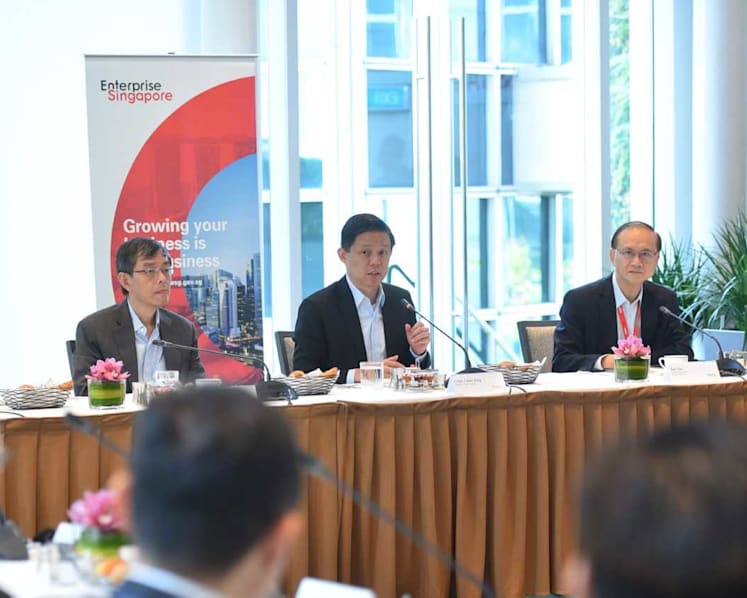
Scale-up SG, a programme to help local firms make it on the global stage, was launched on Wednesday (July 10). From left: Mr Peter Ong, chairman, Enterprise Singapore (left), Minister of Trade and Industry Chan Chun Sing and Mr Ted Tan, deputy chief executive of Enterprise Singapore (right), at the launch event.


SINGAPORE — As Singaporean businesses grow and succeed in the global arena, they should give value back to the nation and create better jobs for Singaporeans, said Minister for Trade and Industry Chan Chun Sing on Wednesday (July 10).
Many countries “fragment and break up” where “not everyone in society gets to grow along” as their businesses expand and make money, he told an audience of business leaders at the launch of the Scale-up SG programme, designed to help firms here become global players.
Unlike those countries, Singapore distinguished itself with its emphasis on social cohesion, Mr Chan told the audience at the Conrad Centennial Hotel.
“However, in Singapore, we distinguish ourselves. This is not just because we have been doing relatively well in terms of economics and business. We distinguish ourselves because even as we do well economically, we also do well by keeping our society stable and cohesive. That can only come about when our companies’ success is also translated into success for our workers.”





He added: “We are spending resources to help you, and I have only one wish and one thing that I ask from all of you. That in your journey towards success, as you succeed, help us to take care of Singapore and fellow Singaporeans.”
Scale-up SG, a targeted two-and-a-half-year programme, unveiled in the latest Budget in February, is being run by trade promotion agency Enterprise Singapore and aims to rapidly scale up a core group of Singaporean companies into global players in their respective fields.
Under Scale-up SG, business leaders from 25 local enterprises, identified by the agency for their high-growth potential and ambitious growth targets, will be put through a specialised programme meant to impart business expertise to these leaders as they seek to grow revenue, expand overseas or break into new markets.
The 25 companies will participate in the programme in two cohorts, run separately by consultancy firms McKinsey and PwC Singapore. The homegrown firms come from various industry sectors and pull in annual revenue between S$10 million and more than S$300 million.
Examples include fast food chain 4Fingers, jewellery retail chain SK Jewellery, Chinese barbequed meat producer Bee Cheng Hiang and food court operator Koufu.
“I have no limit on how many companies can join this programme as long as the companies and the leadership of the companies have the same, if not higher, level of ambition, for yourselves and by your workers,” said Mr Chan, who helped conceptualise the programme soon after he took on the Trade and Industry portfolio in April 2018.
With Enterprise Singapore co-funding up to 70 per cent of the costs, these leaders will learn from business consultants as well as experts in their respective fields. The cost of the programme was not disclosed, but is believed to come out of the S$1 billion earmarked in the last Budget for helping firms build deep enterprise capabilities.
'LEADERS LEARN BEST FROM LEADERS'
Another key goal is to create a community of founders and chief executives, said Enterprise Singapore chairman Peter Ong. “A tenet influencing the design of this programme is that leaders learn best from leaders, and this is true in both success and failure,” he said.
Mr Ong said the first batch of companies possess the “vital ingredient of hunger and ambition for growth”.
Only companies with a proven track record of growth, have their global headquarters in Singapore, have strong leadership and the ability to create economic spin-offs for Singapore, such as job opportunities for Singaporeans, are eligible for the Scale-up SG programme, said the agency in a statement.
Speaking to TODAY, several of the participating chief executive officers said the programme, which started in earnest two days ago, exposed them to other thought leadership and attitudes needed to sustain their ambitions.
Seafood restaurant chain Jumbo group CEO Ang Kiam Meng said business leaders would surely benefit from more “insight and direction” as they internationalise. The programme, which involves several food services companies, has also given him some new ideas.
“I don’t see the others as competitors," he said. "Just a wild thought, this programme may in fact teach us how to merge the various F&B groups to become one amalgated Singaporean company that can venture overseas together.”
Asked why such knowledge is critical, Mr Kelvin Lim, CEO of advanced battery manufacturer Durapower, said: “The amount of effort needed to grow a company from making S$1 to S$10 is exponentially smaller than from S$10 to S$100. This is a tricky point because if you are not careful, the opposite of ‘scale up’ may be ‘screw up’.”
The CEOs also said the growth of their companies will inevitably lead to better jobs for Singaporean workers, even as they internationalise their businesses.
Bathroom supplies manufacturer Rigel’s group CEO Christopher Ng said his company sees Singapore as its home base to support its regional expansion into the Asia Pacific over the next three to five years. Any expansion of its research and development efforts, for example, will require more local manpower to drive that effort in its Singapore headquarters, he said.
But more needs to be done to help more research talent join the industry instead of remaining in academia, said Mr Lim. “The situation today is that they would rather create research publications instead of products. Imagine if Dyson is here tomorrow, and what a shame if we do not have a ready pool of people joining it today.”
In January, Mr James Dyson, the billionaire who revolutionised vacuum cleaners with his bagless technology, announced that he would be moving his corporate office and tax registration to Singapore from Britain to be closer to his fastest-growing markets.
Late last year, the technology firm said that it intended to manufacture its first electric car in Singapore, with a factory to be built by 2020 and the first car model set to roll out by 2021.




