Sports leaders reach consensus on new gender policy - IOC
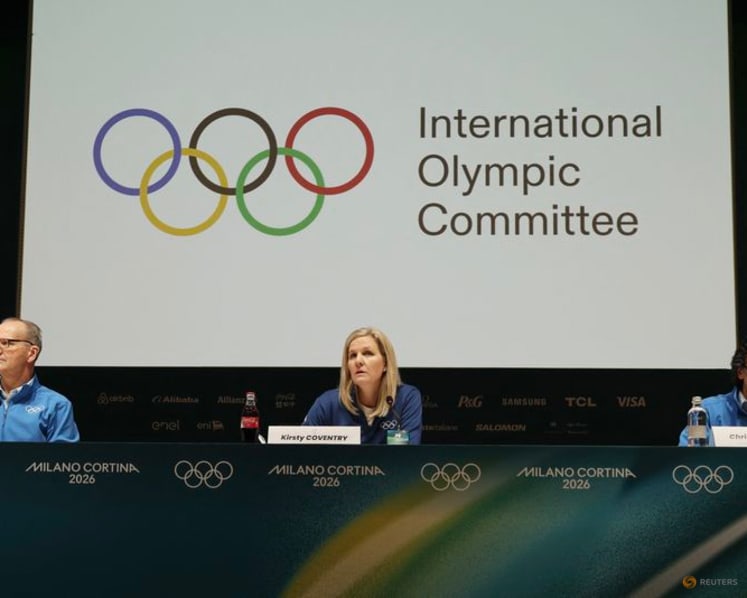
Milano Cortina 2026 Winter Olympics - Press Visit at the Olympic and Paralympic Athletes' Village - Milan, Italy - February 1, 2026 IOC Communications Director Mark Adams, IOC President Kirsty Coventry and IOC Olympic Games Executive Director Christophe Dubi during a press conference REUTERS/Alkis Konstantinidis
MILAN, Feb 7 : Global sports leaders have reached consensus on a new set of eligibility criteria for transgender athletes, with the new policy expected to be announced within the first half of this year, the International Olympic Committee said on Saturday.
It would be the first uniform policy adopted by the IOC and international sports federations, applying to major events in dozens of sports, including the Games and world championships. Currently, federations have their own rules which can vary.
Details of the new policy are unclear but it is expected to severely restrict the participation of transgender athletes who compete in women's categories if they have undergone full male puberty before any subsequent medical transition.
The IOC, under its first female president Kirsty Coventry, took the lead in June, opting for a uniform approach.





"Protecting the female category is one of the key reforms she wants to bring in," IOC spokesman Mark Adams told a press conference at the Milan-Cortina Winter Games on Saturday.
"I would say it is going to happen shortly, within the next few months."
"It has been out to consultation phase and we had the 'pause and reflect' (period) on it," Adams said. "Generally speaking there is consensus within the sporting movement. I think you will have a new policy in the first half of this year. Don't hold me to it, but that is roughly the timescale."
In September, Coventry set up the 'Protection of the Female Category' working group, made up of experts as well as representatives of international federations, to look into how best to protect the female category in sports.
Before Coventry's decision, the IOC had long baulked at any universal rule on transgender participation for the Games, instructing international federations in 2021 to come up with their own guidelines. Under current rules, still in force, transgender athletes are eligible to take part in the Olympics once cleared by their respective federations.
Only a handful of openly transgender athletes have taken part in the Games. New Zealand's Laurel Hubbard became the first openly transgender athlete to compete in a different gender category to that assigned at birth when the weightlifter took part in the Tokyo Olympics in 2021.
Currently, for example, World Aquatics allows transgender athletes who have transitioned before the age of 12, to compete. World Rugby bans all transgender athletes from elite-level competitions.
U.S. President Donald Trump has banned transgender athletes from competing in school, college and pro events in the female category in the United States, as Los Angeles prepares to host the 2028 summer Olympics.
Trump, who signed the "Keeping Men Out of Women's Sports" order in February, has said he would not allow transgender athletes to compete at the LA Games.