Born in a bush and raised in a shelter, this former flight attendant opens up about surviving trauma and chasing a new dream
Born while his mother was homeless and raised largely in a children’s home, Mr Dino Isaac, a former cabin crew member, grappled with mental health struggles and domestic violence and is now determined to pursue a course in social work.
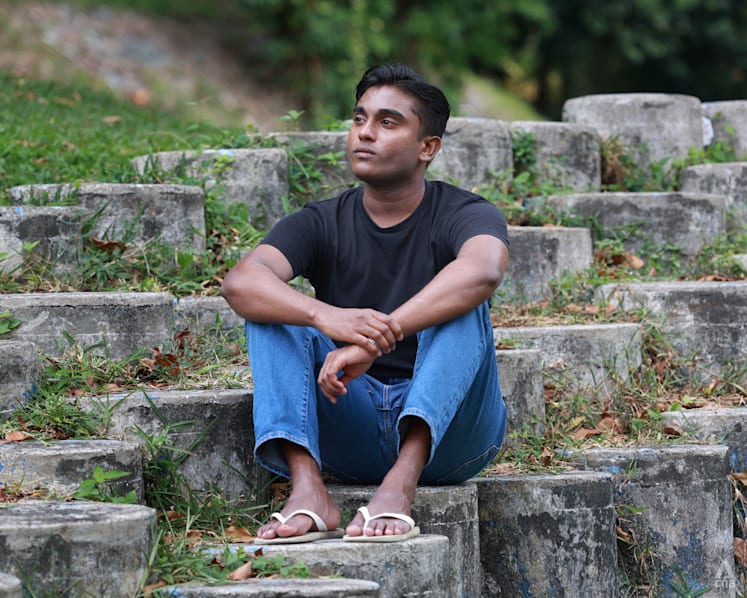
Mr Dino Isaac, 29, spent most of his youth in a children's home. He later went on to become an air steward with Singapore Airlines. He is now hoping to pursue social work at a polytechnic. (Photo: CNA/Raj Nadarajan)

This audio is generated by an AI tool.


Warning: This article contains details of domestic violence and references to suicide.
In a forested area in Sembawang on a Tuesday in 1996, Dino Isaac took his first breath.
His mother was terrified and in pain. Full-term pregnant when she fled her abusive husband, she was suddenly faced with the reality of giving birth while homeless.
A relative who was with her at the time called for an ambulance, and she and her newborn son were taken to a hospital.
In a now-viral video first posted to social media on Jan 24, Mr Dino, now 29, flashed a photo of his birth certificate, which listed his place of birth as "Gambas Avenue, open space surrounded by bushes".
The video would unveil other bombshells about his life – how he spent most of his early years in a children's home under a government protection order, before gaining financial independence as a cabin crew member with Singapore Airlines.
Posted on a days-old social media account, it was his response to a disparaging comment comparing being a cabin crew member to being a "high class waiter", punctuated with a laughing emoji.
"I'll take it," Mr Dino said in the video, without airs. "Because this job saved my life."
The video, which compressed decades of Mr Dino's life into just 64 seconds, has since drawn more than 400,000 views across Instagram and TikTok.
It also drew this journalist into the two-room public rental flat where he now lives with his mother. I met him there for the first time on a recent Wednesday.
When I asked what he thought about the wild circumstances of his birth, Mr Dino told me it was "kind of cool".
"My siblings were born in hospitals and at home. For me to be born in the jungle just seems like a movie. And I love movies."
Over the course of the next few hours, I learnt that being born under a bush is only the beginning of Mr Dino's complicated life story – one marked by domestic violence, instability and trauma.





"Some things, I remember by the scars that I have on my body today," he said. "I still see them every day and I'm not gonna lie, it still affects me.
"I feel like a child should never see (what I saw)."
THE JUNGLE BOY
The unique nature of Mr Dino's birth earned him a family nickname: "Jungle boy".
Relatives and friends often drew comparisons to Mowgli, the Indian boy protagonist of Disney's The Jungle Book – adapted from English writer Rudyard Kipling's book of the same name.
Mr Dino is the youngest of four children – an older brother and sister were raised alongside him, while another brother was given to a family friend.
For as long as he can remember, he was passed from "caretaker to caretaker" as life at home was punctuated by fear.
His father drank heavily and was frequently violent towards Dino's mother, siblings and Dino himself.
"I remember seeing blood on the walls," said Mr Dino. "Many times I had to run out of the house with my siblings because he was just drunk and creating a ruckus at home."
For a short period in his infancy, he was passed to a cousin’s family, where he found sanctuary – but that lasted only for about two years.
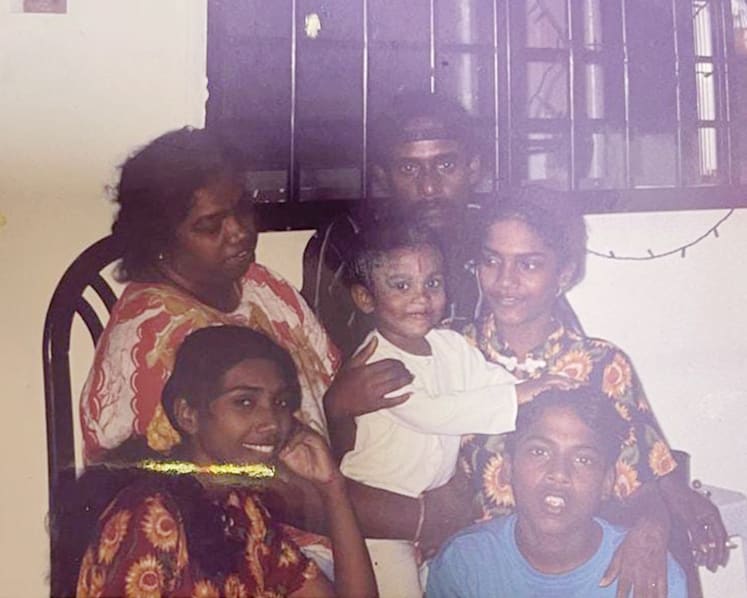
Soon after, he was moved again, to another relative's home that left its own physical and emotional scars.
A long gash on his left arm, Mr Dino said, was a remnant from when that temporary guardian twisted and broke his arm. He was just three years old at the time.
There was even a stretch when he and his mother slept under a flyover for a few weeks.
During the day, she left him at random desolate buildings for hours at a stretch while she took on work as a cleaner.
"I remember not eating anything," Mr Dino said. "I have visions of broken staircases. I was so scared, it would become dark, and it just felt so lonely."
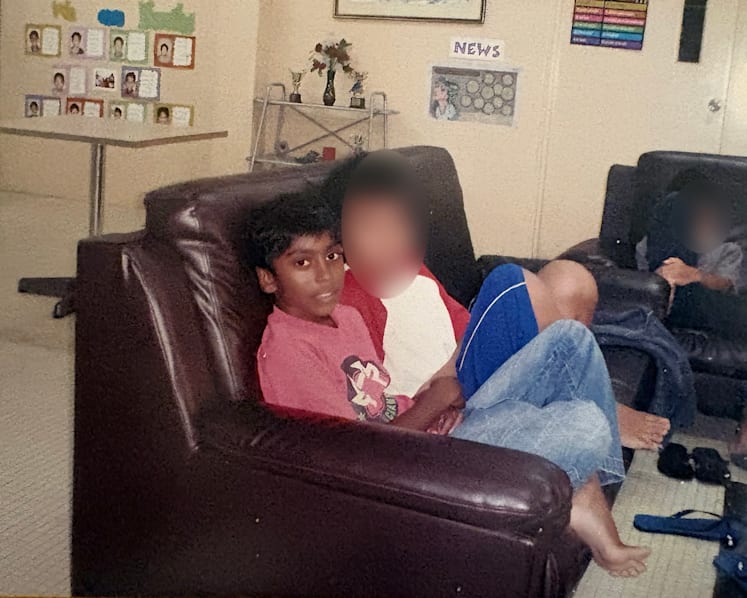
When he was five, Mr Dino and his two eldest siblings were placed in a children's home. He stayed there until he was 15, seeing his mother on scheduled visits while his father moved in and out of prison for fighting offences.
Time in the home was peppered with bright sparks: Having peers he could relate to, chasing chickens on the compound, and being able to play 11 v 11 football games.
It was also where he discovered a love of performing, once even landing a part in After School, a programme by the now-defunct TV channel Okto.
But it was also during this period that he first began to realise his experience of childhood was different from that of others, particularly during Sunday visits to church services outside the home.
"I could see all these other kids (with) two parents; they always have nice clothes to wear," said Mr Dino.
"They don't have to eat the food at the fellowship hall. They get to go out for lunch."
In 2009, another tragedy ruptured Mr Dino's life.
"I was preparing for secondary school and they told me, 'Dino, you're not going to school today because your father is no longer with us'."
His father was killed during a fight shortly after his release from prison. Sitting in his mother's flat, Mr Dino recited the official cause of death as if it were yesterday: multiple injuries due to blunt force trauma to the head, chest and abdomen.
He readily admitted that his father's death is something he still struggles to process now as an adult.
Even as a young teen, his grief wrestled with his recognition that his father was his family's abuser for many years.
A few weeks prior to this, Mr Dino went on a supervised family trip to Malaysia's Tioman Island under the drug rehabilitation programme his father was in.
Though the trip was short, Mr Dino refused to stay in the same room or ride a jet ski with his father out of fear.
This would turn out to be his last memory of his father.
"Even though I didn't have a relationship with him, I instantly cried for hours (when I heard about his death). And I remember thinking, 'I have no father'."
The emotional turmoil grew even stormier when news reports were published about his father's death. Classmates began taunting him each day in school by chanting his father's name.
"As a 13-year-old child, how are you supposed to process such information? It was very difficult for me to concentrate in school as well right after (his death)," said Mr Dino.
"I think I became a very defensive kid as well, because I felt like I was the only person who could protect myself."
At the children's home, Mr Dino described himself as mischievous and outspoken – traits that often got him into trouble.
"I remember being very stubborn. If a houseparent asked me to wear a certain shirt, I would try to wear something else – because I just wanted to have control over my life."
NEW HEIGHTS, NEW LOWS
At 15, Mr Dino was reunified with his family, who had moved into a two-room rental flat in Tanglin Halt.
But squeezing into cramped quarters, tensions began to boil over and Mr Dino voluntarily went back to the children's home for his own safety. He would end up staying there until he found his first job.
After completing National Service, Mr Dino was at a loss for what to do next – until a superior officer at the Singapore Civil Defence Force noted that he was "well-groomed and well-spoken" and encouraged him to try out to become a cabin crew member.
After interviews with a couple of airlines, he accepted and started a job with Scoot. About 10 months into the gig, he applied to Singapore Airlines (SIA) and was accepted.
Upon completing training with SIA, off he went on his first assignment: London.
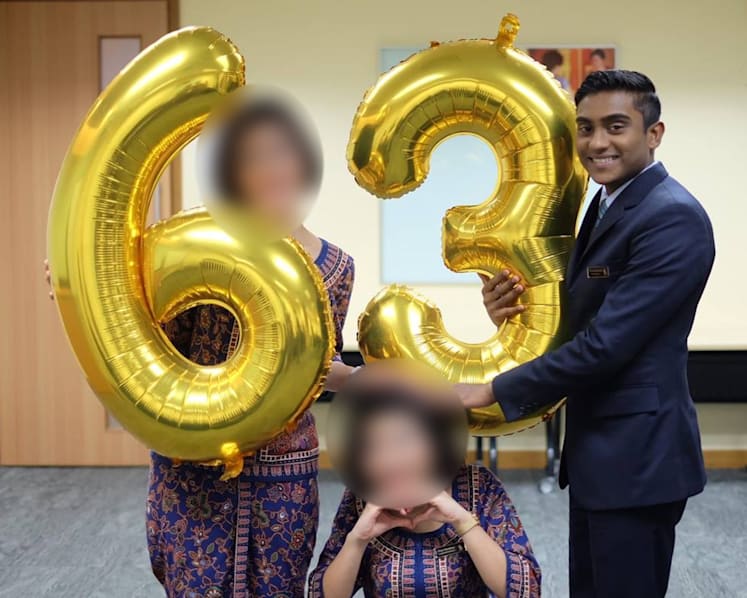

"When we were landing, I was looking out the window, thinking, 'Oh my gosh. How am I in London?'" he recalled, disbelief in his voice.
"I came from nothing. I was sleeping under a highway with my mum. It's so surreal that I, from the children's home, can be in London."
At 22, the cabin crew's salary was "life-changing" for Mr Dino. It allowed him to move out of the children's home and rent a small studio apartment – the very first space he'd had of his own.
"I was no longer starving. I could go to restaurants to eat. If I'm late, I can take a cab," he said.
This later inspired him to make videos on social media, including one where he transparently revealed details about his monthly salary as a cabin crew. His income varied from around S$1,200 during training to over S$7,000 at its peak depending on the flights he worked.
While negative comments like "high class waiter" crop up occasionally in response to his videos, Mr Dino wants to show that the profession provided him with a viable path to financial independence – and could do the same for someone else.
"Some people look down on the job because cabin crew clean aircraft lavatories. What many do not realise is that when we do so, we are also performing important safety checks," said Mr Dino, including for potential fire hazards such as damaged smoke detectors and waste bin flaps not closed properly by passengers.
But financial security was just one piece of the puzzle.
Having achieved his childhood goals of seeing the world so early in young adulthood, Mr Dino eventually found himself unable to shake a growing feeling that something was still missing.
"I was enjoying a good salary and travelling the world. But who am I sharing it with? It's such a shame that I'm not able to share it with my family, because we are so broken," he said.
I was enjoying a good salary and travelling the world. But who am I sharing it with?
In 2023, after five years of flying, he left the airline and did a brief stint as a relations manager in the food and beverage industry.
But feelings of loneliness and abandonment continued to consume him. When that gig ended, he decided to take a break for his mental health before diving into the search for another job.
For Mr Dino, this was much more than the sense of aimlessness that comes with unemployment.
"I realised that I was losing a lot of my will to live in this world," he said plainly.
"I felt that, after everything I've been through, there was nothing much to live for. I was also very angry at the world."
Feeling that his struggles were "very difficult" for others to relate to, he kept much of them to himself.
FINDING PURPOSE
In 2025, at one of his lowest points, Mr Dino attempted to take his own life. That experience prompted him to seek help at a Family Service Centre.
A social worker, along with a friend, accompanied him to the Institute of Mental Health (IMH), where he was admitted and diagnosed with major depressive disorder.
He spent a month warded at IMH, where therapy helped him make sense of the traumas he had been carrying since birth.
On the ride to IMH, he had a conversation with the social worker about how he got into the industry – a brief exchange that proved to be another turning point for Mr Dino.
"I thought, 'If I had his education, plus my experience being a kid from the (children's) home, I think I could make something very powerful out of this life'," said Mr Dino, whose highest academic qualification now is a national certificate from the Institute of Technical Education.
Earlier this month, he applied to Nanyang Polytechnic to pursue a diploma in social work.
While he awaits the outcome, he has begun work on an autobiographical book.
"It's more of a little diary for myself, so that I do not forget where I came from and how far I've come. And if this book connects with anybody, it will really touch my heart and make me very happy," said Mr Dino.
Still, the work of healing continues – and the path has not been linear.
In late 2023, he reconnected with his 59-year-old mother, Madam Sahadevi Alagappan, who has developed Parkinson's disease. Soon after, he moved into her rental flat to care for her after his siblings moved out.
Living together again has helped him understand and accept that she, too, had been a victim of abuse, with little control over her circumstances.
"My mother has never told me 'I love you' before. I know she does, but she just comes from a generation that doesn't really say these things out loud," he said.
"I feel like she tells me she loves me through cooking for me."
These days it is mostly Mr Dino doing the cooking, since his mother's strength is deteriorating. But he is determined to learn one recipe a week from her, documenting them carefully.
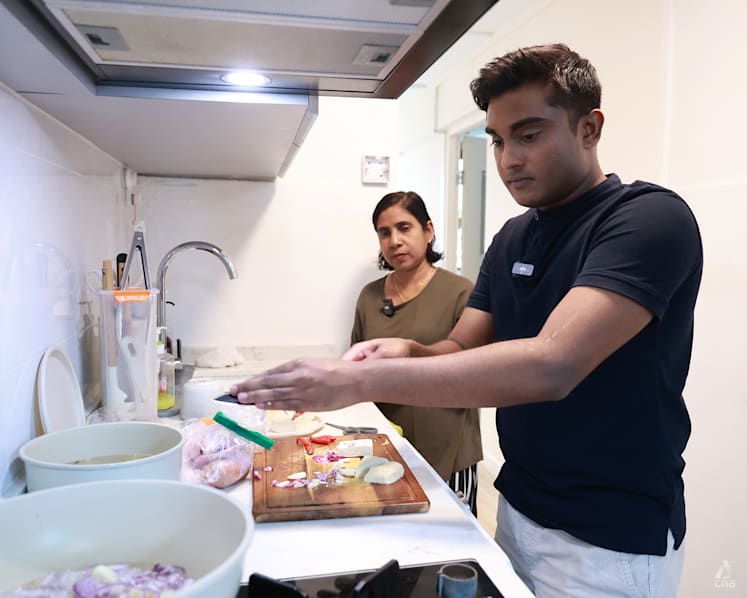
As he prepared sodhi – a coconut milk-based stew – he paused often to check in with her. "Is this enough?" he asked, showing her a small mountain of freshly chopped aromatics.
Theirs was not quite the biting, overly familiar banter one might expect from a typical scene of homely domesticity – but there was a clear tenderness in how they were still relearning how to be around each other.
Mdm Sahadevi told me her son's cooking is "same as my cooking, same".
Mr Dino laughed but didn't quite agree with her unequivocal declarations – his efforts so far have turned out "really good", but his mother was not strict in her teachings.
"There's no measurements. Right now I have her to tell me how much to add, but when she's out, I just have to listen to the ancestors," Mr Dino joked.
Cooking has also helped him reconnect with his Indian heritage.
Growing up in a children’s home where most of his peers were Chinese, Mr Dino said he had little exposure to Tamil but is now learning the language through his mother's cooking tutorials. While he did learn Tamil in school, his time speaking the language was limited.
Documenting his healing journey online, including everyday moments like cooking with his mother, has also connected him with countless strangers – something that still shocks him.
"I've had a few small wins in my life, but throughout that, I haven't really heard my family tell me that they were proud of me. So getting this response from strangers and by the hundreds was just more than I could ask for," said Mr Dino.
His video has not only drawn attention from the public, celebrities and politicians, but also reconnected him with people from his past – including former caretakers and even relatives.
Ms Shalini Devi Manisagram, a 39-year-old preschool teacher, was scrolling through TikTok when she came across his viral video.
Instantly, she recognised him as her beloved baby cousin she had long lost touch with, and reached out. Hers was the family that Mr Dino had found sanctuary with for a short while when he was two, before he had to move.
When they met again on Wednesday in Mdm Sahadevi's flat, their reunion was filled with hugs and tears as the family dog, Cookie, padded quietly around them. Hard of hearing, the 17-year-old animal was contentedly oblivious not just to sound but also the palpable emotions unfolding around him.
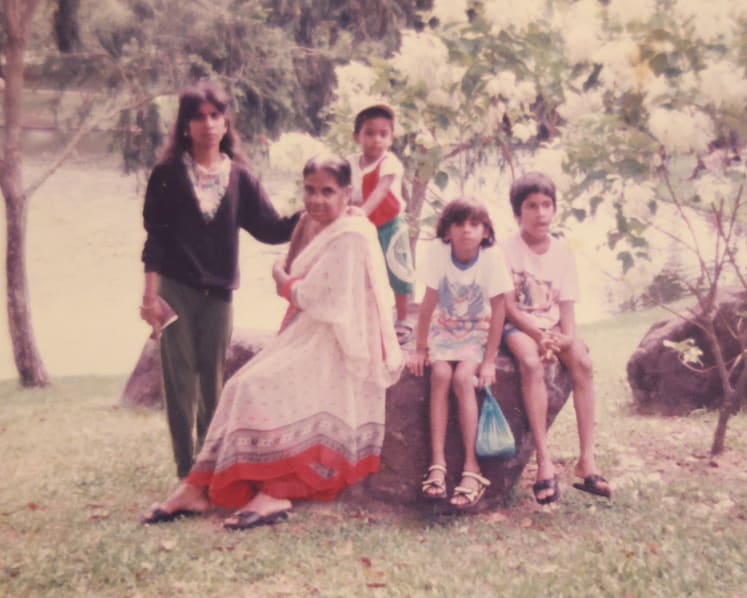
Ms Shalini shared stories of toddler Dino following her around their home everywhere, calling her "Amma" (a Tamil endearment for a maternal figure), and handed him faded photos of when he stayed with her family.
In one, she is 12 years old, hugging a two-year-old Dino tightly when he was to leave their care.
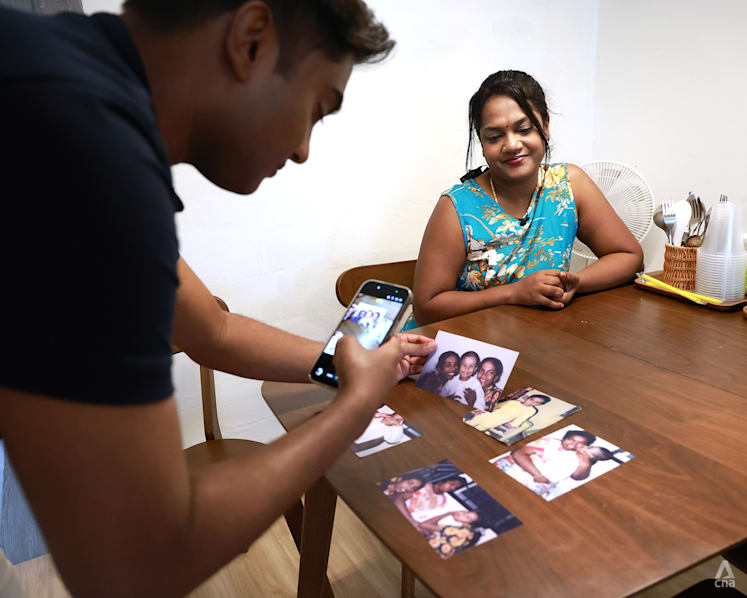
"All the things he went through – he's definitely a hero. But this boy is on a very positive path, and I know he is going to make us more proud," said Ms Shalini, beaming. Her cousin, sitting next to her, is clearly overcome with emotion in this moment – he can barely voice a response.
It's the same awe I see in him the next day, when we visit the children's home in Pasir Panjang where he grew up.
Save for the sound of leafblowers, it's all quiet on the emptied-out grounds of The Salvation Army The Haven. The residential home's operations have moved since 2024 as the Pasir Panjang site is slated for redevelopment.
A few steps into the foyer and he immediately recognises a flurry of details – the same seahorse, dolphin and star design on the metal gates, and the landline he used to call staff members on when he returned from home visits.
Eyes welling up with tears, he told me: "I feel like my dream has come true."
That dream was never to be a social worker – he once wanted to be a scientist, a marine biologist, or someone who worked with plants.
But this is no surprise to Ms Margaret Wheatley, 65, a former houseparent at The Haven.
"(Dino) has the niche and compassion for it," said Ms Wheatley, who is now a part-time gallery officer.
"He had the gift of the gab. He could make friends with anybody new – he had that charisma in him."
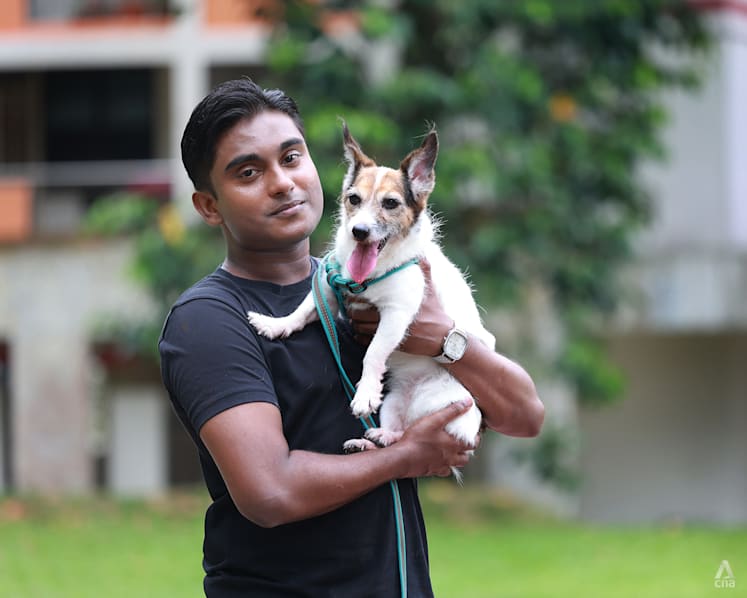
Walking around the compound, I asked Mr Dino what his younger self, who ran through these halls at times angry to be there, would think about him now.
"I think he would be more at ease," Mr Dino said. "I know I don't have a degree and all that, but I'm successful in a sense where I keep myself safe, I'm healthy, I'm happy, my mental health is great."
Having fought more battles than most just to be alive today, he now wants to fight for others too. Part of that, for Mr Dino, is sharing his story as openly as he can.
"I'm not afraid of the struggles I've gone through. I wear it as a badge of honour," he said. "And I want to motivate people, especially young people, to keep on pushing as well.
"Even with a crazy childhood like mine, you can come through alive and thriving."
Where to get help
National Mental Health helpline: 1771
Samaritans of Singapore Hotline: 1767
Singapore Association for Mental Health Helpline: 1800 283 7019
If you or someone you know is facing family violence-related matters, you can call the National Anti-Violence & Sexual Harassment Helpline at 1800-777-0000.
You can also find a list of international helplines here. If someone you know is at immediate risk, call 24-hour emergency medical services.