Often mistaken as being Malay, this China-born woman speaks Mandarin and runs a halal Chinese restaurant
When Ms Aisha Tan Xiuzhi couldn't find the Xinjiang flavours she and her children missed, she decided to recreate them herself. Today, she's found a way to bring a taste of home to Singapore, which has since grown into a popular halal Chinese restaurant.

This audio is generated by an AI tool.


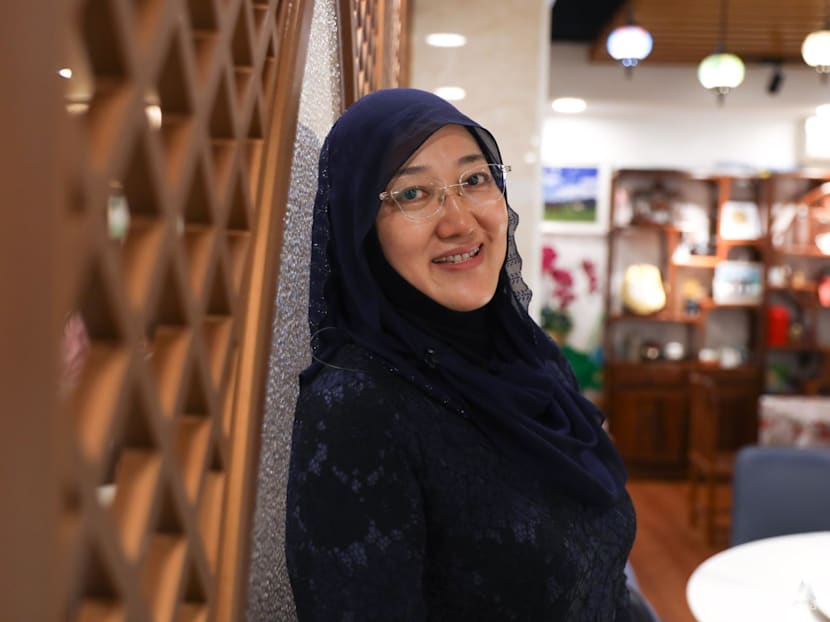
At first glance, Ms Aisha Tan Xiuzhi is often mistaken for being Malay, something she has grown used to.
The 53-year-old wears a beautiful, long dress that resembles a traditional Malay cultural outfit, a tudung and a warm smile to welcome patrons into her halal restaurant in Joo Chiat.
But the moment she speaks, a stream of Mandarin flows effortlessly.
"Because of what I wear, people assume I'm Malay, or I've converted to Islam. When I say I'm from China, they say they wouldn't have expected that," she told me in Mandarin.
We sat in a cosy nook of her noodle restaurant, our conversation occasionally punctuated by soft clattering from the kitchen. Customers were few, but the midday quiet was not business as usual for the establishment. Our visit coincided with Ramadan, the Islamic month of fasting from dawn to sunset.





Ms Aisha has been living in Singapore for the past 14 years. Born in Xinjiang, China, she later married and moved to the neighbouring province of Qinghai, where her husband is from.
Back then, she had no plans to go abroad. She was more than content to run the foodstuffs trading business she and her husband owned and operated, specialising in Qinghai specialities such as cordyceps, a type of fungi used in Chinese medicine.
And then she had children, and began thinking about their education and their future.
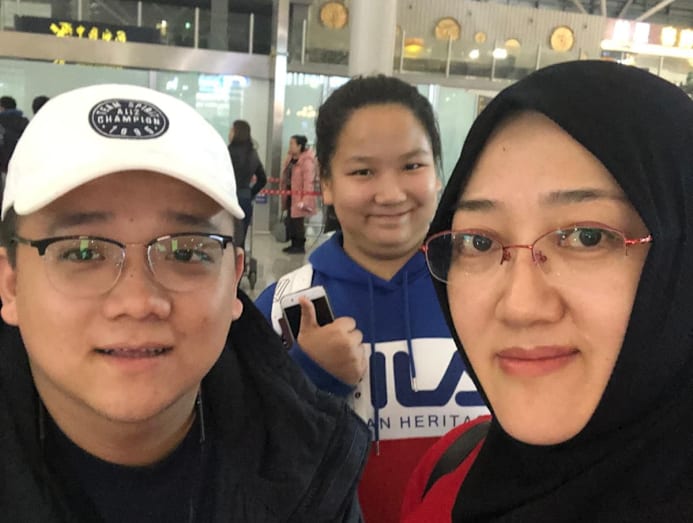
And so, at 39, the intrepid mother of two arrived in Singapore with her 14-year-old son in tow. A year later, her nine-year-old daughter joined them and enrolled in Primary 3.
The plan was simple: Stay for a few years, help the kids settle in, then return to China.
But when a few years had passed, she found it difficult to leave her kids behind.
"I felt they were still too young, so I stayed a bit longer. Then, before I knew it, 14 years had passed," she said.
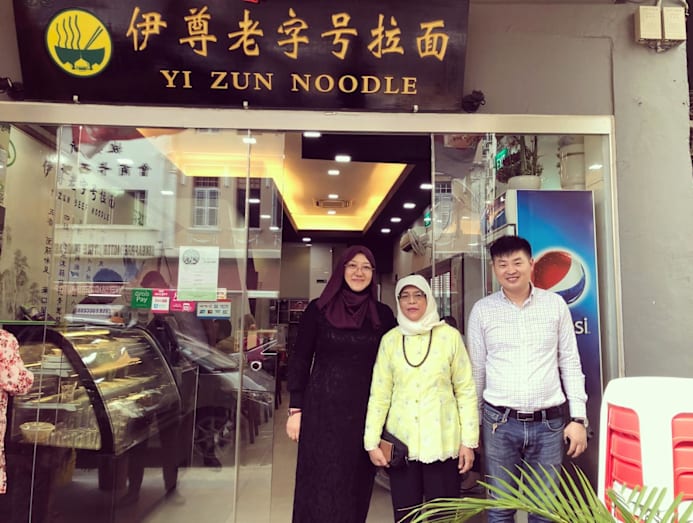
Today, Ms Aisha runs Yi Zun Noodle, a halal Chinese restaurant known for its hand-pulled noodles and Xinjiang-style dishes that now boasts not one but three branches.
Besides the original Joo Chiat outlet, she's opened two more at Marina Square and City Square Mall.
But how did she go from study mama to successful entrepreneur and restaurateur?
ADJUSTING TO SINGAPORE WHILE MISSING HOME
With a burgeoning business on her hands back in Qinghai, plenty of friends and family members were confused by Ms Aisha's decision to uproot herself and her children. Couldn't they study in China, they asked?
"I wanted them to have a different experience and broaden their horizons," she said.
She already had friends who had sent their own children here to study, and each spoke highly of it. It's one of the safest cities in the world, the education system is strong, and there are enough Mandarin speakers for Chinese nationals to get by.
It made only practical sense for Ms Aisha to follow suit, with her husband remaining in Qinghai to run their business.
Despite her enthusiasm for Singapore, adjusting to life here was not easy at first, Ms Aisha admitted.
Much of it was due to language barriers, despite her initial assumptions that there wouldn't be many.

Her children had to get used to studying in English, relying on extra tuition to keep up in their first year. Meanwhile, she struggled to navigate a foreign city, where even running everyday errands felt unfamiliar and stressful.
It was a far cry from the life she knew growing up in Xinjiang's Altay city and later in Xining, Qinghai, where she had been living with her husband since they were married. The two cities are about 2,000km apart, but despite the distance, there were enough similarities for her to get by on intuition and common sense.
Here, she couldn't do that, especially at the start.
She recalled how disorienting it was to get used to things being "the other way round" here in Singapore – the order in which dates are written, for instance, or left-hand traffic.
"I would even get lost on the MRT sometimes, trying to figure out my way around."
One silver lining Ms Aisha hadn't expected: How easy life could be as a Muslim in Singapore.
"Before I came to Singapore, I thought halal options might be limited because of the large Chinese population. But after arriving, I realised it's actually very Muslim-friendly."
She was pleasantly surprised that halal food was generally easy to find in most neighbourhoods. However, Ms Aisha and her children quickly found that most halal options came in the form of Malay or Indian cuisine, or Western fare.
Halal food was everywhere in Singapore – but halal Chinese dishes, particularly ones that reminded them of home, were scarce.
Ms Aisha cooked occasionally for herself and her kids, but it was not quite the same.
Meantime, she was also trying to get a business off the ground here.
In 2013, she opened a small shop in Chinatown selling cordyceps and other Qinghai specialities, continuing her trade from China. But sales were slow, and she closed it in 2015, not expecting to stay in Singapore long-term.
By then, the question of food had become more persistent. During school holidays, when Ms Aisha took her children back to China, they would often ask for beef la mian (hand-pulled noodles) because back in Singapore, nothing came close.
Eventually, an idea sparked in her head: "Why not introduce Muslim food from China to Singaporeans? Let them try it, see how it's different."
Around this time, she reconnected with a man whose goals seemed to align with hers: Mr Li Xinyi, a Henan-born chef who is now Singaporean and looking to start his own venture.
Mr Li, 50, and Ms Aisha had met in Singapore through a mutual friend a few years earlier. They had casually discussed entering the food and beverage industry, but she had her reservations about working together because she didn't think they had enough in common.
They were each scouting for a shop space on their own and ended up visiting the same premises together. That day, what once had been a fleeting idea suddenly felt concrete.
"We started thinking about whether we should partner and open a restaurant together," said Ms Aisha.
Further discussion revealed a promising compatibility in their skill sets: "I'm better at management and administration, and he's more familiar with the kitchen.
"That's how we started looking for a place, which later became Yi Zun's first outlet."
BUILDING YI ZUN NOODLE TOGETHER
In 2017, Ms Aisha and Mr Li found a unit near Mustafa Centre in Little India and moved in quickly to set up their new business.
But it proved to be a rough start for the new partners. There were licences, permits and insurance requirements they had not fully accounted for. For two to three months, they still had to pay rent for the premises even though they were unable to operate.
They finally got themselves up and running, but business was painfully slow at first. On some days, they made only a few hundred dollars – barely enough to cover manpower costs.
Focused on survival, they hadn't spent much thought on marketing. But then local media outlets started paying attention to them – at the time, the concept of a halal Chinese restaurant serving Xinjiang-style cuisine was certainly rare in Singapore.
Soon, the online buzz quickly turned into a physical crowd, with queues to dine lasting about two hours, Ms Aisha recalled.
At first, Malays made up the majority of their patronage but over time, the crowd diversified to include more Chinese diners as well.
Eventually, they had to face up to the fact that their little Mustafa unit, seating only 56 diners, was simply too small. They closed that space and reopened the business at Joo Chiat Road in February 2019.
They remained popular despite the move, but when COVID-19 struck a year later, they were once again thrust into a struggle for survival.
"We didn't lay off any employees. We just held on and pushed through," Ms Aisha said. During that time, her landlord assisted by waiving several months of rent.
"When it was hard to pay staff salaries, we took loans. It was very tough."
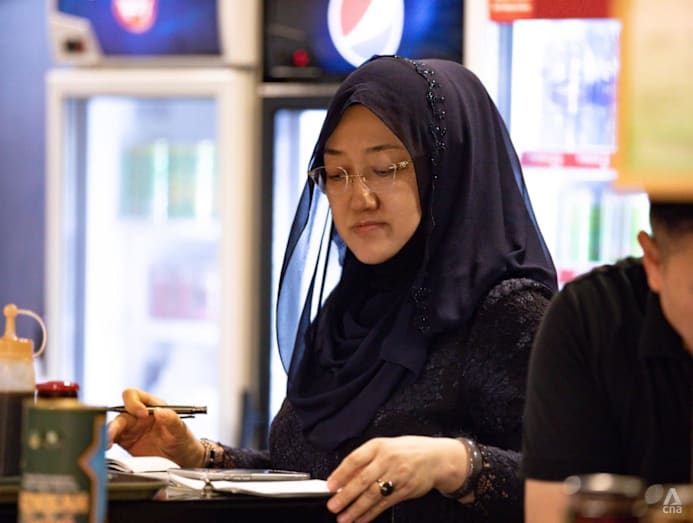
It was only after weathering that period that business began to recover, she said.
Today, their Joo Chiat outlet is large enough to accommodate around 280 diners. Over the last seven years, they've seen a mix of customers traipsing in and out, not just Malay Muslims.
The restaurant has even hosted Malay weddings, serving dishes course by course to guests in the traditional Chinese restaurant style, a contrast to the usual buffet spread.
That evening, I watched from my corner nook in the restaurant as families began arriving after 5.30pm, in preparation to break their fast.
As the tables filled up, a major glitch struck: the digital cash register malfunctioned.
Immediately, Ms Aisha sprang into action, handing out pens and paper and directing waitstaff to jot down reservations and orders.
Most customers had pre-ordered set menus prior to their arrival, but with the cash register down, the team had to manually check and track existing orders, bookings and additional requests for customisation.
As Ms Aisha kept service running smoothly, Mr Li watched over the flow of dishes coming out of the kitchen. Even with the sheer volume of pre-orders, every plate had to meet his exacting standards.
Despite the tech hiccup, as far as I could tell, all customers broke their fast and ate on time. No complaints, no expressions of discontent or dissatisfaction.
As happy customers ate and laughed, oblivious to the myriad challenges their hosts were resolving in real time, I marvelled at the many hurdles Ms Aisha has overcome simply to keep the business afloat – let alone to expand it to two more outlets, one in Marina Square shopping mall in 2022 and another in City Square Mall in 2025.

Nevertheless, some hurdles remain.
Today, manpower remains one of Ms Aisha's biggest concerns.
Finding chefs who can replicate the techniques and flavours she wants is no easy task, especially for dishes with a storied history that rely heavily on the cook's cultural instinct and experience.
To bridge that gap, she brought in chefs directly from China and carefully oversees each menu item alongside Mr Li. It's crucially important to her that the flavours carry the same memory of home, no matter which outlet a customer visits.
Ms Aisha has also had to make other adjustments to how she does business in Singapore, though they're not always about logistics or operations.
She told me how, in Xinjiang, food is typically eaten piping hot, which brings out its full flavour. When Ms Aisha first opened Yi Zun, she often found herself grappling with the urge to chivvy customers along instead of letting their food cool.
"I wanted to tell them: 'Please eat it now, it tastes better when it's hot'," she said, trying to mimic the urgent gestures she used to show customers.
"But in Singapore, I realised many customers prefer to let their food cool before eating. So over time, I learnt to stop insisting."
She paused, and laughed. "The more I say, the more I might make them think there's something wrong with the food!"
A PLACE TO CALL HOME
During her first few years in Singapore, Ms Aisha found herself struggling not only to help her children adjust to a foreign country and keep a business running.
Back home in Xinjiang and later Qinghai, she was part of tight-knit communities that banded together and looked out for each other.
But here in Singapore, making friends proved trickier than she thought.

Despite the country's majority Chinese population, she found it difficult to relate to and forge friendships with people. Her instinct was to gravitate towards the Malay Muslim community, but soon found many of her interactions limited as she could not speak Malay.
Many of her early encounters with people in Singapore were transactional rather than social, and the most familiar faces to her were the Mandarin-speaking Malay agents who helped her secure housing and navigate a new city.
She also took some time to adjust to social differences. She observed that women in China tend to be more reserved and family-oriented, whereas women in Singapore are generally more direct and independent.
"Life back home was also more intertwined. Relatives and neighbours were closely involved in one another's daily lives," she said. "Here (in Singapore), people give you more space."
She kept pushing, striking out to make meaningful connections of her own.
Now, 14 years on, Ms Aisha has both Chinese and Malay friends aplenty. A Malay friend started inviting her to activities organised by the Muslim Converts' Association of Singapore, a non-profit organisation also known as Darul Arqam.
She began attending these activities regularly, even volunteering to help distribute food or offer support where needed. Through such events, she has also managed to meet and form strong connections with other Chinese Muslims – unlike her, most are converts to Islam.
Over time, even the agents who had helped her with housing and business affairs became some of her closest friends here. To this day, she continues to meet with them regularly, having hearty chats over food and tea.
Slowly but surely, she has built a network of friends and like-minded people – her new community away from her old ones in Qinghai and Xinjiang. Picking up Malay is also on her to-do list.
Ms Aisha has also developed a strong appreciation for Singapore's multicultural melting pot, with festive occasions being celebrated in different ways than back home.
She recalled big festivals in Xinjiang for Hari Raya Haji, which commemorates Prophet Ibrahim's willingness to sacrifice his son as an act of obedience to God.
"We'd slaughter lamb or cattle, sing, dance and wear new clothes. Chinese New Year is not something we really celebrate there."
Despite the lack of grand town-square-style events in Singapore, her excitement was palpable as she described how heartwarming it was to see families here dressing up in matching traditional attire during Hari Raya Puasa and going out to visit one another.
"I even asked my kids if they wanted to do the same, but they're not too keen on matching," she laughed. "Sometimes, though, they'll make an effort to coordinate (our outfits) when we go out to eat together."
What's next for a person who has spent 14 years building a life in a country that's not her own?
Ms Aisha's son, now 29, has since returned to China temporarily with his wife, whom he met while studying in Singapore. Her daughter, now 22, is currently attending university in Australia.
Her husband is still based in China to manage the family business, visiting Singapore once every month or two.
But Ms Aisha is in no hurry to leave the country she's spent over a decade making her home. After all these years, going back to China no longer feels quite the same.
As for Yi Zun, she sees it as both a livelihood and a mission to share Chinese cuisine, with hopes of expanding its presence across Singapore.
"More than anything, I hope people in Singapore, whether they enjoy Chinese cuisine or halal food, will come and taste what we have to offer."