'Be human first, influence later': Why F&B operators are urging online reviewers to show empathy
These days, a single viral review posted online can make or break a small business. F&B operators tell CNA TODAY how they are navigating the double-edged sword of internet exposure.
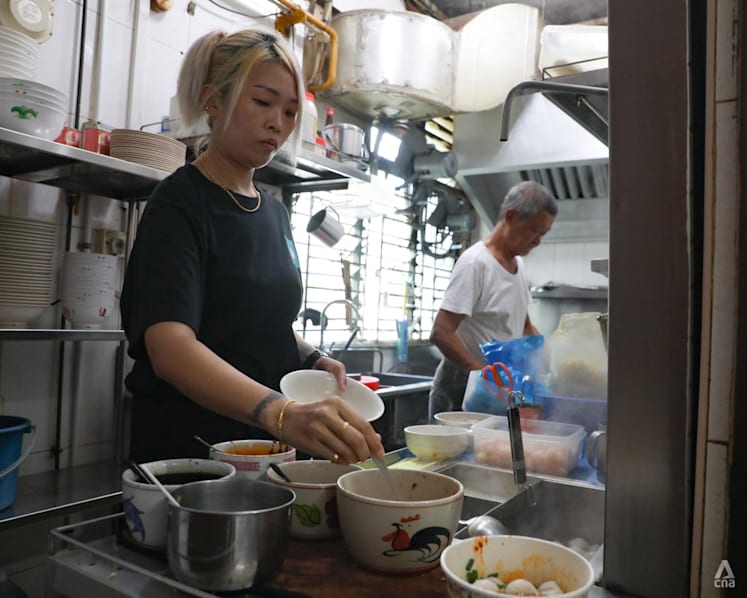
Ms Jean Lim, second-generation hawker at Ah Hua Teochew Fishball Noodles, and her father Mr Lim Jian Hua cooking fishball noodles for customers in the kitchen on Mar 16, 2026. (Photo: CNA/Mak Jia Kee)

This audio is generated by an AI tool.


Ms Jean Lim, who runs Ah Hua Teochew Fishball Noodles at Pandan Gardens, has to admit that online reviews have been a boon to her business every now and then.
Her stall has occasionally been featured by food influencers on social media, including those with sizeable followings, such as Miss Tam Chiak.
The 36-year-old second-generation hawker said that each time that happens, the impact is noticeable in the days that follow, with the stall seeing more new customers.
"Some customers even mention that they came after seeing the post online," she said.





"For a small hawker stall like ours, these changes are quite noticeable because most of our business relies on daily walk-in customers."
But sometimes, such exposure can also be a challenge to such businesses.
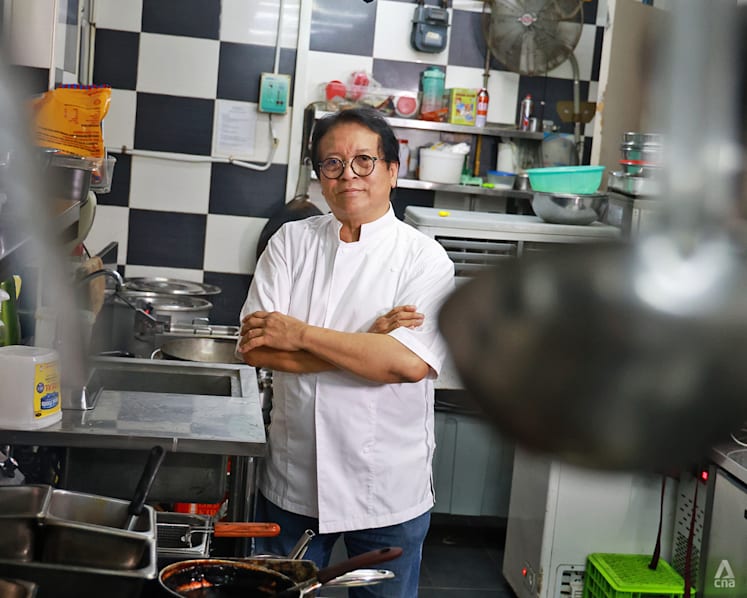
For Mr Frederick Puah, the 69-year-old founder of British Hainan Heritage Restaurant, that reality became clear when one of his now-closed outlets began attracting a string of negative reviews online in 2021.
The complaints, he said, were largely linked to issues caused by a manager he had hired at the time. But by the time the problem was identified, the damage had already been done.
In 2024, he decided to close the outlet and consolidate the business into a single outlet now operating at Kallang Way.
Online reviews, whether posted by influencers on social media or by everyday diners on platforms such as Google, have increasingly become part and parcel of running a food and beverage (F&B) business today.
Several operators told CNA TODAY that it remains tricky, especially when the difference between a positive review and a negative one can mean success or mere survival.
"BE HUMAN FIRST, INFLUENCE LATER"
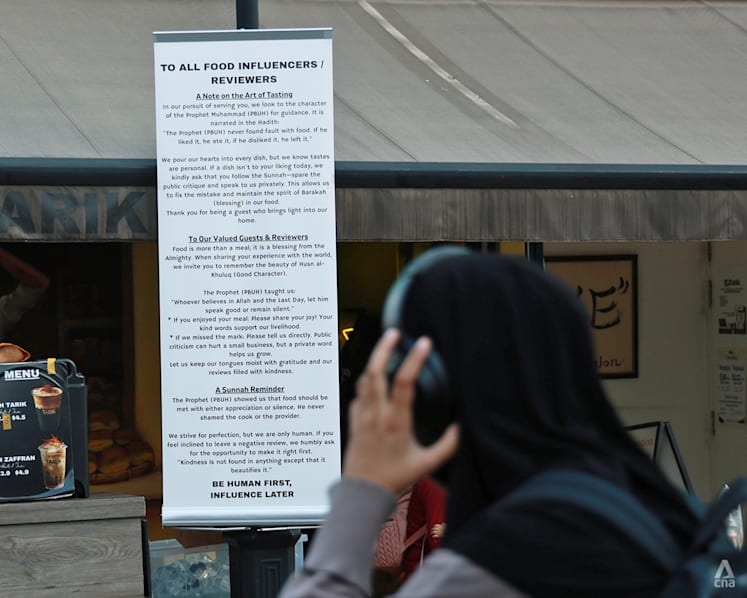
The issue came under the spotlight recently after a banner put up at the Kampong Glam Ramadan Bazaar went viral on social media.
The banner urged food reviewers and influencers to exercise kindness and to "be human first, influence later" when reviewing food, sparking discussions about how frank reviewers should be and whether negative reviews could unfairly harm small businesses.
Some observers argued that customers have every right to share honest opinions about food they have paid for. Others questioned whether it is the reviewers' responsibility to consider the potential impact of their feedback on business owners' livelihoods.
Mr Ali Redha, the owner of tea shop Tarik on Arab Street and a long-time participant in the Kampong Glam Ramadan Bazaar, said he put up the banner to encourage consumers and reviewers to spread kindness rather than animosity.
The 43-year-old, who ran a stall called Gohed Gostan by Tarik at this year's bazaar, said that while he believes consumers are entitled to their opinions, he also wanted to nudge reviewers to prioritise empathy over brutal honesty.
"An opinion can be valid, but its delivery doesn't have to be ugly," said Mr Ali.
"Honest criticism is acceptable when it stays specific and focused on the dining experience, but it becomes harsh or unethical when it degrades the individuals, misrepresents the situation, or causes disproportionate harm to a business purely for dramatic content."
Reviews can also be unfair when they ignore context such as price points, cuisine styles or a one-off bad dish, and instead paint an entire stall as terrible, he added.
Ideally, he believes vendors should be given a chance to make things right before a consumer flames their product online.
His concerns are widely shared by other small business owners.
Mr Syed Muhammad Farit Syed Ahmad, organiser of the Kampong Glam Ramadan Bazaar, said that before the bazaar opened in mid-February, about half of its 104 vendors had approached him with worries about how reviews might affect their business.
Mr Syed, who is also director at Syed's Trader, said some prospective vendors had raised concerns about high stall rental rates, and feared that negative reviews could lead to reduced footfall at the bazaar, making it difficult for them to recoup their costs.
To address this, Mr Syed said the organisers engaged influencers to promote the bazaar and its vendors on social media, particularly to help newer stalls gain visibility.
The vendors' concerns are not without basis.
In the 2024 edition of the Kampong Glam bazaar, a viral TikTok review of "smokey" fries sold by a stall called Frank On Wheels escalated into a dispute when the vendor threatened legal action over the reviewer's 1-out-of-10 rating.
More recently, last December, Hup Chong Yong Tau Foo, located at Block 203 Toa Payoh North, said in a Facebook post that a negative review by a local news site had turned "what should have been a Merry Christmas to the worst Christmas ever in our life".
The family behind the stall, which had announced its impending closure even before the review was published and subsequently shuttered in January this year, said it respects differing opinions and customer experiences.
However, they criticised the review for "shaming and moral judgment", adding that the article left them feeling "disappointed in humanity".

THE IMPACT OF FOOD REVIEWS
Despite being aware of the risks online reviews carry, most F&B operators told CNA TODAY that they generally view them neutrally: As tastes are subjective, mixed reviews are often inevitable.
Still, they must be prepared for real consequences, said Mr Daniel Charles, chief executive of Sum Capital Partners, which owns dim sum chain Sum Dim Sum.
He cited a viral social media post in 2022 or 2023 featuring a special menu item at their now-closed outlet in Punggol.
The video racked up a few hundred thousand views. In the days that followed, the outlet was packed with customers and the special item was selling out on a daily basis.
However, Mr Charles admitted that previously, his team did not pay much heed to negative Google reviews. They later realised that lower Google ratings could reduce their online visibility, in turn dampening foot traffic and overall revenue.
Today, they pay close attention to online reviews.
"We have a person on our team whose sole job is to monitor reviews, reply to the reviews and flag issues when the reviews talk about something negative," said Mr Charles.
Operators acknowledged that customers and reviewers have every right to share honest opinions. However, many echoed Mr Ali's view that the issue is not negative feedback itself but how it is conveyed.
Most said they would prefer customers to raise concerns in person if something is wrong, so that issues can be addressed immediately.

Mr Woo Wai Leong, chef-owner of Restaurant Ibid, said: "If something isn't quite up to your expectations, or you have a question about whether something is done in a way you don't think it should be, raise it with the establishment right there and then.
"If the restaurant team and operators care about the product they are putting out and the experience they are giving, they will do their best to try and fix it right there and then."
On the flip side, he added, it can be difficult for a restaurant to address issues when a customer leaves a review only after they have left, as the restaurant may not be able to get in contact with them again.
He said that even critical reviews can be helpful when accompanied by constructive feedback.
"It's a little difficult if someone just gives you two out of five stars with no explanation," said Mr Woo.
"But when a guest takes the time to write and say 'the food took too long', or maybe 'the restaurant's a little too warm', then those are salient points which I, as the business owner, can and should respond to."
And while operators say they cannot control what customers say, they can control how they respond – by taking feedback on board, improving their food and service and working to recover from the setback.
For instance, Mr Puah of British Hainan prioritises positive service interactions between staff and customers.
When staff are friendly, approachable and engaging, he said, diners are more likely to raise issues directly with the restaurant instead of turning to online reviews as a first course of action.
Ms Fateha Hashim, 26, said that for F&B businesses, both positive and negative reviews are inevitable. She is a staff member at Meokja, a Muslim-owned Korean restaurant that also ran a stall selling Korean street toast and hotteok, a sweet pancake, at this year's Kampong Glam Ramadan Bazaar.
"Our food cannot satisfy every single tastebud that is out there," she said.
"Reviews let us know if there's anything we need to improve, from the food taste to the preparation time or the service, so they are actually helping us to make our business better."
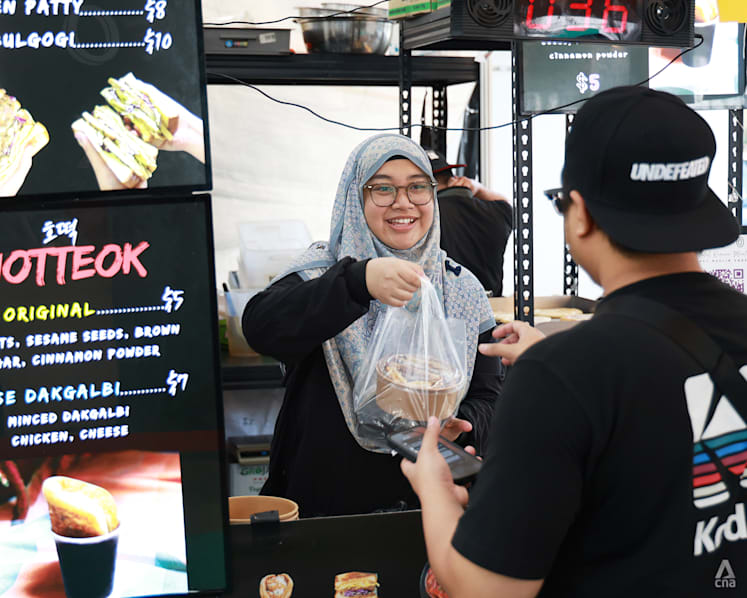
Ms Fateha said the team monitors and responds to feedback online from diners, as well as messages received on their social media platforms.
When customers have had a negative experience, the team will usually try to understand the issue and may offer a voucher for them to return and give the store another chance to make things right, she said.
HOW TO READ REVIEWS
Diners and consumers told CNA TODAY that while they value honest reviews, feedback should be delivered with fairness and restraint.
They cited a preference for reviews that focus on the food and overall experience rather than personal attacks.
Mr Eldred Wee, 34, said businesses are ultimately responsible for maintaining food quality, hygiene and service standards.
But he emphasised that exercising empathy when writing online reviews can have a significant impact on small F&B businesses.
"It is possible to say that something did not meet expectations without using language that tears people down," said Mr Wee, who is the founder and managing director of mergers and acquisitions advisory firm Edenity.
Noting that taste is subjective, Ms Shi Lee, a director at an entertainment commerce consultancy, said that the most helpful reviews are balanced ones, reflecting both what worked and what did not in terms of the reviewer's personal preferences.
"Someone who dislikes a particular flavour combination may rate it poorly, while others might actively seek it out," said the 45-year-old. To her, a constructive review frames feedback "in a way that helps others decide whether it suits their own tastes".

Diners also told CNA TODAY that they exercise their own judgment when reading reviews.
For example, some said the credibility of the food reviewer matters, and that they prefer to follow food reviewers and influencers who are known for offering neutral and honest assessments.
Some also noted that Google reviews posted by everyday diners may not always be reliable. For example, businesses occasionally offer perks such as free desserts or discounts in exchange for positive ratings.
On the other hand, some may use negative reviews as "leverage to demand better service, or to air grievances that may not be entirely fair", said Ms Geargina Tan, chief operating officer of WTFOX.ai, an artificial intelligence firm focused on business sales and efficiency.
However, some diners occasionally find value in seeking out certain types of negative reviews.
Ms Lee said that when researching a new eatery, she filters reviews to show the lowest ratings first, so she can understand common complaints and manage her expectations.
"The bad reviews … tend to tell you more about what could go wrong," she said. "On very rare occasions, I'll visit a place just to see whether the criticism is justified."
Overall, however, diners generally agreed that online reviews matter only so much.
Ms Tan, for one, said that personal recommendations from friends often carry more weight than any rating.
Agreeing, Mr Lim Wee Siang, a corporate wellness speaker, said that it is difficult to immediately spot any bias in online reviews.
The 38-year-old, who is also a health coach at Khrysalyst, a performance coaching firm, said: "The best is to try it for yourself before judging."
BEING A RESPONSIBLE REVIEWER
So how should an ethical diner go about providing fair and honest feedback for fellow consumers, while also being mindful of its potential impact on a family business?
Dr Shilpa Madan, an assistant professor of marketing at Singapore Management University (SMU), said that reviews play a key role in reducing uncertainty for other diners, especially in categories such as food where quality is subjective and only fully apparent after purchase.
"At the same time, research shows that negative information often carries disproportionate weight," she said. "This means carelessness in criticism can have effects larger than the reviewer intends."
Dr Madan said that a thoughtful review would distinguish between subjective preference and more "generalisable" problems.
For example, expressing that "this flavour profile was not for me" is different from implying that the business is objectively bad, she said.
Dr Leslie Tay, who has run food blog ieatishootipost for nearly two decades, said he strives to focus on sharing positive reviews when he finds food worth recommending.
Where there is room for improvement, he usually refrains from publishing a public review and instead informs the owners directly, especially if he has specific feedback. This is particularly the case for independent F&B operators such as hawkers or small establishments, where reviews could have an outsized impact on the business.
Dr Tay added that reviewers who wish to offer honest feedback should ensure the information they share is accurate and objective, and explain constructively what went wrong with the food.
For instance, if a reviewer claims that meat served at an establishment had been frozen, he recommended that they verify this rather than making assumptions. Reviewers, he said, should not make such claims online without first doing their due diligence.
On that note, Mr Charles of Sum Capital Partners said he hopes customers would act responsibly when giving feedback.
"Feel free to share a comment, but be factually fair," he said. Basing feedback in facts, he added, "works for both sides, because people also want to know what (other) people think about the business".
And what about times where we may feel the need to be brutally honest?
"You don't have to be brutal," said Dr Tay. "Be honest in a way that will tell people that 'it can be improved in this way'.
"Do it gently rather than vindictively."