

How my daughter’s reading list got caught up in India’s fight over essential commerce
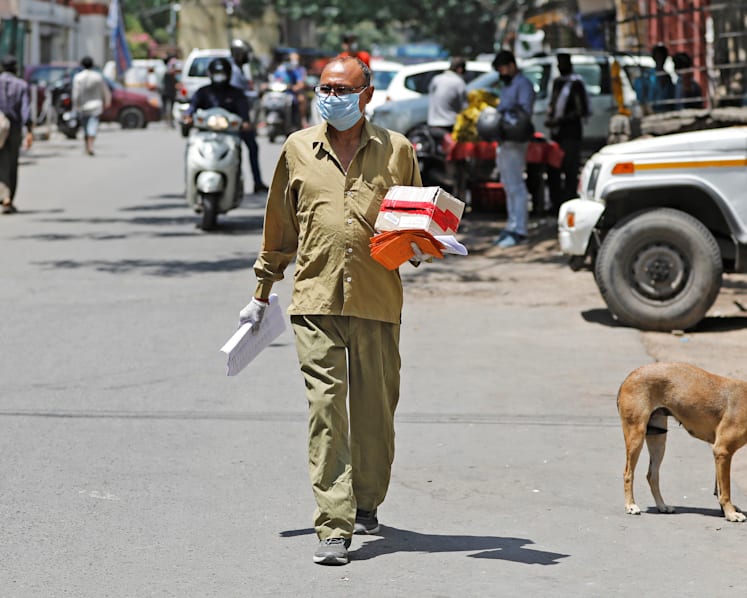
A postman walks on a street as he carries mails and parcels to deliver, during an extended nationwide lockdown to slow the spreading of Covid-19 in New Delhi, India, April 20, 2020.
In the days before Indian prime minister Narendra Modi’s coronavirus lockdown, I started to sense that things I might need could become harder to come by.
As Delhi markets began shutting down, I rushed around stocking up on items to keep my eight-year-old engaged on long days without school, friends or ballet classes.
I visited a toy store to buy board games to play. At the stationers, I bought a pack of 500 sheets of blank A4 paper, canvases, acrylic paints and watercolours, so she could explore her artistic side.
Once home, I went online to order a book that had sustained me as child: Little House on the Prairie, Laura Ingalls Wilder’s memoir of her childhood on the American frontier.





I was already reading the first book in that series to my daughter. The account of children who didn’t go to school and relied mainly on their hardworking parents for companionship resonated as we struggled with social distancing.
I hoped the book would help her realise that many children have grown up very differently from what she considered normal, and help her to come to terms with her own radically and rapidly changing circumstances.
But alas! A day or so after I ordered, Mr Modi imposed a strict, nationwide curfew, with just four hours’ notice.
Amazon India, Walmart-owned Flipkart and other ecommerce companies were thrown into chaos, their operations forced to a standstill by local authorities amid confusion as to what sorts of business, precisely, they were permitted to continue.
New Delhi has always had fraught relationships with ecommerce, though these companies are among India’s biggest foreign investors. These companies have built much-needed modern supply-chain infrastructure.
And, in a lockdown intended to keep people home and stop an infectious disease, they clearly had a vital role to play.
Yet ecommerce has also been viewed as a threat to India’s millions of independent mom-and-pop-store owners, a powerful lobby that Mr Modi’s ruling Bharatiya Janata Party has counted as core constituents.
As the lockdown began, New Delhi decided to restrict ecommerce firms to delivering “essential items” such as food, personal hygiene products, cleaning supplies and medical products. My unfulfilled book order was formally cancelled.
Although disappointed, I understood the official priorities, given how many people had been caught off guard by the lockdown and were anxious to stock up on staple foods and other basics.
But as urban Indians now endure a sixth straight week confined to their homes, with the prospect of more to come, many middle-class consumers are frustrated at the government’s narrow description of what constitutes an “essential item”, and angry at the tight restrictions on their online purchases.
There is now a mounting clamour for ecommerce companies to be permitted to deliver mobile phone handsets, laptops, power chargers and other essentials needed to cope with the challenges of lockdown life, including working from home, online schooling, breakages and boredom.
The government is aware of the rising angst. In mid-April, when the 21-day lockdown was extended for another three weeks, it said that ecommerce firms could start selling all manner of goods from April 20.
Amazon and Flipkart geared up to meet a surge of pent-up demand, especially for phones and electronics. (I kept checking to see when I could reorder my Little House book.)
But the powerful lobby of traders and small shop owners was anxious that their rivals might gain an unfair advantage. Under intense pressure, the decision to loosen the rules was reversed a few days later, with a fresh edict barring ecommerce sales of anything but groceries.
The Confederation of All India Traders was exultant at its win. But New Delhi’s bigger gift to its favoured constituents was yet to come.
Last weekend, it was announced that stores selling non-essential items could start to reopen across much of the country, if their state governments also approve the decision.
Yet, even now, companies including Amazon and Flipkart, which could safely deliver a wide range of items to people inside their homes, are barred from selling anything but groceries.
For my daughter, reading Little House on the Prairie will just have to wait. FINANCIAL TIMES
ABOUT THE AUTHOR:
Amy Kazmin is the Financial Times’ South Asia bureau chief. She is based in New Delhi, where she also reported for five years in the 1990s.




