When one of my 5 kids calls me out, I choose to own my mistake, not defend myself
After years of raising five children, Ms Daphne Ling believes that admitting mistakes and putting in the effort to do better actually matters more than getting parenting completely right.
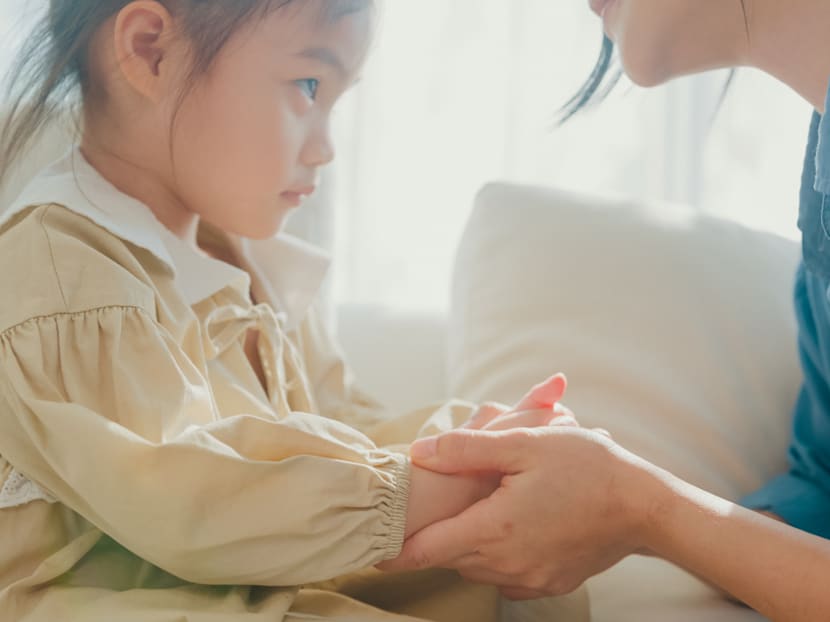
Ms Daphne Ling believes that real parenting comes from being able to honestly and humbly admit her mistakes, rather than seeking to be the "perfect" parent or becoming defensive. (Photo: iStock)

This audio is generated by an AI tool.


It was a work-from-home day, and I was alone with my two toddlers – Truett was three years old, and Kirsten, two years. While I took a long phone call in the living room, they played in the kitchen nearby, where my laptop was. I kept gesturing for them to keep it down.
But at their tender ages, they couldn't take the hint. Then suddenly, I heard a crash.
I walked into the kitchen to find my laptop on the floor, its screen cracked clean across.
Money was tight then, and I immediately knew that forking out a few hundred dollars just to repair my laptop was something we couldn't afford. I felt panic, then anger, and then both at once.





And so I yelled. Really yelled. I don't think I ever had before.
I still remember the looks on their faces. It was the mixture of devastation and terror that only very young children can show – the kind that tells you they don't fully understand what they did wrong, only that the person they love most in the world is furious with them.
I picked them up, held them close and apologised properly, with tears and no qualification.
It was not to teach them forgiveness, but to be accountable for what I had just done. Losing my temper like that is not who I want to be, or what I want to model. I haven't done it since.
But I've never forgotten it. I don't think I'm supposed to.
CHILDREN WILL NOTICE EVERYTHING
Our five children are now aged 10 to 18. Between my husband and I, we have accumulated many years of parenting experience, and with it, a running catalogue of mistakes we've made – in parenting and in life.
Like any other parents, we often talk to our kids about right and wrong. But after nearly two decades of raising kids, I've come to believe that what they observe us doing is a much more influential teacher.


It's easy to say the right words, but children are always watching our actions to see whether they match what we say.
And they notice everything from the good to the bad.
The "urgent" phone call we take after telling them to put their phones away. The harsh words or tone we use with them, after telling them to be kind.
When there's a gap between what we expect of them and what we hold ourselves to, they track all of it quietly, and they draw their own conclusions about whether we do what they say.
So when they call us out – and they do quite often – we can choose to either defend ourselves or own it.
For us, it has to be the latter. We admit our mistakes and say we're sorry because we want them to understand that admitting to a failure is the beginning of growth, not the end of it.
And more importantly, we learn from those mistakes. We genuinely try to do better each time, and show them that it is possible to become better versions of ourselves as we grow.
CONVERSATIONS GROW WITH THE CHILD
When the children were younger, the rules in our house were simple and non-negotiable. Put the phone away at dinner. Eat your vegetables. Limit junk food. Share your toys.
Young children need clarity and consistency. They're not yet equipped for nuance, and the boundaries give them something solid to stand on.
We want our kids to understand that admitting to a failure is the beginning of something, not the end of it.
As they’ve grown older, the conversations have had to change. A rule applied rigidly to an 18-year-old is a different thing altogether.
At some point, enforcing compliance is no longer the goal. Instead, it's about fostering understanding.
When we tell the older ones to put their phones away at dinner, we talk about why presence matters, about what it means to be fully in a room with the people you love, and how easily that gets eroded without intention.
We can tell them to limit their sugar intake, but we can't actually control what they eat or drink.
Instead, we need to have a conversation about what actually happens in the body: how a spike in blood glucose triggers a rapid insulin response, the crash that follows, and how that affects mood, focus and energy.
We want them to make informed choices, rather than just obedient ones.

And when I vent about something that irritates me – whether it be at the dinner table or in the car – my older children ask me questions I never asked my own parents, such as: "Mum, why does that bother you so much?"
The honest answer is that even though I'm working on being kind, I fail at it more times than I can count. There are days I get it wrong with the people I love most, and I have to sit with that.
Instead of simply saying "I made a mistake", I try to explain the part of my personality that led to it.
I think that is a more useful response for a teenager figuring out what triggers them – to be more aware of the gap between who they want to be and who they are on a hard day.
My kids already know that their parents aren't perfect.
What I want them to see as well is the difference between being imperfect and being self-aware, and that working to close that gap doesn't end when you become an adult.
LEARNING FROM OUR MISTAKES
I don't know yet how our children will remember these years. Memory is selective, and children remember their own versions of what we said and did – some may surprise you, while others might hurt.
But if they remember that their parents got things wrong and kept trying, kept apologising when they could've done better, kept being honest even when it was uncomfortable, I think that would be enough.
Getting it wrong sometimes is only human. What you do after is what actually shapes a person.
I won't know for years whether we've got this right. Parenting is one of those things you only get to evaluate in retrospect, and by then the window has already closed.
But I'm certain of this: Pretending to be perfect in front of our children would have been the biggest mistake of all.
Not because perfection is undesirable, but because it isn't real – and children know the difference between someone who pretends to have it all together and someone who is genuinely trying.
We are, without question, a work in progress. We get things wrong. We say so. We try again.
The real parenting happens when we can face up to our mistakes with honesty and humility.
Daphne Ling is a mum of five. She is also the co-owner of an advertising agency.