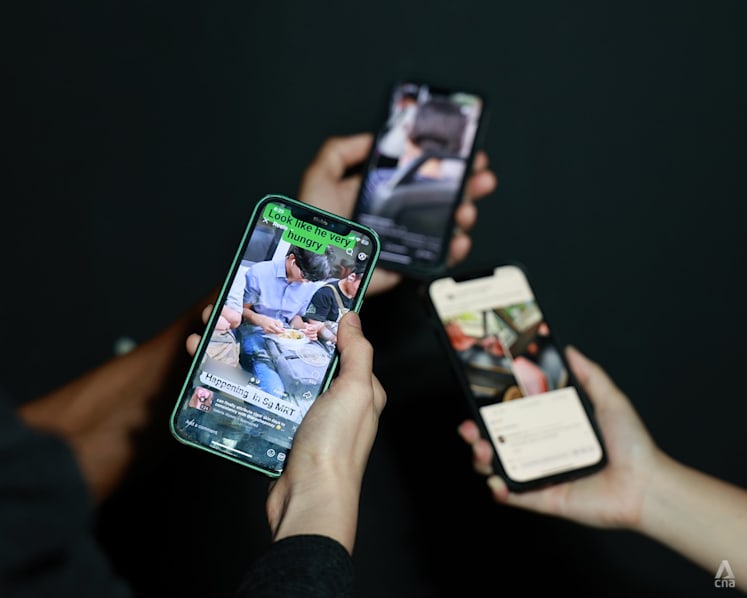
Why do we take issue with people who film and post their mental breakdowns online?
Is online authenticity dead? CNA Lifestyle's Grace Yeoh delves into why highly emotive content can evoke reactions of fatigue and scepticism rather than sympathy from audiences.
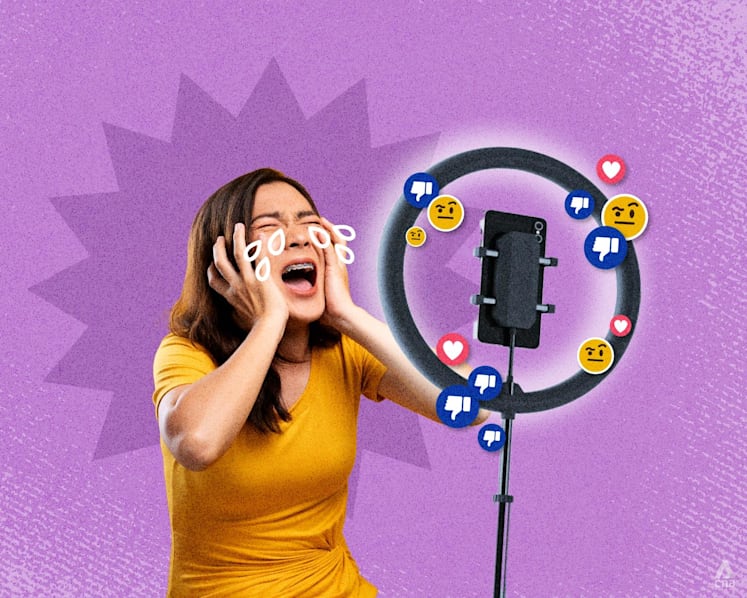
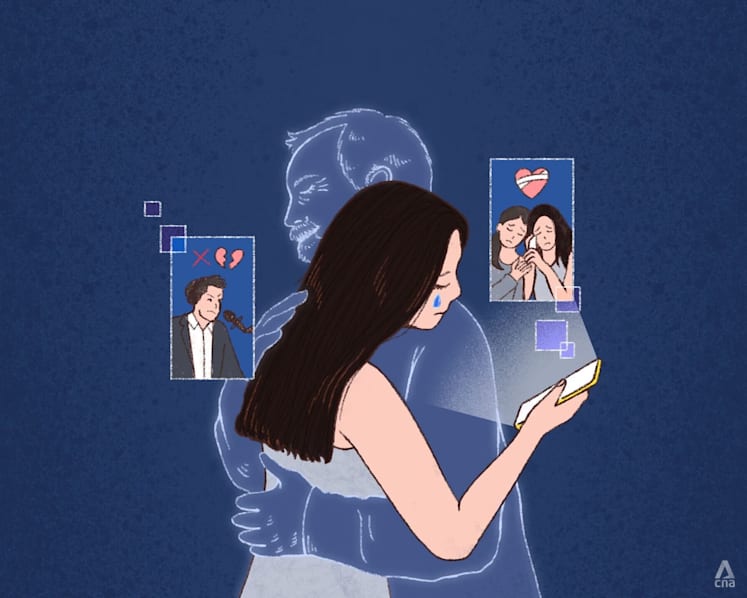
Many people automatically assume that someone was fabricating their distress for clicks if they chose to share it on social media. (Illustration: CNA/Nurjannah Suhaimi)

This audio is generated by an AI tool.


If I had a full-blown panic attack on a plane during turbulence, would I film my visceral reaction and upload it online for my few hundreds of followers to see? Probably not.
I wouldn't want to recall the trauma every time someone left a comment or reacted to the post, or have my name forever tagged to the incident via good old search engine optimisation.
But that doesn't mean I would automatically assume that people are fabricating their distress for clicks if they chose to share it on social media.
Yet, a Korean woman living in Singapore drew such flak after she uploaded a video on Jan 12 of her panic attack on a plane.
"Mia" goes by the handle @_youmia on TikTok, where she has more than 28,000 followers. She was filming a vlog of her flight when turbulence hit. She screamed, her face contorted in distress, while a passenger beside her was seen reaching across her armrest to calm her down.
The final clip included her panic attack and it has since racked up more than 34 million views.
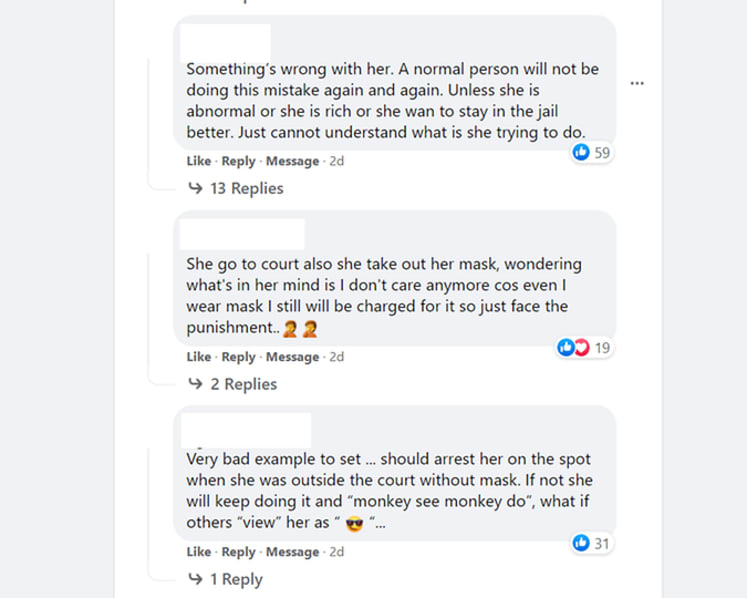
Many people who commented called it a "performative mental breakdown", suggesting that it was "planned", with some saying that it was not "what a panic attack is like".
One remarked, sarcastically, that she was "so brave for still having this (video) up".





Having watched the clip, it was clear to me that the issue wasn't really about her "dramatic" reaction to the turbulence, but that she had chosen to film and upload it.
She had committed the ultimate social media faux pas: appearing inauthentic.
WHEN DOES SOMETHING BECOME PERFORMATIVE?
Mia is obviously not the first person to have her social media post go viral from sharing personal reactions to private incidents, so the response to her experience was almost expected.
People questioned whether her emotions were legitimate simply because she didn't behave as they thought she should.
What likely made matters worse was her attempt to clarify later, in a second video posted Jan 15, adding that she had included the panic attack clip in the initial post because she thought it was "funny".
People using dark humour to reckon with their hurt and trauma in online content is not a new trend. Mia's second video also revealed that she had been a passenger on the SQ321 flight that experienced severe turbulence in 2024.
Instead, the choppy editing – a hallmark of TikTok videos – had cut abruptly from a shot of her enjoying a meal to her shaking in fear and back again, making her panic attack come across to many as a mockery of the real deal.
The resulting public backlash was another reminder of the growing audience fatigue around content that appears to have been carefully curated for clicks.
In 2022, Braden Wallake, the chief executive of marketing agency Hypersocial, sparked controversy when he posted a selfie of himself crying on LinkedIn after he laid off employees in his company.
Like Mia, he was swiftly dogpiled online for being performative.
Arguably, the criticism was more understandable in Mr Wallake's situation. He may have intended for his post to come across as accountability, but by highlighting his own sadness amid the major distress he had just caused his employees, it was only tone-deaf.
He may have been genuinely upset, but even if those feelings were valid, he wasn't entitled to air them, according to the rules of social media etiquette.
And when both he and Mia failed to read the room, they were taken to task – less for what they had posted and more for the seemingly disingenuous attempt at seeking sympathy.
.jpg?itok=SlAOOCr8)
Psychologist Ong Mian Li explained to me that digital creators are aware that emotionally intense content tends to travel further online and can translate into more views, followers or income.
This awareness can shape how emotion is presented, even subconsciously, he said.
Dr Ong, the founder and principal clinical psychologist of Lightfull Psychology and Consulting Practice, also said that audiences have become more aware that "emotional intensity is rewarded with engagement" and hence, have grown more sceptical of how emotion appears online.
"Judgment around the authenticity of a video is no longer about what is felt, but how it is framed, too."
I've noticed a similar turning of the tide when it comes to positive emotion as well.
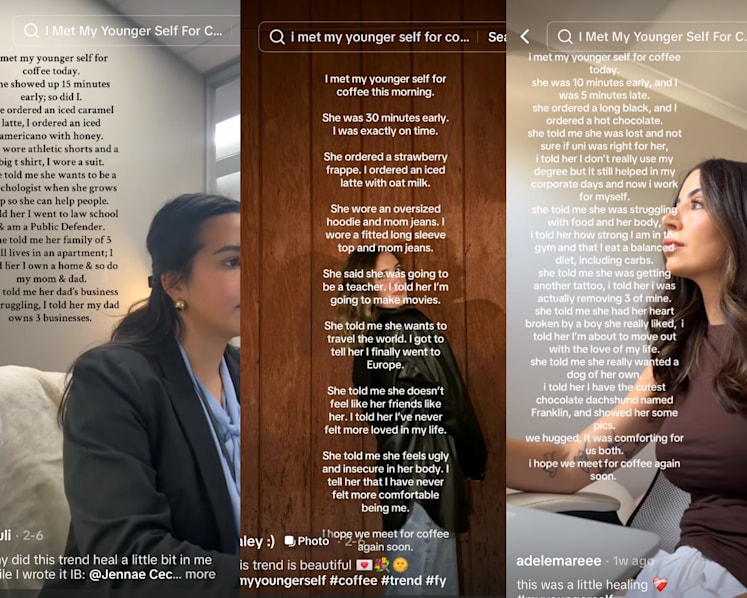
Recall the viral "I met my younger self for coffee" trend from early 2025. As more people jumped onboard, what started out as an exercise to spark reflection and self-compassion soon felt like a thin excuse to humblebrag about one's successes in a contrived comeback story.
Elsewhere, content creator couples whose posts are entirely about their relationship are also sometimes met with comments suggesting they may be overcompensating for something lacking.
Over time, viewers may pull back, not because they lack empathy but because constant exposure to visible (extreme emotional states) is psychologically draining.
Such judgments may stem from projection – the act of attributing to others the feelings or opinions one would have in a similar situation.
But they also point to the long-term effects of repeatedly consuming "highly emotive content, especially when it appears optimised to provoke a reaction", Dr Ong noted.
"Over time, viewers may pull back, not because they lack empathy but because constant exposure to visible (extreme emotional states) is psychologically draining."
SEEKING CONNECTION, NOT JUST ATTENTION
That said, Dr Ong stressed that "performative elements do not cancel out real distress", and it does not mean that the distress is "fake".
"A person can be genuinely overwhelmed while also shaping how that distress is presented, especially on platforms where attention and reaction are rewarded," he said.
"Wanting to be seen and responding to incentives are not mutually exclusive."

Regrettably, the attention-seeking nature of social media has made the very act of seeking attention feel "cringe" and taboo, as though it is morally inferior to desire external validation – or at least to appear as such.
But like Dr Ong, I'm more inclined to consider another perspective: that we're all driven by the basic human need to know that our experiences matter, even if I might not present my need in the same way.
"At its core, it is important to note that such behaviour is usually driven by a need for connection and validation, not purely attention.
"When people are overwhelmed or afraid, the nervous system looks for reassurance," he said.
"With its immediacy, social media has often become a substitute for social support. Posting can feel like saying, 'Please witness this. Help me feel less alone'.
"The validation from others can have an 'ameliorative' (soothing) effect in the short term. Feeling understood or affirmed can reduce shame and calm distress, especially after fear-based experiences."
Of course, this nuance is likely lost on the average social media user, who has no immediate incentive to pause before passing judgment.
Several online users cast doubt on Mia's panic attack because she had glanced at the camera, as if awareness of being filmed negates the authenticity of what is captured.
Dr Ong pointed out that during intense emotional states, such as a sudden panic attack, people don't always act "strategically".
For some, the mere act of recording can be "a familiar or automatic behaviour rather than a calculated performance".
In her clarification video, Mia explained that she had fractured her spine during the severe turbulence on SQ321 and the experience has left her "so paranoid" in brushes with air turbulence, even mild ones.
Therefore, her panic attack this time was very real.
Personally, I didn't think she needed to explain herself. But that seems to be the nature of sharing anything online these days: If you look to others to help hold your emotions, you are responsible for making sure those emotions are easy to hold.
Genuine healing, however, requires more than "brief and fragmented" affirmation and reassurance from strangers online, Dr Ong said.
It also requires learning to regulate one's emotions internally.
"When emotional expression is shaped by engagement incentives as seen on social media … it becomes (harder) to trust what we see online and to respond humanely to real distress," he added.
The unfortunate result, from my observation, may ironically be the direct opposite of more authentic sharing online.
We may be collectively building a culture where people increasingly second-guess how they express themselves, knowing that others would judge those emotions against how they believe such expressions should look.
Sometimes, what we label as inauthentic is simply unfamiliar. Cementing a shared reflex to condemn it is a choice that may come back to haunt us when we are the ones seeking understanding.
Grace Yeoh is a correspondent with CNA Lifestyle.
If you have an experience to share or know someone who wishes to contribute to this series, write to voices [at] mediacorp.com.sg (voices[at]mediacorp[dot]com[dot]sg) with your full name, address and phone number.