Push for democratised AI and stronger safety rules at India summit
Prime Minister Narendra Modi said at India's AI Impact Summit that artificial intelligence must be made widely accessible, stressing that it should serve as a tool for inclusion and empowerment, especially for countries in the Global South.
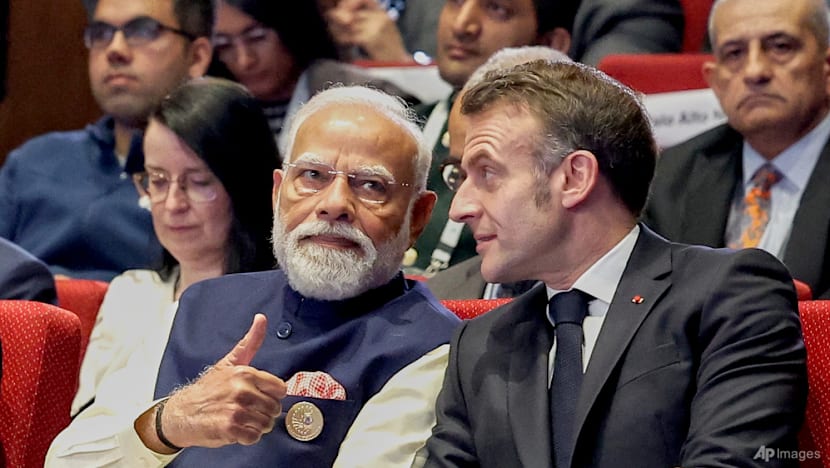
India's Prime Minister Narendra Modi, left, talks with French President Emmanuel Macron during the AI Summit in New Delhi, India, Thursday, Feb 19, 2026. (Photo: AP)
NEW DELHI: Artificial intelligence has to be open to all, Indian Prime Minister Narendra Modi told a global AI summit on Thursday (Feb 19).
"AI has to be democratised so that humans do not just become a data point for AI or remain a raw material for AI," Modi said.
"We must democratise AI. It must become a medium for inclusion and empowerment, particularly for the Global South."
The AI Impact Summit is the fourth annual international gathering focused on the rapidly advancing field.
Last year, India leapt to third place in an annual global ranking of AI competitiveness calculated by Stanford researchers.
But despite plans for large-scale infrastructure and grand ambitions for innovation, experts say it has a long way to go before it can rival the United States and China.





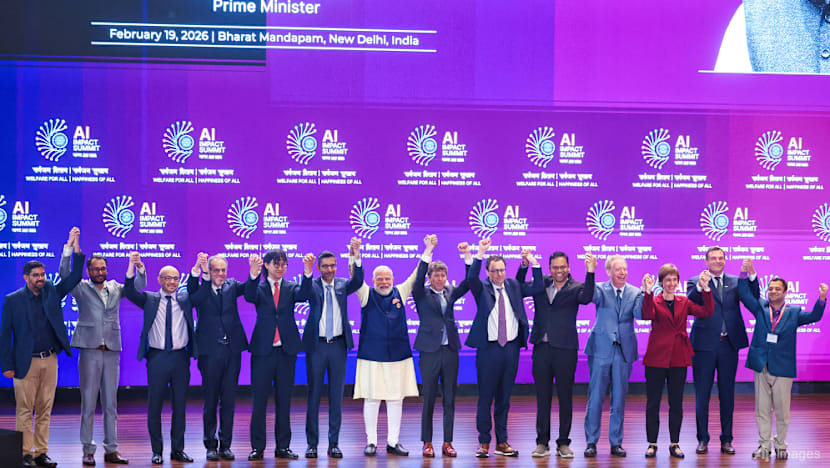
In his speech, Modi highlighted recent launches of AI models by Indian companies, saying that "the AI model which succeeds in India can be deployed all over the world".
"India believes that AI technology will only be beneficial when it is shared and its core systems are open, only then will our millions of young minds be able to make it better and safer," Modi added.
"We must resolve that AI is used for the global common good."
Modi added: "We are entering an era where humans and intelligence systems co-create, co-work and co-evolve."
Modi delivered his speech in front of an audience that included the UN chief Antonio Guterres, French President Emmanuel Macron, and top executives of AI firms like OpenAI CEO Sam Altman, Google CEO Sundar Pichai, and Anthropic CEO Dario Amodei.
UN CHIEF TARGETS TO RAISE US$3 BILLION FUND FOR AI
Guterres in his speech at the global AI summit warned technology leaders of the risks of AI, saying its future cannot be left to "the whims of a few billionaires".
He pressed for global guardrails to ensure oversight and accountability, and the creation of "Global Fund on AI" to build basic capacity and called for the global tech executives to contribute to it.
"Our target is US$3 billion," he told the conference. The fund is to ensure open access to the fast-advancing technology for all.
"That's less than one percent of the annual revenue of a single tech company. A small price for AI diffusion that benefits all, including the businesses building AI."
Without investment, "many countries will be logged out of the AI age", exacerbating global divides, he said.
"AI must belong to everyone," he said.
"The future of AI cannot be decided by a handful of countries - or left to the whims of a few billionaires," he added, warning the world risked deepening inequality unless urgent steps were taken.
"Done right, AI can ... accelerate breakthroughs in medicine, expand learning opportunities, strengthen food security, bolster climate action and disaster preparedness and improve access to vital public services," he said.
"But it can also deepen inequality, amplify bias and fuel harm."
The UN has set up an AI scientific advisory body to help countries make decisions about the revolutionary technology.
Guterres warned that people must be protected from exploitation, and that "no child should be a test subject for unregulated AI".
He also cautioned that as AI's energy and water demands soar, data centres must switch to clean power, rather than "shift costs to vulnerable communities".



MACRON ON SHAPING AI REGULATIONS WITH ALLIES
French President Emmanuel Macron, who spoke at the summit too, said he was determined to ensure safe oversight of the fast-evolving technology.
The European Union has led the way for global regulation with its Artificial Intelligence Act, which was adopted in 2024 and is coming into force in phases.
"We are determined to continue to shape the rules of the game ... with our allies such as India," Macron said in New Delhi.
"Europe is not blindly focused on regulation - Europe is a space for innovation and investment, but it is a safe space."

Under EU laws, regulators can ban AI systems deemed to pose "unacceptable risks" to society, such as identifying people in real time using cameras in public spaces.
Macron further said that France was "doubling the number of AI scientists and engineers trained", with new startups in the sector creating "dozens of thousands" of jobs.
Last month, French lawmakers passed a bill that would ban social media use for under-15s, which awaits a Senate vote before becoming law, following a similar ban enacted by Australia in December.
"One of our G7 priorities will be, as well, children's protection against AI and digital abuse," said Macron.
"There is no reason our children should be exposed online to what is legally forbidden in the real world," he said.
France is "committed here in this journey" with several European countries, Macron said, adding that he knows India "will join this club".
"Protecting our children is not regulation ... It is civilization," he said.
TECH DEALS STRUCK AT INDIA AI SUMMIT
The AI summit that wraps up on Saturday has also been a chance for India to boost its position in the booming sector.
The nation expects more than US$200 billion in investments over the next two years, and the US tech titans have unveiled new deals, investments and infrastructure for the South Asian country this week.
On Thursday, ChatGPT maker OpenAI and Indian IT giant Tata Consultancy Services (TCS) announced a plan to build hyperscale AI data centre capacity in the South Asian country.
Sam Altman, head of OpenAI, told the conference that the world "urgently" needs to regulate the fast-evolving technology.
"This is not to suggest that we won't need any regulation or safeguards. We obviously do, urgently, like we have for other powerful technologies," Altman said on stage in New Delhi.
The previous day Google said it planned to build subsea cables as part of an existing US$15 billion AI infrastructure investment.
"Since my childhood growing up in Chennai, India has undergone an incredible transformation," Google CEO Sundar Pichai said at the summit.
"India is going to have an extraordinary trajectory with AI and we want to be a partner," he added.
US chip behemoth Nvidia - the world's most valuable company - also said it was teaming up with Indian cloud computing providers to provide advanced processors for data centres that can train and run AI systems.
AI data centres are under construction worldwide on a massive scale, as companies race to develop super-intelligent systems.
The huge amounts of electricity needed to power them and water to cool hot servers has sparked alarm at a time when countries have pledged to decarbonise their grids to try and slow climate change.