In State of the Nation address, Prabowo touts early wins after 21 months in office
Friday’s State of the Nation address was Indonesian President Prabowo Subianto’s second since taking office in October 2024.
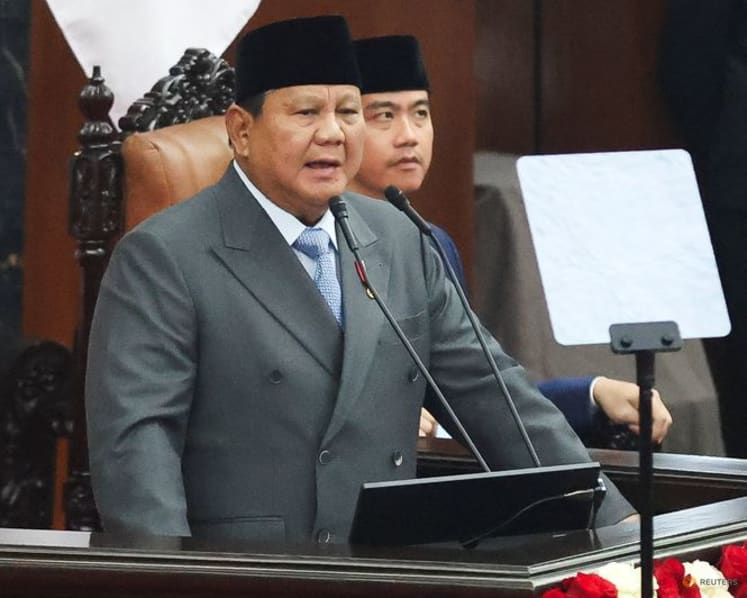
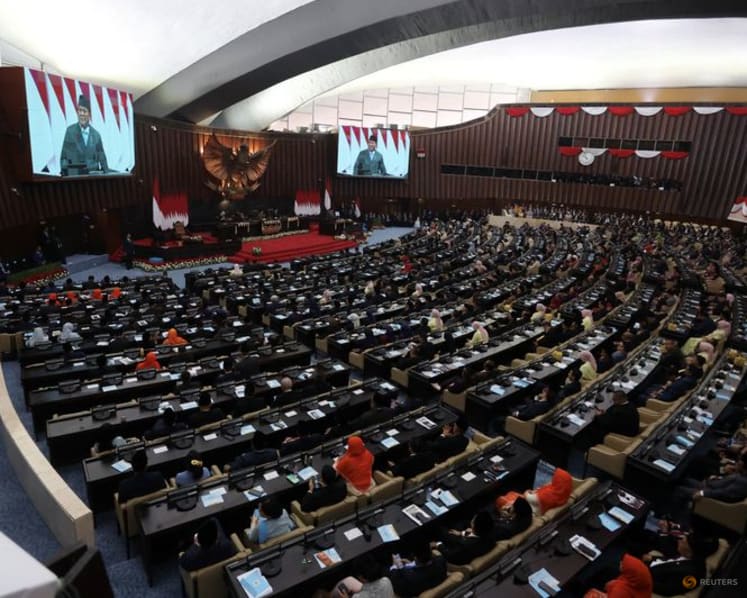
Indonesian President Prabowo Subianto delivers his annual State of the Nation address at the parliament, as Vice-President Gibran Rakabuming Raka sits next to him ahead of the country's 81st Independence Day anniversary in Jakarta, Indonesia on Aug 14, 2026. (Photo: Reuters/Stringer)

This audio is generated by an AI tool.


JAKARTA: Indonesian President Prabowo Subianto said his government has successfully tackled long-standing problems after 21 months in office, touting early gains in food and energy self-sufficiency, even as he said more needs to be done and called for the nation's support.
He also expressed confidence that Indonesia could register economic growth of 6 per cent by the end of this year.
Speaking in his second State of the Nation address on Friday (Aug 14) and ahead of the country’s 81st Independence Day on Aug 17, Prabowo said that his administration had implemented 121 “transformative policies” in 663 days since he took office - akin to one policy implementation “every five days”.
He framed his presidency as one that is focused on speed, state intervention and tangible benefits for ordinary Indonesians, although he acknowledged that not all issues have been resolved.





“I did not receive a mandate from the people to explain why problems cannot be solved,” said Prabowo, even as he cautioned against complacency.
‘I received a mandate from the people precisely to resolve issues and overcome the difficulties faced by the public.”
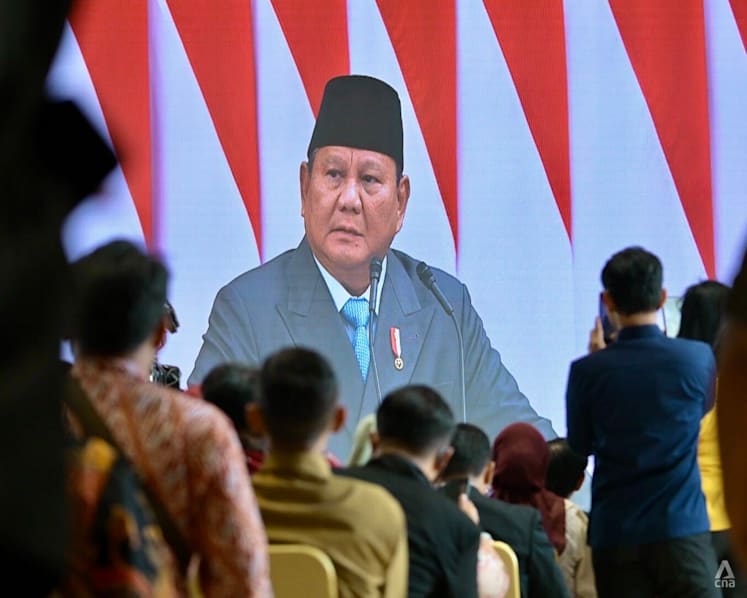
Speaking at the annual event at the parliament, Prabowo noted that Indonesia’s economy grew 5.61 per cent in the first quarter and 5.45 per cent in the first half of 2026.
“This is the highest first-quarter and first-half growth in the last 13 years," he said.
“With the right policies, I am confident that our economic growth can reach 6 per cent by the end of this year.”
He had previously set a target for the country’s GDP to grow by 8 per cent by the end of his presidential term in 2029.
On Friday, he stressed that economic growth however is not his government’s ultimate goal.
“My objective is the welfare of the people. Every rupiah of investment must create jobs. Every policy must improve the lives of the people. That is the guiding principle of the government I lead."
Prabowo noted that Indonesia has achieved food self-sufficiency in staples such as rice, corn, sugar, chicken meat, chicken eggs, shallots, large chilli peppers, and bird's eye chillies.
Beyond food security, the government is also moving to realise its target of energy self-sufficiency by implementing B50 biofuel, which blends palm oil-based biodiesel with diesel fuel.
In his speech, Prabowo said that Indonesia has ceased importing diesel fuel from abroad starting Jul 1. The move has enabled Indonesia to save up to 170 trillion rupiah (US$9.5 billion).
But he acknowledged the long road ahead.
“I cannot yet say that all the nation’s problems have been resolved, or that every promise I made has been fulfilled. Not yet,” he said.
He also called on Indonesians and officials to work with him in addressing the country’s challenges.
"Nation-building is not a task for the President alone. This Republic is built through the collective efforts of all state institutions, the central and regional governments, and the entire Indonesian people."
PERFORMANCE OF KEY PROGRAMMES
Prabowo presented a report on the performance of state institutions and highlighted key programmes undertaken by his administration, including the free nutritious meal programme and the Red-White village cooperatives. The latter aims to improve the people's economy in rural areas while also creating jobs.
Since its inception in July 2025, about 10,000 Red-White village cooperatives are already operational, said Prabowo. His target is to have 30,000 Red-White village cooperatives operational by the end of 2026.
Prabowo also highlighted the government's achievement in providing free basic medical check-ups to millions of citizens as well as the establishment of Garuda School - a programme designed to ensure equitable access to quality education for students across the country.
Other achievements touted by Prabowo include reclaiming unauthorised land and cracking down on illegal mining practices. For instance, authorities have since shut down 1,000 illegal mining sites in Bangka Belitung, Prabowo said.
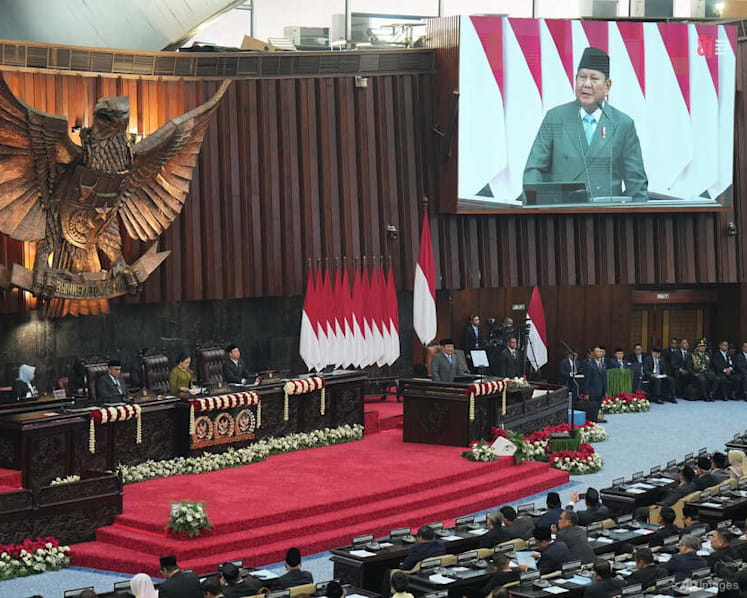
In his speech, the president stressed that his administration will also ensure that Danantara Sumber Daya Indonesia (DSI) - which seeks to centralise the overseas sales of strategic commodities such as crude palm oil, coal, and ferroalloys - will be fully operational in September.
DSI - whose formation was first announced in May - is a state-controlled export firm under the country’s sovereign wealth fund, Danantara Indonesia.
Like previous years, the State of the Nation address was held in front of about 1,200 people, including lawmakers, former presidents - including Joko Widodo - and vice-presidents, ministers as well as ambassadors.
This year’s event was also attended by Prabowo’s eight special guests who are representatives of the communities benefiting from government programmes ranging from farmers to students.
In a separate speech in parliament on Friday afternoon, Prabowo will outline the 2027 government budget.
MEASURED YET AMBITIOUS: ANALYSTS
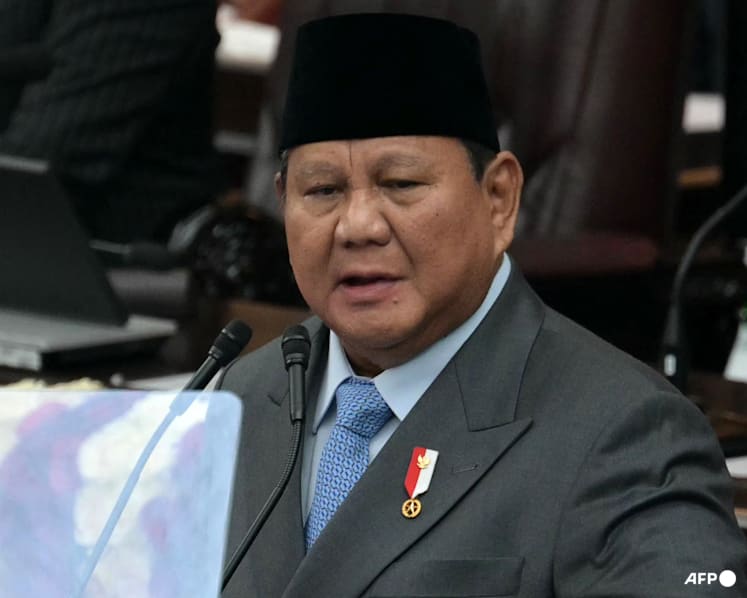
Analysts told CNA that Prabowo’s State of the Nation address was relatively measured, but warned that some of his economic and policy targets remain difficult to achieve.
Yunarto Wijaya, executive director of Jakarta-based think-tank Charta Politika, said the president appeared to acknowledge criticisms of some of his policies that were perceived to be overly populist or ambitious.
He pointed to Prabowo’s comment that the free nutritious meals programme could be revised for greater efficiency.
Prabowo did not elaborate on this in his speech. The US$12.81 billion flagship free meal programme has been hit in recent months by allegations of corruption as well as food poisoning cases, prompting some observers calling for it to be halted.
On the economy, Yunarto said that geopolitical uncertainty would make growth of 7 or 8 per cent difficult.
“Maintaining growth above 5 per cent, or reaching around 6 per cent, would already be the most realistic target and a strong performance compared with other countries.”
But he added that the quality and drivers of that growth mattered, noting that recent expansion had been driven significantly by government spending rather than investment.
Yunarto raised a similar concern over Prabowo’s target of having 30,000 Red and White village cooperatives operating by year-end.
While the number of outlets may be achievable, Yunarto said the larger question was whether they would be ready to generate economic activity in villages.
“Will the establishment of the outlets actually guarantee that they are ready to operate and generate a multiplier effect and the circulation of money within the village community?”
Aditya Perdana, a political expert from the University of Indonesia, characterised Prabowo’s economic message as optimistic.
“He wants to show that he is optimistic and he has the numbers to prove them,” said Aditya.
“He seems very optimistic that they can achieve 6 per cent, even though he may still deep down inside aim for the 8 per cent growth.”
Aditya added that there should be more transparency over how the 30,000-cooperative target was set.
Nicky Fahrizal, a political analyst from the think tank Centre for Strategic and International Studies, said the cooperative target was unrealistic.
“For 30,000 cooperatives to be operating optimally by year-end, about 192 cooperatives need to reach optimal status each day over a period of 139 days,” said Nicky.
“The actual rate achieved since May has been around 26 per day. That would be a sevenfold acceleration.”
But he said the 6 per cent economic growth was realistic.
“Because the figure is already 5.45 per cent in the first half of the year.”
However, he noted that this does not mean that Prabowo has lowered his target to achieve 8 per cent growth by the end of his term in 2029.
Ray Rangkuti, executive director of Jakarta-based think-tank Lingkar Madani, said programmes such as the free nutritious meals scheme and Red and White village cooperatives were sound in concept, but vulnerable to implementation problems.
“A cooperative can be assisted by the state, but it should not be supplied entirely by the state because the government’s funding is limited, and the government itself also has limitations,” he said.
“Sometimes, when governance creates problems, it ends up undermining the original objective as well.”