Final phase of Myanmar's election underway, military-backed party set to win
Despite widespread criticism that the polls are a sham to perpetuate the military's hold, the ruling junta has vowed it will transfer power to a new government, likely in April.
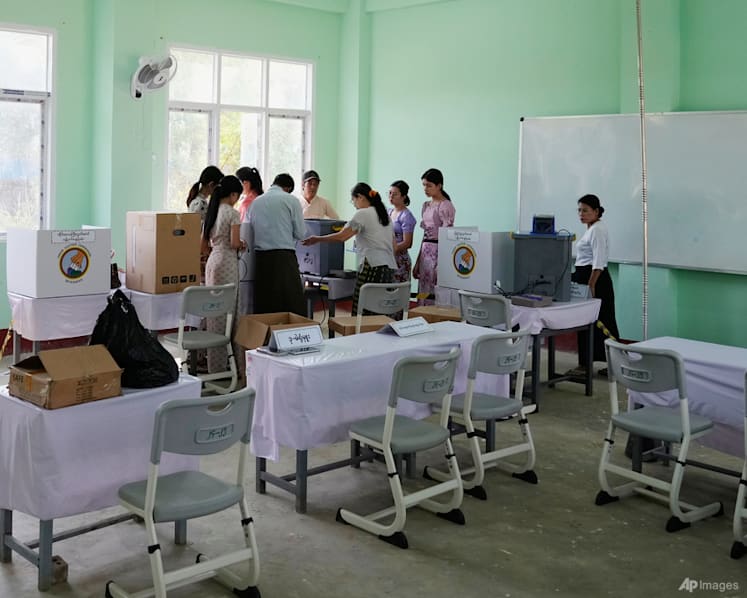
Officials of the Union Election Commission set up an electronic voting machine at a polling station, one day ahead of the third phase of the general election, in Yangon, Myanmar, Saturday, Jan 24, 2026. (Photo: AP/Thein Zaw)
Polling stations in Myanmar opened on Sunday (Jan 25) for the final round of a general election in the war-torn country, with a military-backed party set to win and the junta chief expected to take on a political role after the widely criticised election.
The previous two phases of the election - held on Dec 28 and Jan 11 - have been marked by low voter turnout of around 55 per cent, well below the turnout of about 70 per cent recorded in Myanmar's 2020 and 2015 general elections.
Voters in 60 townships will cast their ballots, including in the major cities of Yangon and Mandalay, amid a civil war triggered by a coup that brought the military to power.
The United Nations, rights groups and the UK have denounced the polls as a sham exercise to perpetuate the military's hold.





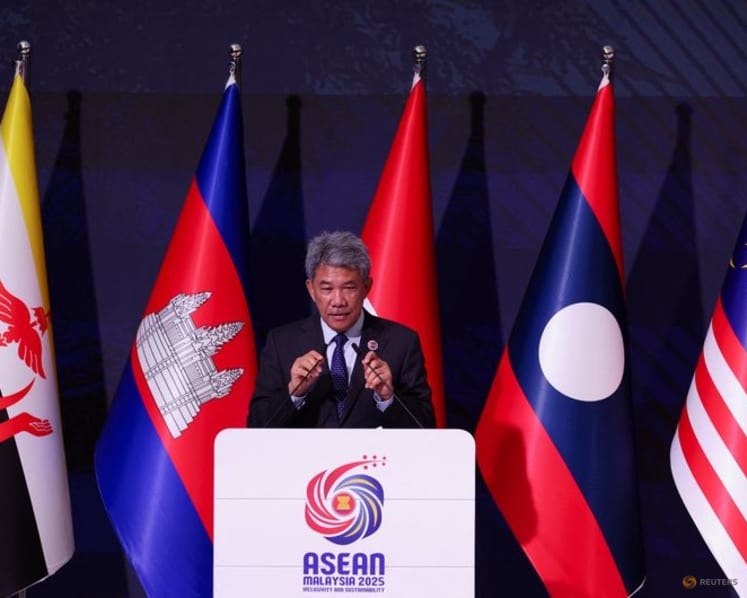
Malaysia, which last year chaired the 11-member Association of Southeast Asian Nations, which includes Myanmar, has said the bloc would not endorse the election.
"Whether the international community recognizes this or not, we don't understand their perspective. The people’s vote is the recognition we need," junta chief Min Aung Hlaing told reporters on Sunday, according to video broadcast on state TV.
Min Aung Hlaing said the country's elections are "the path chosen by the people".
"The people from Myanmar can support whoever they want to support," he said.
The ruling junta has vowed it will transfer power to a new government, likely in April.
The military took control of the impoverished Southeast Asian nation in a dawn coup on Feb 1, 2021, ousting an elected civilian government led by Nobel Peace Prize winner Aung San Suu Kyi.
The 80-year-old politician remains in detention and, like several other opposition groups, her National League for Democracy has been dissolved by the junta, tilting the political playing field in favour of the military-backed party that is leading the polls.
"Rather than resolving a crisis now in its fifth year, the vote is more likely to reinforce the military's hold on power, with little prospect of restoring domestic legitimacy or improving the country's standing with Western partners," said Kaho Yu, Principal Asia Analyst at risk intelligence company Verisk Maplecroft.
Fighting has continued through the election campaign and earlier voting in many parts of Myanmar, including air strikes around civilian areas in the border states of Rakhine, Shan and Kayin.
MILITARY TRANSITION
So far, the military-backed Union Solidarity and Development Party has secured 193 out of 209 seats in the lower house and 52 out of 78 seats in the upper house, according to the election commission, leaving the party in a dominant position.
The USDP, which was formed in 2010 and governed the country for five years following the end of a previous military government, is chaired by a retired brigadier general and packed with other former high-ranking officers.
Myanmar's military, which has ruled the country for five of the past six decades, does not appear to have any real intention of withdrawing from its political leadership role.
"Regardless of how successive governments may change over time, Tatmadaw remains a steadfast institution that will continue to shoulder the responsibilities of national defence and security," said the junta leader last week, referring to the Burmese term for the military.
The 69-year-old general has indicated he is considering appointing a successor as armed forces chief and will likely move into a fully political role, Reuters has reported.
While the junta has portrayed the election as a success despite the low turnout, residents of Myanmar's biggest cities have told Reuters of an atmosphere of fear, where many felt compelled to vote to avoid potential arrest or retribution.
The military has insisted the election is free of coercion and has public backing.
On the back of an election protection law, the junta has charged over 400 people for criticising and obstructing the election process, according to state media.