Myanmar ex-military chief on first Thailand trip as civilian leader
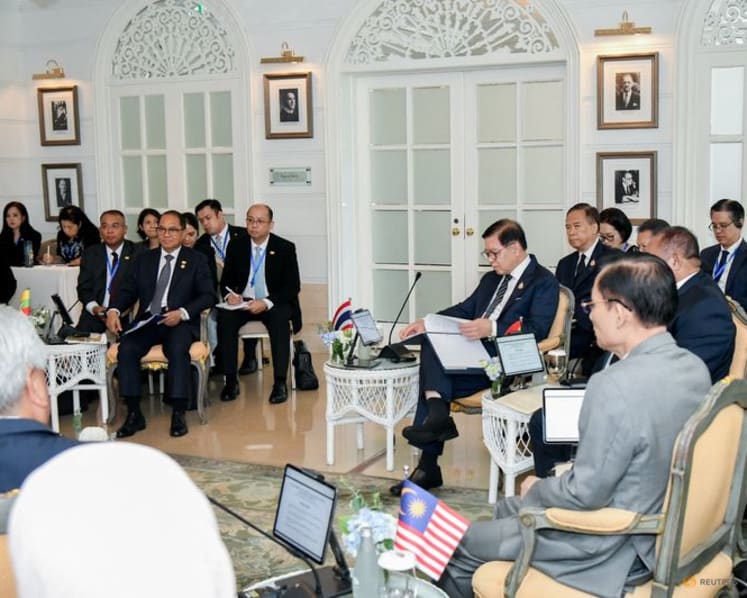
Thai Prime Minister Anutin Charnvirakul has been leading an effort to normalise relations with Myanmar, both bilaterally and through the 11-nation Association of Southeast Asian Nations (ASEAN).
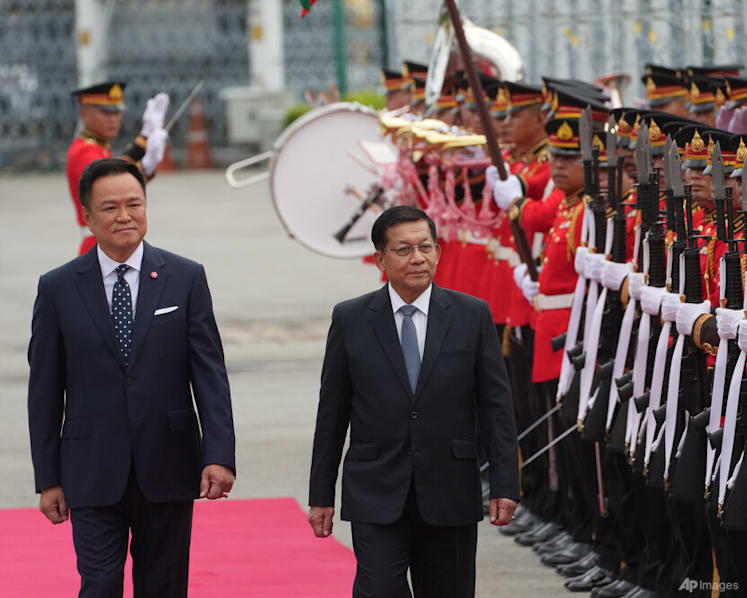
Thailand's Prime Minister Anutin Charnvirakul (left) and Myanmar's President Min Aung Hlaing review an honour guard during a welcome ceremony at the Government House in Bangkok, Thailand, on Aug 6, 2026. (Photo: AP/Sakchai Lalit)
BANGKOK: Myanmar's ex-military chief Min Aung Hlaing met with Thailand's prime minister in Bangkok on Thursday (Aug 6), his first visit to the neighbouring nation as civilian leader, as he seeks to ease Myanmar’s diplomatic isolation.
As a general, Min Aung Hlaing led a 2021 military coup that ousted democratic leader Aung San Suu Kyi, triggering a civil war estimated to have killed more than 100,000 people on all sides.
He was installed as Myanmar's leader in April following elections that democracy watchdogs and Western nations called a sham intended to launder the military government's image.
Thailand has since been leading an effort to normalise relations with Myanmar, both bilaterally and through the 11-nation Association of Southeast Asian Nations (ASEAN).





Thai Prime Minister Anutin Charnvirakul said his discussion with Min Aung Hlaing at Bangkok's Government House on Thursday was an opportunity to "push cooperation".
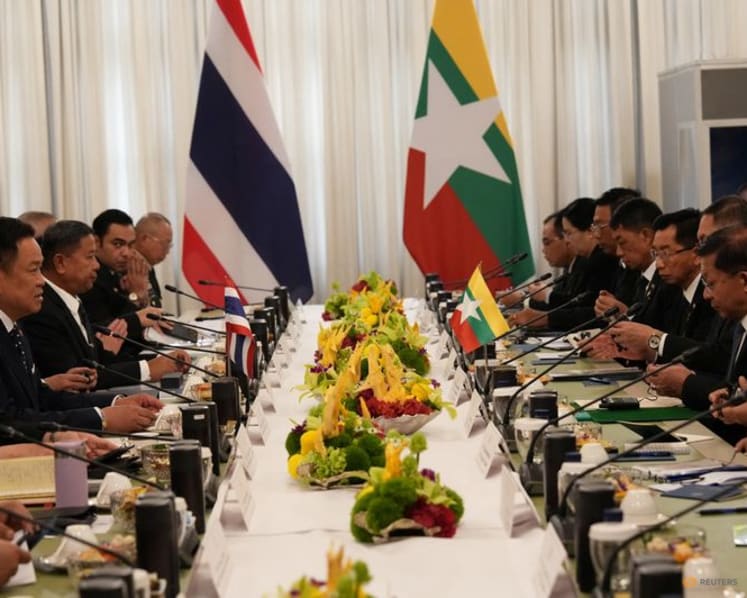
"Both Thailand and Myanmar are members of the ASEAN family, and Thailand fully supports Myanmar's participation in ASEAN," Anutin said, sitting with Thai officials at a long table across from Min Aung Hlaing and his delegation.
The Myanmar leader said his government was working towards democracy and stability in his country, as well as normalising relations with ASEAN.
But his government has refused to buy into the bloc's "five-point consensus" framework aimed at ending hostilities in Myanmar through dialogue.
ASEAN has excluded member state Myanmar's leadership from high-level summits since the putsch, but the country's foreign minister attended an informal meeting with his regional counterparts last month in Bangkok.
And Min Aung Hlaing has been on a diplomatic drive since swapping his military uniform for civilian dress, visiting India, key ally China, and ASEAN member Laos in turn.
"REALITY, NOT LEGITIMACY"
In the run-up to his Bangkok trip, Aung San Suu Kyi - who remains under house arrest - was allowed to meet a representative of the International Committee of the Red Cross on Monday, the first time she has been seen meeting a foreign official since her ouster.
Full reintegration into ASEAN would open "a pathway for normalisation of relations with others, including Western countries that have remained opposed to the military regime", said Myanmar specialist Morgan Michaels.
But the country had already secured recognition from India, China, Russia and Thailand, making restored ties with the regional grouping a "nice to have" rather than essential, he said.
Min Aung Hlaing was welcomed on Thursday by an honour guard at Government House and met one-on-one with Anutin.
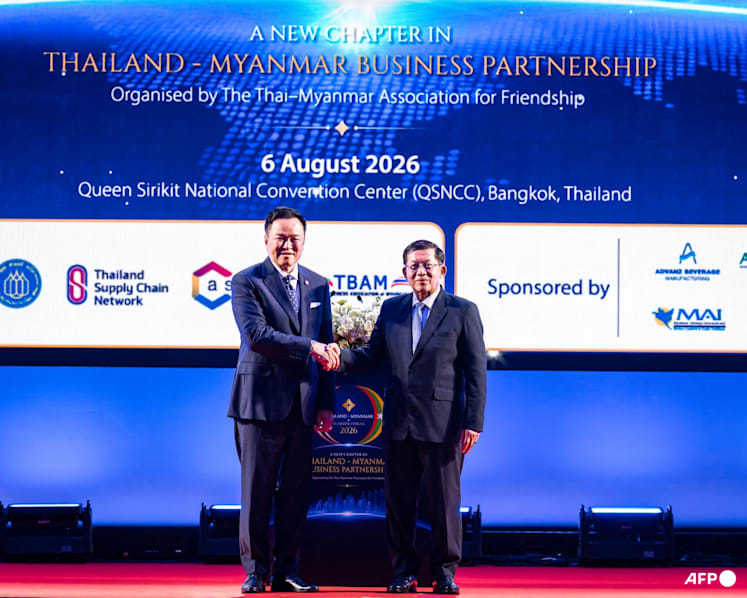
At a business forum, he said Myanmar and its "good friend" Thailand needed to cooperate in combatting illegal cross-border trade, which cost both nations revenues.
His country - where several million people have been internally displaced by the civil war - was also inviting investment in energy infrastructure and agriculture, as well as education and healthcare, he said.
Critics say Bangkok has lent legitimacy to Min Aung Hlaing and his nominally civilian government by hosting him.
The former military chief has been sanctioned by several Western nations and is wanted by the International Criminal Court for crimes against humanity.
Thailand's Foreign Minister Sihasak Phuangketkeow told reporters on Thursday that Bangkok's diplomatic overtures were practical.
"It's not about legitimacy, it's about reality," Sihasak said.
TRADE AND BORDER SECURITY
"We have problems that we face along the border and at the same time we have to be proactive in terms of helping Myanmar on the path of peace and stability," the top diplomat said.
"The best way to achieve that is to have talks with those who are in the position of power."
Observers agree Bangkok has cause to repair relations.
Fighting between Myanmar's military and myriad rebel factions has spilt over the long border with Thailand, which hosts millions of refugees from Myanmar.
Thailand also has to deal with cyberscam networks and illicit drug traffickers in Myanmar's volatile borderlands.
Sihasak said on Thursday the two sides had discussed a number of regional issues, including trade, border security and scams and established a working group to address river pollution.
The Southeast Asian neighbours were aiming to boost bilateral annual trade to US$12 billion, from US$7.4 billion, he added.
Sihasak earlier this week welcomed Aung San Suu Kyi's Red Cross meeting, saying he hoped that Myanmar authorities "will undertake further positive steps" towards peace and stability.
Thomas Kean, senior consultant for Myanmar and Bangladesh at the International Crisis Group, said Thailand’s engagement with Myanmar is driven by a range of bilateral concerns, including energy supplies and border security.
"But this is not just about bilateral relations. This is also about Thailand's push to have ASEAN normalise ties with Myanmar, and that is creating quite a lot of divisions within the bloc," he told CNA's Asia First.
Part of Thailand’s concern is also the extent of China’s influence in Myanmar, and fears that keeping the country on the sidelines of ASEAN’s high-level meetings could push it closer to Beijing.
Kean, however, does not see that as a major risk, as "Myanmar's generals are always wary of China and will be doing whatever they can to decrease Beijing's leverage over them".