Suicide bombing in Pakistan capital kills 12, raises regional tension
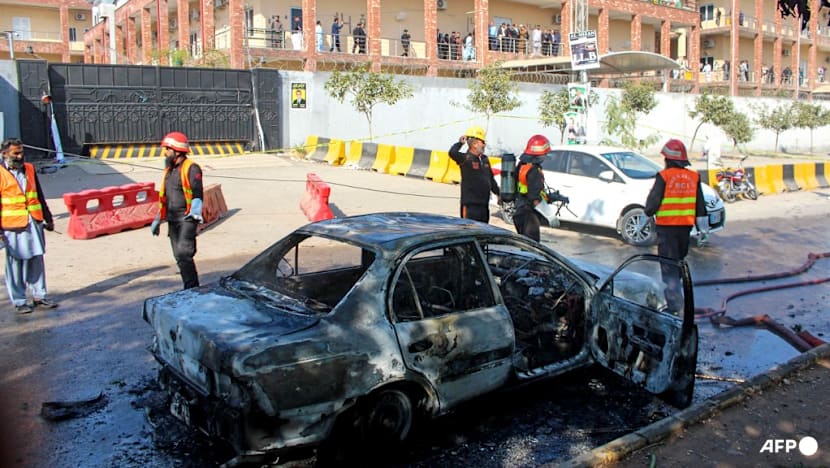
Firefighters douse a car at the suicide blast site in Islamabad on Nov 11, 2025. A suicide bombing outside district court buildings in a residential area of the Pakistani capital killed 12 people and wounded 27 on Nov 11, the interior minister said. (Photo: AFP)
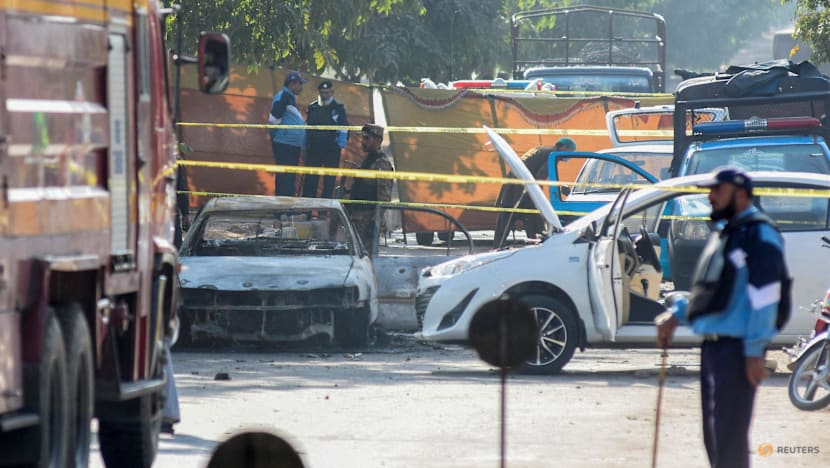
ISLAMABAD: Charred vehicles and a mangled motorcycle lay outside Islamabad's district court on Tuesday (Nov 11), their metal frames still warm as investigators sealed off the area where a suicide bomber had killed at least 12 people.
It was a rare assault at the heart of Pakistan's capital where blood stained a two-way street, and shattered glass glimmered among the debris.
"It was a very strong and terrifying explosion," said Khalid Mandokhel, a 24-year-old lawyer.
"Many of the victims were bystanders," he told AFP at the scene.
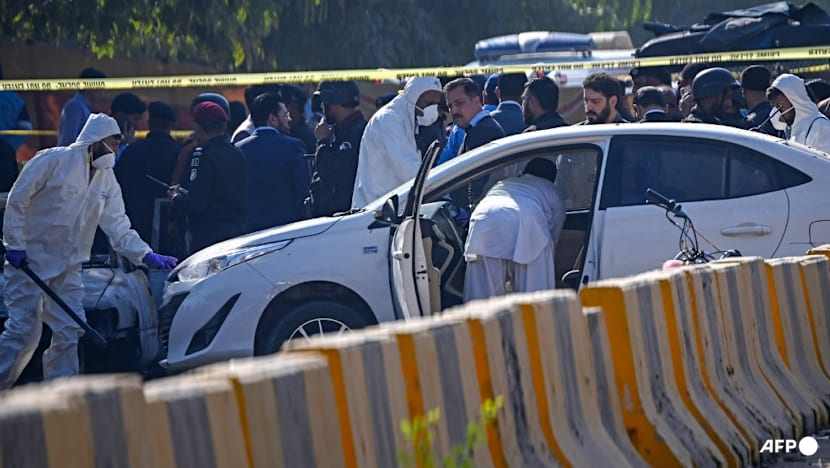
The blue police van, hit in the blast, stood crippled at the entrance, its metal pierced by shrapnel and tyres shredded, as investigators documented every mark on the vehicle.
27 people were wounded in the attack.
Rustam Malik, another lawyer, said he "heard a loud bang at the gate" as he entered the complex, where, daily, hundreds of people arrive to sort out legal matters.
They did not expect to leave with their lives hanging by a thread. "There was thick smoke," Malik told AFP.
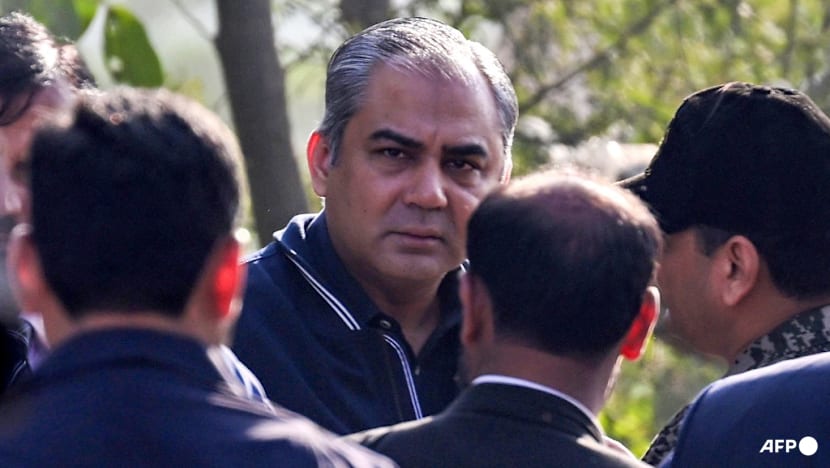
Interior Minister Mohsin Naqvi told journalists outside the court that the attacker had lingered outside the building for several minutes before striking.
"He could not go inside (the complex); he blew himself up near the police vehicle," Naqvi said.
"We are investigating this incident from different angles. It is not just another bombing. It happened right in Islamabad," the minister said.
An AFP journalist saw paramilitary troops cordoning off the area where the minister said the assailant detonated the explosives near a police vehicle.
"We are trying to identify who (the attacker) is and where he came from," Naqvi said.
COMPLETE CHAOS
The complex, home to several courts, is usually one of the busiest areas in Islamabad during the day. Nearby offices of senior administration and police officials add to the dense crowds.
Outside the government-run hospital where most of the victims were taken, people were milling about as rescue workers wheeled people with head and leg injuries into the emergency room. Security guards, on alert, prevented the media from entering.
Back at the blast site, cordoned off at several points, investigators gathered evidence until late afternoon.
A heavy presence of police and paramilitary soldiers combed through the wreckage as a stray dog rummaged through the remains, sniffing at the scattered debris.
Malik recalled "complete chaos" - lawyers and visitors running in panic after the explosion thundered through the compound.
As investigators processed the scene, the lawyer waited patiently for police clearance so he could collect his vehicle, which was damaged in the attack.
"I saw two dead bodies lying at the gate, and several cars were on fire," he said.
CROSS-BORDER VIOLENCE
Islamabad has largely been spared major militant violence in recent years, with the last suicide attack occurring in December 2022.
But the country is facing a resurgence of attacks, which officials attribute mainly to armed groups allegedly sheltered on Afghan soil.
The bombing came as Pakistani security forces battled militants who had holed up in a school in northwest Khyber Pakhtunkhwa's Wana district, near the Afghan border.
"There was an attack in Wana as well last night," Naqvi said. "Three people died in that attack. The attacker involved in that attack is an Afghan. Afghanistan is directly involved in that attack."
Recent attacks prompted a bloody clash between Pakistan and Afghanistan in October, their worst fighting across their border in years.
More than 70 people were killed on both sides, including about 50 Afghan civilians, according to the United Nations.
The two countries agreed to a fragile ceasefire, but failed to finalise its details during several rounds of negotiations that collapsed last week. Each side blamed the other for the impasse.
Pakistan's Defence Minister Khawaja Asif said the Islamabad suicide attack should be seen as "a wake-up call".
"In this environment, it would be futile to hold out greater hope for successful negotiations with the rulers of Kabul," he wrote on X.
Islamabad accuses Kabul of sheltering the Pakistani Taliban and other militant groups that launch attacks across a long, porous border, which the Afghan government denies.