







Amazon opens up logistics network to other businesses in challenge to UPS, FedEx
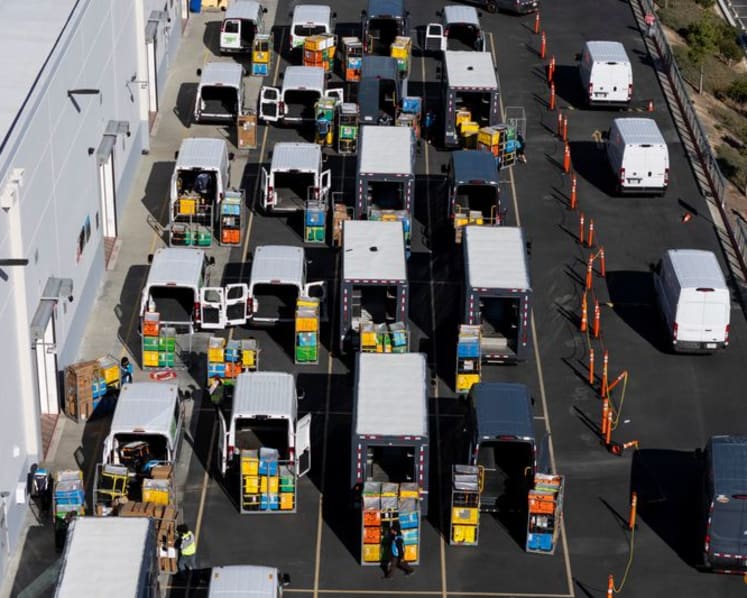
Workers load vans with packages at an Amazon fulfillment center in Valencia, California, December 4, 2025. REUTERS/Daniel Cole
May 4 : Amazon.com said on Monday it would allow other businesses to store and ship goods ranging from raw materials to final products through its vast network, as the e-commerce giant moves to challenge a market long dominated by UPS and FedEx.
"Amazon Supply Chain Services" will allow companies across industries such as retail, healthcare and manufacturing to use the company's supply-chain network spanning ocean, road, rail and air.
The move could position Amazon as a major player in the U.S. logistics industry, intensifying competition on pricing and speed for incumbents.
The company boasts a fleet of more than 100 cargo planes — behind only FedEx and UPS — along with a vast network of warehouses and sorting hubs. Shares of FedEx and UPS fell more than 9 per cent each, while Amazon rose nearly 1 per cent.





It would also help Amazon unlock a new growth opportunity for its e-commerce unit, building on a service that already supports thousands of independent third-party sellers on the platform worldwide.
Companies can take advantage of Amazon's speedy two-to-five-day delivery timelines, as well as inventory forecasting capabilities, among other distribution and fulfillment services.
The move is "a direct competitive blow," to parcel firms such as UPS and FedEx, analysts at Evercore ISI said in a note.
Contract logistics firms DHL Supply Chain, Maersk Logistics and GXO Logistics are also among the most exposed, they said.
Shares of DHL were down 7.3 per cent, GXO was down nearly 13 per cent, while Maersk was little changed.
Amazon said companies can use its solutions across all of their sales channels, including their own website, social media and physical stores. It said it has already signed on consumer goods major Procter & Gamble, industrial heavyweight 3M and apparel firm American Eagle Outfitters.
Amazon's expansion takes aim at the business-to-business shipping market, a prized high-margin segment for logistics firms where deliveries tend to be denser, more predictable and less expensive to serve than consumer shipments.
The move is "Amazon trying to convert logistics from a cost burden into an infrastructure product," said Parth Talsania, CEO of Equisights Research.
It also takes a leaf out of Amazon's cloud computing unit's playbook — Amazon Web Services was launched in 2006 to revamp the company's own IT infrastructure, and it later evolved into the world's biggest cloud services provider.
Meanwhile, UPS and FedEx have been de-emphasizing retail shipments and pursuing higher-profit healthcare, data center and business-to-business shipments.
"We would not be surprised to see near-term weakness across the less-than-truckload, air-freight, and forwarding complexes as the market assesses the competitive implications of the announcement," analysts at Baird said.





