Asia moves to calm markets as South Korea buys bonds, Manila holds surprise rate review
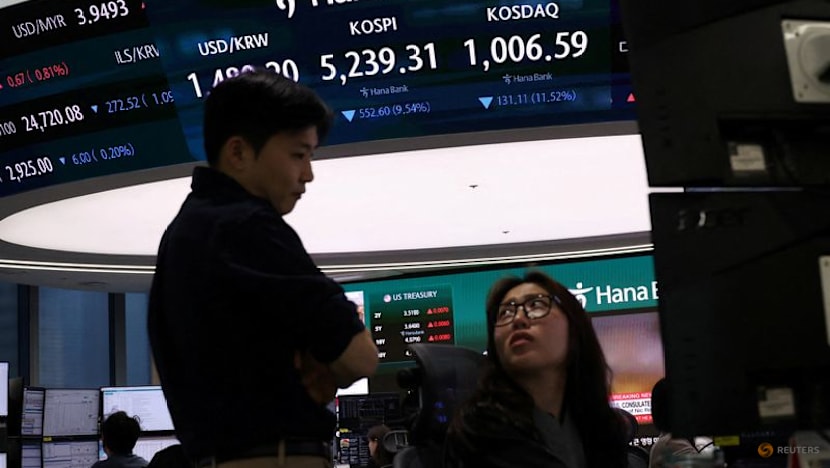
FILE PHOTO: Currency dealers talk in front of an electronic board displaying the Korea Composite Stock Price Index (KOSPI), the exchange rate between the U.S. Dollar and South Korean Won and the Korea Securities Dealers Automated Quotations (KOSDAQ) at the dealing room of a bank in Seoul, South Korea, March 4, 2026. REUTERS/Kim Hong-JI/File Photo
MANILA, March 26 : Asian central banks moved to shore up market confidence on Thursday, with South Korea announcing a 5 trillion won ($3.3 billion) emergency bond buyback while the Philippines held a surprise policy meeting, signaling its readiness to act if inflation pressures worsen.
Both economies, heavily exposed to imported fuel, have come under strain from a surge in global oil prices triggered by the U.S.-Israel war on Iran.
The Bangko Sentral ng Pilipinas, the first in Asia to convene an off-schedule policy review, kept its key policy rate steady at 4.25 per cent, underscoring policymakers' concerns about the conflict's spillover effects on growth and inflation.
BSP Governor Eli Remolona said the review, held less than a month before the scheduled April 23 meeting, was meant to "reassure the market that we are assessing the situation constantly."





With inflation expectations still well anchored, Remolona said there was no need for a rate hike for now, warning that tighter policy could "delay the recovery" of the economy already projected to grow at a weaker pace of 4.4 per cent, compared with the central bank's earlier forecast of 4.6 per cent.
But given the "very uncertain" and "very unusual" environment, Remolona signaled the central bank's readiness to act should inflation expectations slip.
"If inflation expectations de-anchor, then we would have to be more aggressive in terms of monetary policy," Remolona told a press conference.
RELIANCE ON ENERGY IMPORTS CREATES TENSIONS
Like the Philippines, South Korea faces a particular vulnerability due to its heavy reliance on energy imports passing through the Strait of Hormuz, which has been effectively closed since early March.
South Korea said its bond-buying operation will be conducted in two tranches, 2.5 trillion won on March 27 and another 2.5 trillion won on April 1, to add liquidity to the local bond market and cap rising yields after three-year treasury bond yields surged to the highest point since the middle of 2024.
The move was paired with an increased price cap on fuel, effective Friday at midnight, and an expansion of fuel tax breaks to prevent local retailers from passing on the effects of sudden international oil spikes to consumers.
Korean consumers and bond market participants have been hit hard due to the country's heavy reliance on imported oil, with markets now penciling in more than 100 basis points of interest rate hikes over the next 12 months.
In the Philippines, rising fuel costs have sparked street protests by transport workers and drivers who say soaring prices have gutted their daily earnings.
Philippine President Ferdinand Marcos Jr declared a state of national energy emergency on Tuesday to expedite the government's response to the fallout and fast-track oil procurement, with national inventories covering only 45 days as of March 20.
ECONOMIC IMPACT OF WAR
Thursday's measures add to the list of policy responses across Asia to cushion the economic fallout from the U.S.-Israeli war on Iran, which has rattled global financial markets and threatened to slow growth and stoke inflation.
Japan is also bracing for the impact. The Bank of Japan's former top economist said on Thursday that an interest rate hike is likely by June as rising oil costs from the Iran war heighten the chance of being too late in addressing the risk of too high inflation.
The Asian Development Bank on Thursday warned the conflict could cut developing Asia's growth by up to 1.3 per centage points over 2026 to 2027 and increase inflation by 3.2 per centage points if energy market disruptions persist for more than a year. The Manila-based lender had forecast 4.5 per cent growth and 2.1 per cent inflation for the region in its December outlook.
($1 = 1,504.8000 won)