







BOJ to hike rates by June as war-fuelled inflation risks mount: Reuters poll
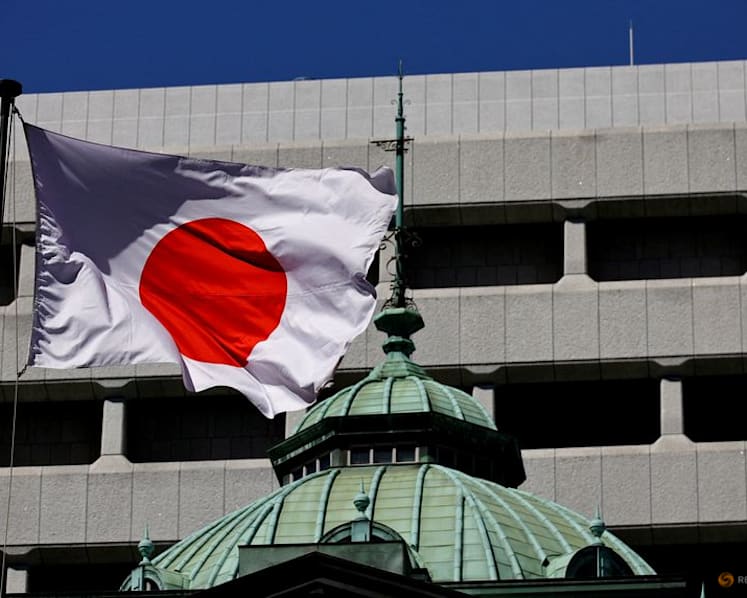
FILE PHOTO: The Japanese national flag flies at the Bank of Japan building in Tokyo, Japan March 18, 2024. REUTERS/Kim Kyung-Hoon/File Photo
TOKYO, April 16 : The Bank of Japan will raise its benchmark rate to 1.00 per cent by end-June, with nearly two-thirds of economists in a Reuters poll predicting the move, and a hike this month or in June seen as equally likely amid uncertainty over the fallout from the Iran war.
Markets are struggling to read the BOJ ahead of its April 27-28 policy meeting, with officials likely to offer far less forward guidance than in past decisions, heightening the risk of a surprise.
Economists still broadly expect the BOJ to tighten again this quarter, a view largely unchanged since the outbreak of the U.S.-Israeli war with Iran on February 28. If anything, the conflict has reinforced hawkish expectations by stoking fears of higher energy prices, renewed inflation pressure and further yen weakness.
In the April 7-14 survey, 65 per cent of economists, 46 of 71, forecast the policy rate would reach 1.00 per cent by end-June, up from 60 per cent in March and 58 per cent in February. Of 40 economists who specified when, 38 per cent chose April and 35 per cent June. Last month, June led at 32 per cent with July at 30 per cent and April 27 per cent.





A hike next week is possible, said Hiroshi Namioka, chief strategist at T&D Asset Management, noting that policymakers are wary of falling behind the curve as a weakening yen bolsters the case for early action. The yen has weakened about 2 per cent against the U.S. dollar since the war began.
But Junki Iwahashi, senior economist at Sumitomo Mitsui Trust Bank, said a rate hike this month was unlikely.
"While a spike in crude oil prices caused by worsening conditions in the Middle East would temporarily push up inflation through cost-push pressures, it would also weigh on the economy, making the rate-hike decision difficult," Iwahashi said, predicting a June move.
The BOJ "will want a little more time to assess the situation," he said.
Beyond June, median forecasts showed the BOJ raising borrowing costs to 1.25 per cent in the fourth quarter, a little earlier than previously expected.
Another 25-basis-point hike to 1.50 per cent was expected for the third quarter of 2027, according to medians, with rates then staying there until year-end although a handful expect a rise to 1.75 per cent.
With inflation remaining above target for most of the past four years, the BOJ has been laying the groundwork for a near-term hike by highlighting mounting price pressures.
Unlike its U.S. and European peers, Japan's policy rate at 0.75 per cent remains below the neutral rate - one that neither stimulates nor restricts economic activity. With inflation around 2 per cent the BOJ risks overheating the economy by keeping real borrowing costs deeply negative.
That hawkish backdrop, however, is being tested by escalating uncertainty over the Middle East war, where fast-moving developments are unsettling markets and clouding the outlook for the import-dependent economy.
In the poll, 62 per cent of respondents - 18 of 29 - said the Iran war would raise Japan's core consumer price index (CPI) by 0.2-0.4 per centage points cumulatively over the next 12 months. Core inflation includes energy but excludes fresh food.
Compared with March's survey median forecasts for year-on-year core CPI were revised up 0.1 to 0.3 per centage point in every quarter through June next year.
None of the 29 respondents to an additional question expected the war to push Japan into recession but forecasts for annualised GDP growth in the second and third quarters were lowered sharply.
The economy was expected to grow an annualised 0.4 per cent in April-June, down dramatically from 1.1 per cent in the March poll. For the next quarter growth was forecast at 0.7 per cent, slowing from 1.2 per cent.
Most respondents, 21 of 29, said stagflation risks were low or extremely low.
(For other stories from the Reuters global economic poll)





