China makes small dents in deflation battle as supply-demand imbalance persists
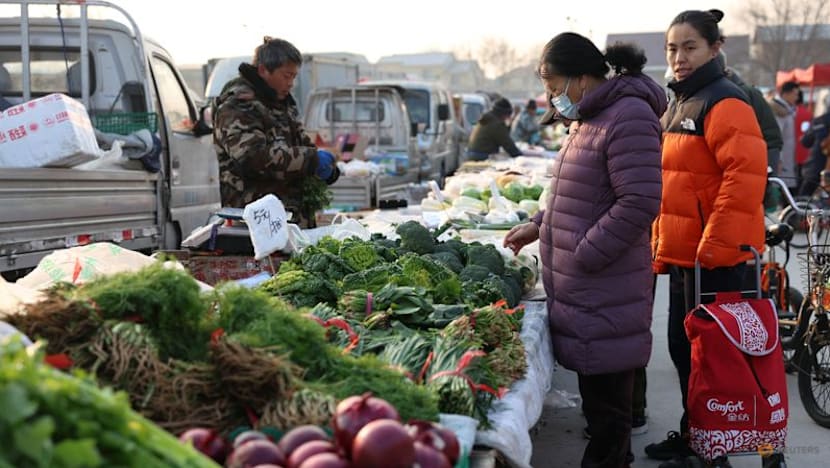
A woman looks at vegetables displayed at a stall at an outdoor market in Beijing, China, on Jan 12, 2024. (Photo: REUTERS/Florence Lo)
BEIJING: China's consumer inflation cooled in January while producer price deflation persisted, highlighting once again the underlying weakness in domestic demand and a key challenge for policymakers looking to shore up an uneven economic recovery.
Beijing has repeatedly pledged to better align supply and demand and promised to raise people's incomes to spur goods and services consumption, but policy measures so far have delivered only modest results.
"With the imbalances between supply and demand set to persist, we doubt China's deflationary pressures will fade any time soon," said Zichun Huang, China economist at Capital Economics.
Data from the National Bureau of Statistics (NBS) on Wednesday showed the consumer price index (CPI) rose 0.2 per cent from the same month last year, compared with a 0.8 per cent increase in December and missing expectations in a Reuters poll for a 0.4 per cent rise.





The producer price index (PPI) fell 1.4 per cent year-on-year, with the downturn easing for a second month but extending a years-long deflationary trend in the world's second-biggest economy that policymakers are battling to overcome. Economists polled by Reuters had expected a 1.5 per cent drop.
On a monthly basis, CPI edged up 0.2 per cent, missing a forecast for a 0.3 per cent increase and matching the rise in December.
Lynn Song, chief economist for Greater China at ING, said the monthly rise in CPI suggests that "overall we are still on track to see a general recovery of inflation in 2026", projecting full-year consumer inflation at 0.9 per cent.
Song cautioned, however, that risks could stem from the rollout of domestic policy and global price developments.
The moderation in the year-on-year rise of consumer prices was mainly due to a high year-ago base and sharper declines in energy prices, Dong Lijuan, a statistician at NBS, said in a statement.
Food prices dropped 0.7 per cent on plunging pork and egg prices, although those of fresh vegetables and fruits both rose. Services prices edged up 0.1 per cent year-on-year.
Consumer prices in January last year got a bump from the Lunar New Year holiday, which started in late January and pushed up food and services prices. The holiday this year will begin in mid-February.


SUPPLY-DEMAND MISMATCH WOES
Core CPI, which excludes volatile prices of food and fuel, rose 0.8 per cent year-on-year last month, down from the 1.2 per cent rise in December.
A government campaign to curb overcapacity and price competition in major industrial sectors, including solar energy and auto manufacturing, has somewhat mitigated factory-gate price deflation.
Capacity management in some sectors has improved the supply and demand structure, NBS' Dong said, pointing to narrower drops in non-metallic mineral products and ferrous metals smelting and rolling. Prices in nonferrous metals mining surged 22.7 per cent while those in oil and gas extraction slumped 16.7 per cent.
But PPI deflation has persisted and continues to weigh on industrial firms' profits, indicating the need for more policy measures to boost effective demand and address deep-rooted imbalance in the economy.
Chinese manufacturers still rely on exports to absorb their production capacity, with the country logging a whopping US$1.2 trillion trade surplus in 2025 while fighting a trade war with the US.
Policymakers have been trying to boost consumption over the past two years, but analysts say more needs to be done to address the supply-demand imbalance.
Beijing has vowed to keep cracking down on excessive competition and ensure smoother exit of inefficient production capacity in order to stabilise prices.
The government also pledged to implement "more proactive" macroeconomic policies in 2026. The central bank in January cut sector-specific interest rates and earmarked more cheap loans to small and medium-sized tech and private firms.
China will unveil its next five-year development plan and GDP growth target for the year at the annual parliamentary session in early March.