Dollar flirts with new 2026 highs as oil price jump hurts euro
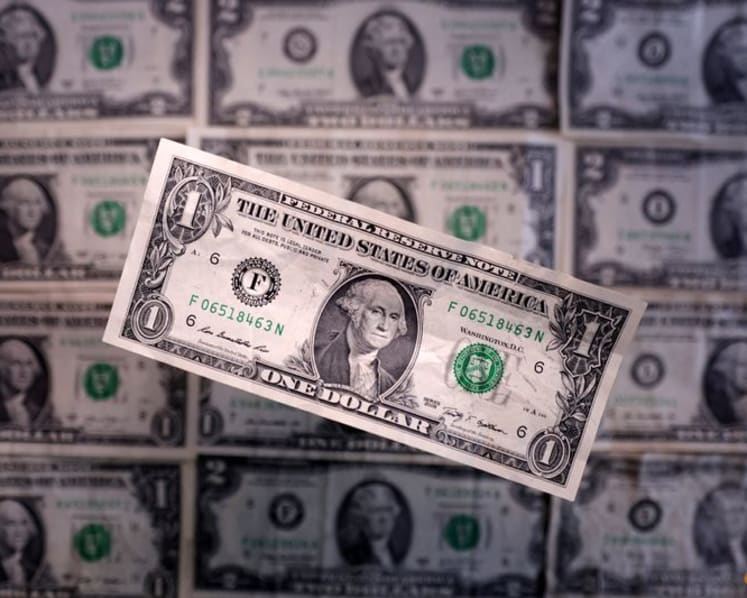
U.S. dollar banknotes are seen in this illustration taken March 19, 2025. REUTERS/Dado Ruvic/Illustration
NEW YORK, March 12 : The dollar rose against the euro for a third straight day on Thursday, inching closer to its strongest levels this year as surging energy prices sparked worries about Europe's import-dependent economy and drove investors toward the safety of the greenback.
Oil prices rose sharply as Iran stepped up attacks on oil and transport facilities across the Middle East, fueling concerns of a prolonged conflict and potential disruption to oil flows.
Iran's new Supreme Leader Mojtaba Khamenei on Thursday vowed to keep the Strait of Hormuz closed.
The rapid increase in energy prices poses a threat to global growth, with economists warning that a prolonged conflict in the Middle East would further amplify the economic impact.





The world's biggest energy importers have seen their currencies post the largest losses against the dollar since the start of the U.S.-Israeli war on Iran. The Indian rupee and Japanese yen have lost more than 1.5 per cent each, while the euro and the Korean won have lost 2 per cent and 3 per cent, respectively.
Meanwhile, the dollar has risen by more than 1.5 per cent against a basket of major currencies and is close to its highest level since November, thanks in part to its safe-haven appeal, but also because the United States is a net energy exporter.
The euro was down 0.5 per cent at $1.1513, not far off its lowest since November.
"A disappointing supply update from the International Energy Agency, and commitment from Supreme Leader Khamenei to keep the Strait of Hormuz closed is to blame," Benjamin Ford, researcher at macro research and strategy firm Macro Hive, said.
"Ahead, we expect EUR/USD can fall to 1.14 with FX markets trading the 2022 Russia-Ukraine game plan," Ford said.
The IEA on Wednesday agreed to release a record 400 million barrels of oil from strategic stockpiles, which would cover only about 20 days of supply lost due to the disruptions along the Strait of Hormuz, and will take weeks or months to reach markets.
"The main thing that matters today is gas and oil, and the euro zone is quite exposed to these things. So you see the euro selling off across the board," Barclays strategist Lefteris Farmakis said.
A more prolonged disruption in energy markets would pile more pressure on the euro, strategists said.
CENTRAL BANK RATE TRIGGER DRAWS CLOSER
Risk appetite took a further hit after Trump's administration on Wednesday launched a new trade investigation into excess industrial capacity in 16 major trading partners, in a move aimed at rebuilding tariff pressure after the U.S. Supreme Court struck down the centerpiece of Trump's tariff program last month.
The pound fell 0.5 per cent to $1.3348, a little above its lowest point of the year so far. Against the yen, the dollar was 0.3 per cent higher at 159.395 yen.
Investors are also focused on next week's meetings at the Federal Reserve and the European Central Bank to gauge how policymakers will react to the prospect of an energy-price shock.
The swaps market on Thursday showed that traders expect the European Central Bank to raise rates possibly as soon as June, while the U.S. Federal Reserve could leave it until September before cutting rates, from a previous expectation for July, according to data compiled by LSEG.
"With the FOMC set to keep the fed funds target range between 3.50 per cent and 3.75 per cent next week, the focus will be on any changes to the policy statement and new economic projections," Stephen Brown, deputy chief North America economist at Capital Economics said in a note.
"The most hawkish outcome would be if the Fed removed its easing bias from the statement, while the median projection shifted from one cut this year to no change," Brown said.
On Thursday, leading cryptocurrency bitcoin fell 1 per cent to slip just below $70,000, but was above the multi-year low of $60,008 touched in early February.