Exclusive-Japan's debt issuance to surge 28% in fiscal 2029 from 2026, finance ministry estimates
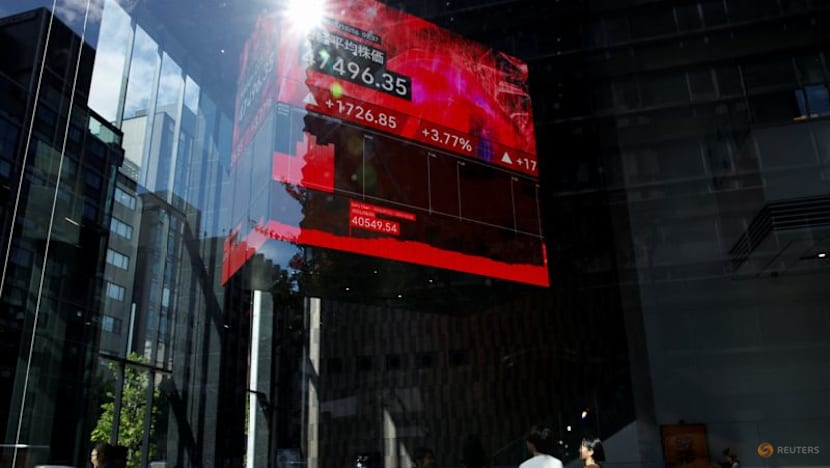
People watch a screen displaying Japan's Nikkei share average at the Tokyo Stock Exchange, on October 4, in Tokyo, Japan, October 6, 2025. REUTERS/Androniki Christodoulou/File Photo
TOKYO, Feb 17 : Japan's annual bond issuance will likely surge 28 per cent three years from now due to rising debt-financing costs, a finance ministry estimate reviewed by Reuters showed on Tuesday, casting doubt on Prime Minister Sanae Takaichi's argument that the country can deliver tax cuts without boosting debt.
Under the estimate, Japan would need to issue up to 38 trillion yen ($248.32 billion) worth of bonds in the fiscal year starting in April 2029 to fill a hole from expenditures surpassing tax revenues, up from 29.6 trillion yen in fiscal 2026.
While tax revenues are expected to keep rising, they will not be enough to pay for a steady increase in spending as a rapidly ageing population and rising long-term interest rates push up social welfare and debt-servicing costs.
Debt-servicing costs will likely hit 40.3 trillion yen in fiscal 2029, up from 31.3 trillion yen in fiscal 2026, amounting to roughly 30 per cent of total expenditures, underscoring the strain that rising bond yields would inflict on Japan's finances.





The estimate, to be presented to Parliament for deliberation, highlights the challenge Takaichi faces in delivering on her pledge to avoid issuing new debt to fund her tax-cutting and spending plans.
While rising inflation and robust corporate profits have pushed up nominal tax revenues, Japan's finances will come under pressure as low-interest bonds that were issued in the past are rolled over.
"Even if interest rates were to remain flat, debt-servicing costs will rise over time," said Tsuyoshi Ueno, executive research fellow at the NLI Research Institute. "For Japan, there's no escape from rising debt-servicing costs."
The prospect of increased debt issuance typically pushes up bond yields. But on Tuesday, the yields on Japanese government bonds fell as investors focused more on tracking last week's sharp declines in U.S. Treasury yields.
"The news would have prompted investors to sell bonds and push the yields higher, but that was offset by the sharp declines in the U.S. Treasury yields," said Katsutoshi Inadome, a senior strategist at Sumitomo Mitsui Trust Asset Management.
The Bank of Japan's rate-hike plans will also keep upward pressure on bond yields. Since exiting a massive stimulus programme in 2024, the central bank has been slowing bond buying and raising interest rates as Japan progresses in durably meeting its 2 per cent inflation target.
"As Japan enters an era of rising interest rates, the biggest impact would be felt on fiscal policy," said Saisuke Sakai, senior economist at Mizuho Research & Technologies. "As the BOJ continues to push up interest rates, bond yields have further scope to rise."
The estimate is based on a scenario assuming nominal economic growth of 1.5 per cent and an average inflation rate of 1 per cent with the 10-year Japanese government bond (JGB) yield moving at 3.0 per cent.
In a scenario assuming nominal growth of 3 per cent and an inflation rate of 2 per cent, debt-servicing costs will hit 41.3 trillion yen in fiscal 2029.
($1 = 153.0300 yen)