Explainer-Data centers' 'flexible' power usage could save the grid billions. Can they scale?
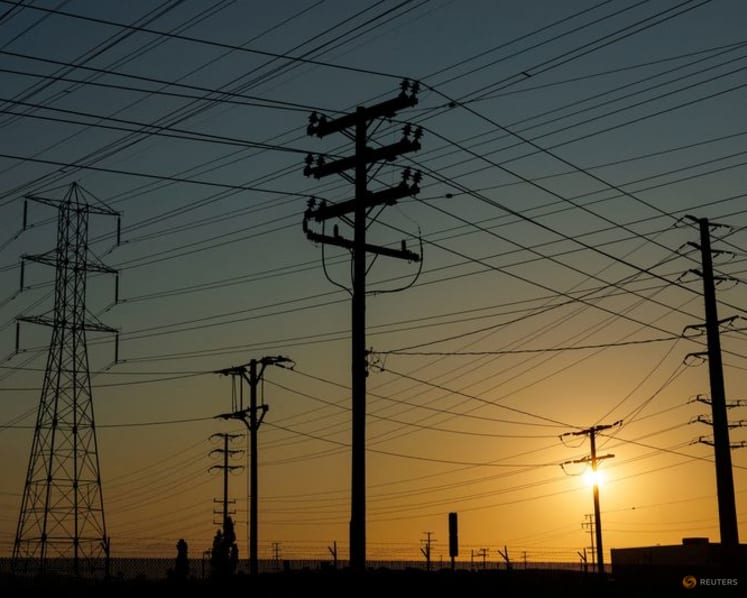
FILE PHOTO: Electrical transmission towers, poles and lines are shown in the early morning of a hot summer day in Commerce, California, U.S, August 7, 2025. REUTERS/Mike Blake/File Photo
Oct 8 : Technology companies and utilities are increasingly exploring ways to make power-hungry data centers more flexible in when and how they consume electricity, helping ease the strain on US power grids as AI-driven demand surges.
The strategy, called "demand response", involves data centers temporarily reducing or shifting electricity use during periods of peak demand or grid stress, and is gaining traction as a way to reduce the need for costly grid upgrades and new power generation.
It's a tool that states around the US, federal agencies and market operators are increasingly exploring, said Lauren Shwisberg, a principal at energy think tank RMI.
WHY DOES DATA CENTER FLEXIBILITY MATTER?





US data center electricity use could rise from about 177 to 192 terawatt-hours in 2024 to between 383 and 793 TWh by 2030, according to the Electric Power Research Institute.
Meanwhile, data centers surveyed by the group reported peak power reduction potential of 10 per cent to 30 per cent, depending on facility type, with some hyperscalers going even higher, according to Arin Kaye, EPRI technical leader.
A study by Duke University's Nicholas Institute estimated that greater flexibility from data centers could save between $40 billion and $150 billion in capital investments over the next decade.
It could also help data centers connect to the grid more quickly, as regulators and grid operators explore faster pathways for facilities willing to curb electricity use during periods of high demand.
WHERE DO EFFORTS STAND?
So far, the "demand response" strategy for data centers has mostly been deployed through pilot projects or one-off agreements. OpenAI, for example, recently agreed to cut the electricity it draws from the grid by up to 1 gigawatt from a planned 3.2-gigawatt facility in Georgia during periods of grid stress.
This, however, is gradually evolving into a broader push. Federal regulators in June ordered grid operators to consider new rules for connecting large power users to the grid, including new pathways for facilities offering this flexibility to connect faster.
Last month, Alphabet's Google, NVIDIA and Emerald AI launched an initiative called the AI Energy Management Alliance, aimed at advancing the deployment of "flexible" data centers.
WHAT ARE THE KEY CHALLENGES?
Experts say scaling up the strategy will require changes on both sides. Data centers need to figure out how to adjust power consumption without disrupting customers, while utilities and grid operators need to develop tariffs, market incentives and faster interconnection pathways that reward that flexibility.
"Demand response can materially soften peak impacts, but scaling curtailment agreements across hundreds of new facilities will demand significant capital expenditure and coordinated policy frameworks," said Alexander Kheder, analyst with BMI, a unit of Fitch Solutions.